





Quick Answer
LMS learning paths provide structured sequences of courses and assessments designed to guide employees systematically through professional or academic development. By breaking complex topics into manageable steps, these curated journeys enhance knowledge retention and allow for personalized learning tailored to individual skill levels. Applicable for everything from onboarding to compliance, modern platforms streamline the administrative process with automated tools and progress dashboards to ultimately boost learner engagement and align training outcomes with organizational success.
In today’s digital learning landscape, structured learning paths in your LMS can make the difference between passive course completion and dynamic learner engagement. Learning paths guide employees and students step-by-step through skills, activities, and assessments so they not only finish courses – but retain knowledge, build confidence, and see measurable progress.
In this post, we’ll explore what learning paths are, why they matter, and how you can create them in your Learning Management System (LMS) to boost engagement and outcomes.
What is a Learning Path and Why Should You Use It?
A learning path, often referred to as a curriculum map or learning journey, is a structured sequence of courses, modules, and learning activities designed to guide individuals through a systematic process of acquiring knowledge and skills in a particular subject or field.
Learning paths are a central feature of modern Learning Management Systems (LMS) and are meticulously curated to provide learners with a clear roadmap for progressing from foundational concepts to more advanced topics. In a corporate or academic environment abundant with information, learning paths help learners focus on relevant topics in a logical sequence, ensuring comprehensive subject mastery.
Core Components & Flexibility
Learning paths organize foundational concepts into advanced competencies, accommodating both mandatory sequences and optional enrichment assets:
- Mandatory Sequences: Core activities, lessons, and assessments that every learner must complete to acquire a specific competency or fulfill regulatory requirements.
- Optional Knowledge Assets: Supplementary resources such as videos, presentations, and PDFs that enable learners to gain in-depth knowledge if they have available time.
The Strategic Impact on Employees & Mentorship
When an employee views their workplace as an environment where they can acquire essential expertise, their connection to the organization grows stronger. A structured path provides a framework for collaboration between employees, trainers, and mentors to map out professional development, address skill gaps, and prepare for career growth within the workplace.
4 Core Organizational Benefits
By breaking down complex concepts into manageable, bite-sized steps, structured learning pathways deliver four core organizational benefits:
- Enhanced Focus and Knowledge Retention:
Curating content around explicit learning objectives ensures learners develop skills in the correct sequence, preventing cognitive overload and driving long-term retention. - Personalized & Adaptive Learning Journeys:
Learning paths adapt dynamically to individual employee skill levels. Advanced learners can bypass foundational modules, while beginners receive step-by-step support before progressing. - Higher Training Completion Rates:
When learners have a clear visual roadmap of their required milestones, motivation increases, leading to significantly higher course completion rates across employee training programs. - Tailored Administrative Control:
Instructional designers and L&D managers can design tailored learning experiences that cater directly to diverse learning styles, job roles, and career progression tracks.
Explore LMS Resources That Drive Results
Get instant access to top webinars, videos, case studies, and ebooks — all about smarter learning.
Real-World Examples of LMS Learning Paths by Role
Learning pathways can be adapted across departments, industries, and skill levels. Below are common real-world examples of how organizations structure learning paths inside an LMS:
| Learning Path Type / Role | Structured Course Sequence | Primary Objective & Business Outcome |
|---|---|---|
| Sales Onboarding Track | Product Fundamentals → Competitive Analysis → CRM Workflow → Live Mock Pitch | Reduces time-to-first-sale for new sales hires. |
| Compliance & Regulatory Track | Cybersecurity 101 → Data Privacy Rules (GDPR/HIPAA) → Final Compliance Assessment | Ensures 100% mandatory regulatory audit completion. |
| Programming Fundamentals | Basic Syntax → Data Structures → Algorithms → Capstone Coding Project | Establishes core software engineering competency for junior developers. |
| Project Management Track | Project Initiation → Risk Planning → Agile Execution → PMP Certification Prep | Prepares senior staff for formal PMP accreditation and leadership roles. |
| Adaptive Math Track (Math Solve AI) | Dynamic Diagnostic Quiz → Adaptive Skill Modules → Automated Difficulty Adjustment | Delivers a personalized math learning journey with Math Solve AI, dynamically adjusting difficulty and content based on each learner’s progress. |
| Microlearning Tech Track | 5-Minute Tool Modules → Interactive Framework Demos → Weekly Skill Check | Delivers rapid upskilling for busy technical professionals. |
Benefits of Learning Paths for LMS Platforms
Implementing learning paths provides several major advantages for both learners and organizations

1. Structured Progression
Learning pathways establish a logical, step-by-step curriculum architecture. By scaffolding knowledge sequentially – ensuring foundational concepts are mastered before complex tasks are unlocked- learners build deep subject competency without experiencing cognitive overload
2. Personalized Learning
Rather than forcing a rigid, one-size-fits-all training schedule, learning paths adapt to individual skill levels and learning speeds. Advanced users can fast-track through familiar material, while those needing additional support receive targeted foundational content
3. Enhanced Engagement
By dividing lengthy training programs into clear, bite-sized milestones, learning paths maintain steady learner momentum. Visual progress tracking eliminates choice fatigue and gives users a continuous sense of accomplishment as they complete each stage
4. Efficient Learning
Structured pathways optimize study time by directing learners exclusively to content relevant to their specific role or skill gaps. Eliminating redundant or extraneous material shortens the learning curve and accelerates time-to-competency
5. Goal Attainment
Every module within a learning path directly supports a tangible business outcome, compliance benchmark, or career advancement goal. This strategic alignment ensures that completed training translates directly into measurable workplace performance and professional growth
How an LMS Helps with Learning Paths
A dedicated Learning Management System plays a central role in designing, managing, and automating structured learning sequences. Modern platforms like Paradiso LMS provide intuitive tools to organize courses, modules, and activities into logical learning journeys that ensure a seamless progression for learners
An LMS also tracks learner progress in real time, allowing trainers to monitor performance, provide personalized feedback, and make adjustments based on individual needs. With built-in LMS features such as assessments, discussion boards, automated quizzes, and resource libraries, organizations can deliver scalable learning pathways in LMS that keep learners engaged while aligning training with specific educational and business goals.
Learner Visibility: The Learning Path Dashboard Block
To maximize learner engagement directly from the user homepage, administrators can deploy the Learning Path Dashboard block:
- From the Home page, toggle Customize this page.
- Click the Add block icon, select Learning Path Dashboard, and the block will automatically dock on the home interface.
- Learner Progress Metrics: The widget gives learners an instant, transparent view of their enrolled pathways, displaying total progress bars (%), start and end dates, required credit totals, expandable nested course progress, and direct certificate download links upon path completion.
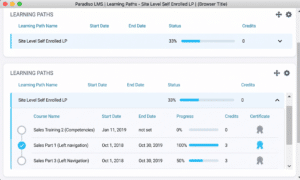

How to Build, Configure, and Deploy a Learning Path in Paradiso LMS (Step-by-Step Master Guide)
Creating, configuring, and deploying a customized learning pathway inside Paradiso LMS involves five simple administrative steps using the system’s seven management tabs (Overview, Courses, Learners, Cohorts, Certificate, Notifications, and Settings):
Step 1: Access the Module & Initiate Setup
- Log into your Paradiso LMS administrative dashboard.
- From the left sidebar navigation menu or Custom Navigation, click on Learning paths.
- On the Landing Page, click the blue “+ Create learning path” button (or green “+” button) to open the creation form.
Step 2: Configure Learning Path Metadata & Settings
- Title / Name: Enter a clear title between 3 and 150 characters (e.g., Product Management).
- Description: Outline the primary learning objectives and expectations for enrolled users.
- Cover Image: Upload a visual graphic in JPG, JPEG, WEBP, GIF, or PNG format (maximum file size: 5MB; recommended aspect ratio: 16:9 / 500×280 px).
- Start and End Dates: Set start and end dates to define the exact duration and timeframe of the pathway.
- Minimum Credits to Pass: Specify optional credit requirements or leave blank to manage credits individually through course properties.
- Catalog Visibility: Toggle Learning Path Catalog to display the pathway in the public catalog for self-enrollment.
Step 3: Add Courses, Set Mandatory Status & Configure Prerequisites
- From the Landing Page, select your created learning path and navigate to the Courses tab.
- Click Add the first course or the “+” / “+ Add courses” button in the upper-right corner, select your target courses, and click Add course.
- Set Required Courses: On the course list, toggle the Required switch next to any course to make it mandatory for pathway completion.
- Configure Prerequisites:
- Click the Gear / Edit icon next to the course you want to restrict.
- Select the prerequisite courses required prior to unlocking the restricted module.
- Click Add, then select Save.
Step 4: Assign Users, Synchronize Cohorts & Export Compliance Data
- Enrolling & Managing Learners:
- Navigate to the Learners tab and click “+ Assign learners”.
- Select individual users via search, or check the top box to choose all available users.
- Optionally set a completion Deadline (dd-mm-yyyy) and click Assign learners.
- Status Filtering & CSV Export: Monitor user progression across four real-time status tabs (Not Started, In Progress, Completed, and Overdue), and click Export CSV to download audit-ready compliance reports.
- Synchronizing Group Cohorts:
- Select the Cohorts tab inside the learning path and click Add / Add Cohorts.
- Select the cohort(s) to synchronize with the path and save changes.
(Note: User membership within cohorts must be managed globally in Cohort Settings).
Step 5: Configure Certificate Fulfillment, Side-Panel Rules & Publish Live
- Automated Certificate Fulfillment: In the Certificate tab, upload a completion certificate. The certificate download button remains inactive/hidden for learners until all required courses and credit thresholds are satisfied, activating automatically upon full completion.
- Self-Enrollment Rules: To enable self-enrollment, click the right Gear icon in path options, scroll to Enable Self Enrollments, and save. (Note: Nested courses must also permit self-enrollment; in self-enrollment mode, prerequisite rules cannot be enforced).
- Catalog Access: Ensure the catalog tab is active by navigating to Settings > General Options > Enable Learning path tab.
- Publishing Live: On the Overview tab, review the Configuration side-panel (showing Enrollment mode, Sequencing rules, Completion credits, and Deadlines) and click the Publish button to make the pathway live.
Final Thoughts
Learning paths are a crucial component of any successful Learning Management System (LMS). By offering a structured, personalized, and engaging learning journey, they help learners build skills more effectively, improve retention, and drive higher completion rates.
With the right tools and best practices in place, LMS learning paths can be tailored to meet the specific needs of your organization, whether for onboarding, compliance, or skill development. By aligning these paths with your organizational goals, you can ensure that your training programs not only meet learners’ needs but also contribute to overall business success.
AI-Powered, Highly Customizable LMS for Enterprise Learning
Highly customizable to fit your business, scalable for employees, customers, and partners, with flexible cloud or on-premise deployment.
Frequently Asked Questions About LMS Learning Paths
What is a learning path in an LMS?
A learning path in a Learning Management System (LMS) is an ordered sequence of courses, training modules, and assessments that guides learners step-by-step toward achieving a specific skill, certification, or job role.
What are some real-world examples of learning pathways?
Common examples include Sales Onboarding Tracks, Mandatory Compliance Sequences, Software Engineering Tracks, Adaptive Math Tracks (Math Solve AI), and PMP Certification Tracks.
Can learning paths be personalized for individual employee skill levels?
Yes. Modern LMS platforms allow learning pathways to adapt dynamically based on learner background, allowing experienced users to test out of basic modules while providing extra foundational support to beginners.
How do learning pathways improve corporate training outcomes?
By organizing training into logical, bite-sized steps, learning pathways remove guesswork, increase engagement, improve knowledge retention, and boost overall course completion rates.