HIPAA-Compliant Healthcare LMS
The Healthcare LMS That Handles It All Workforce, CE/CME, and Compliance
Every healthcare organisation has different training requirements and compliance obligations. Paradiso LMS handles all of them – from HIPAA and GCP to CE/CME – on one platform. HIPAA compliant. BAA available.

Why Paradiso
Purpose-Built for Healthcare
Not Adapted from a Corporate Training Platform
Paradiso LMS is designed around the compliance frameworks, credentialing requirements, and multi-audience training models that healthcare organisations actually operate.
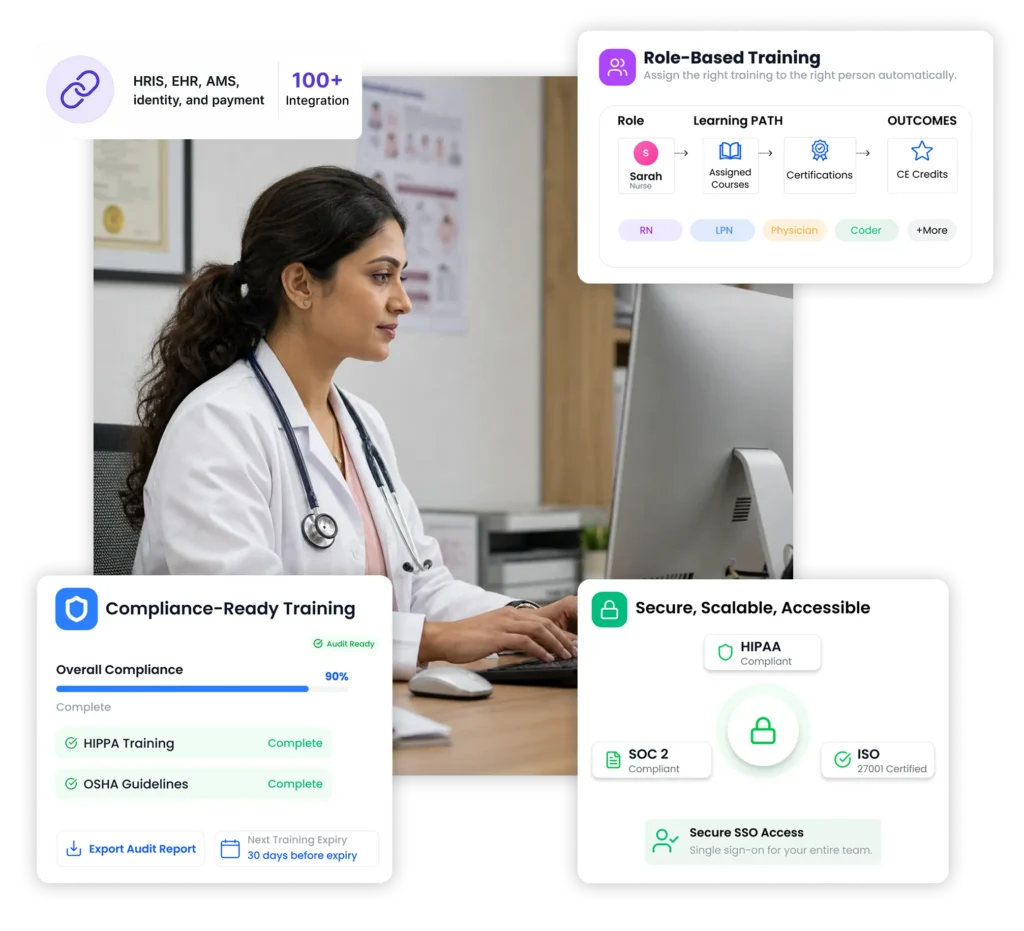
HIPAA Compliant - Core Platform
HIPAA compliance is not a configuration or an add-on. It is built into the platform architecture, data handling, and training tracking workflows from the ground up. BAA signed with every healthcare client as standard
Multi-Tenant, Multi-Audience Architecture
Separate portals per department, facility, member group, or customer - with isolated data environments, distinct branding, and consolidated reporting across all of them.
Credential and Certification Tracking
Licences, certifications, and credentials tracked by role, facility, and expiry date. Automated renewal alerts sent to staff and managers before lapses occur.
White-Label Learning Portals
Your brand on every screen - whether training your own workforce or delivering accredited CE to an external audience. Staff and learners never see Paradiso branding
Audit-Ready Reporting on Demand
Compliance reports formatted for Joint Commission, FDA, accreditation bodies, and internal audits — generated in minutes, not weeks of manual data preparation.
Integrations Built for Healthcare Systems
Connects with EHR (Epic, Cerner), HRIS (Workday, SAP), AMS (Personify, iMIS), and identity systems (Okta, Azure AD) — so training data flows without manual entry.
Trusted by 100s of Companies Globally…




The Problem
Why Healthcare Organisations Outgrow Generic LMS Platforms
01 - Compliance Risk
One missed training record can trigger a regulatory failure
HIPAA, GCP/ICH, Joint Commission, and state licensing boards all require documented proof of training completion. Manual tracking across spreadsheets, email chains, and disconnected systems creates gaps that cost licences, accreditation, and audit outcomes.
02 - Audience Complexity
Your learners are not one audience - they are many
Hospitals train nurses, physicians, non-clinical staff, and new hires differently. CROs train internal project managers and distributed site networks. Associations train their own staff and deliver CE to members. A single LMS with no multi-audience architecture cannot handle this.
03 - Credential and Certification Management
Credential expiry is invisible until it becomes a crisis
Physicians, nurses, research staff, and clinical coordinators all carry credentials with different renewal cycles. Without automated tracking and alerts, renewals lapse creating patient safety risk, regulatory exposure, and staffing disruption.

Building healthcare training content?
Create healthcare-specific courses free with AI, and export to SCORM for any LMS you already use.
What Paradiso Delivers
Three Outcomes.
Every Healthcare Organisation.
Every capability maps directly to a business outcome. Here is how the platform creates measurable value across your CME operation.
Compliance
Stay Compliant Across Every Standard That Applies to You
HIPAA is your floor. Depending on your segment, you also carry GCP/ICH, Joint Commission, GxP, ANCC, or CE accreditation obligations. Paradiso tracks, automates, and reports on every one of them — without manual follow-up from your team.
HIPAA Training Compliance
Automated tracking for every staff member reports generated on demand for audits
GCP / GxP / FDA Alignment
Validated training records and audit trails inspection-ready for pharma, biotech, and CRO teams
CE / CME / CPD Credit Tracking
Credit management, certificate delivery, and transcript generation — ACCME and state board aligned
Readiness
Get Every Learner Onboarded, Certified, and Productive Faster
Structured Onboarding Workflows
Role and site-specific paths triggered automatically mandatory tasks assigned without admin action
Competency-Based Progression
Learners advance on demonstrated skills not slide-click completion alone
Mobile and Microlearning
Short-format modules for clinical staff on shift, site coordinators in the field, and remote learners
Efficiency
Run Training Operations Without the Admin Burden
Manual reporting, siloed systems, and duplicate data entry waste L&D and compliance team capacity every week. Paradiso automates the repetitive work, integrates with your existing systems, and gives administrators a single source of truth for all training activity.
Multi-Tenant Platform Management
One platform across every facility, department, or learner group centralised reporting, local control
On-Demand Compliance Reporting
Audit-ready reports in minutes formatted for Joint Commission, FDA, accreditation bodies, and internal boards
System Integrations
HRIS, EHR, AMS, identity, and payment integrations training data synced without manual entry
Who Uses Paradiso LMS
Built for Every Healthcare Segment
With the Right Compliance Framework for Each
Select your segment to see exactly what Paradiso LMS manages for your organisation.
Healthtech
🔒 HIPAA Compliant
Workforce Training
- HIPAA compliance — annual mandatory training tracked automatically for every employee, with audit-ready completion records
- New hire onboarding — structured paths covering product knowledge, security standards, and role-specific workflows from day one
- Sales enablement — product certifications, competitive positioning, and demo readiness programmes for go-to-market teams
- Customer success teams — client escalation workflows, tool certifications, and account management skills training
- Engineering and security — privacy standards, data handling protocols, and technical compliance training
Customer & Partner Training
- Hospital and clinic admins — platform setup, configuration, and system administration training delivered at scale
- Clinical end users — role-based product walkthroughs that drive adoption and reduce support ticket volume
- IT teams at client sites — integration guides, API documentation, and data flow training for technical staff
- Channel partners and resellers — product certification programmes that ensure consistent delivery quality
- Implementation consultants — standardised onboarding playbooks and deployment best-practice courses
Academic Medical Schools
🔒 HIPAA · ACCME / CME
Faculty, Resident & Staff Training
- Medical students and residents — curriculum delivery, GME programme tracking, and competency assessments at every stage
- Fellows — specialty-specific learning paths with structured progression milestones and board exam prep support
- Faculty and instructional designers — LMS administration tools, course authoring support, and grading workflows
- Research staff — HIPAA compliance, research ethics, and IRB protocol training with documented completion records
- Administrative staff — HR compliance, regulatory requirements, and operational procedure training
ACCME-Accredited CME Delivery
- Physicians seeking CME credits — ACCME-aligned activity delivery with automated credit tracking for licence renewal and MOC
- Nurses and allied health professionals — ANCC-approved CE programmes with certificate and transcript management
- Healthcare employers — bulk CE package purchasing and organisation-level reporting for employer-sponsored learning
- Community and rural practitioners — accessible online disease education and clinical update programmes
- International clinicians — accredited CME programmes adapted for global licence and recertification requirements
Nursing & Allied Health Colleges
🔒 HIPAA · ANCC / State Licensing
Faculty & Staff Operations
- Faculty — course design tools, grading workflows, and LMS administration without reliance on IT support
- Clinical placement coordinators — site scheduling, placement tracking, and clinical hour documentation in one system
- Accreditation and compliance staff — HR training records, regulatory documentation, and audit-ready reports on demand
- Online learning teams — platform management, student support workflows, and course quality assurance tools
Student & CE Programme Delivery
- Pre-licensure nursing students — clinical simulations, NCLEX prep content, and mobile-first learning for busy student schedules
- Allied health students — SCORM and xAPI-compatible practical training content with competency verification
- Nurses in the workforce — CE programmes for ANCC-aligned state licence renewal, delivered on-demand and tracked automatically
- Healthcare employers — bulk CE packages allowing hospital and clinic HR teams to purchase and assign CE for their nursing staff
- State licensing board reporting — automated completion tracking and transcript delivery formatted for board submission
Clinical Research - Academic Medical Centres
🔒 HIPAA · GCP / ICH · FDA
Research, Clinical & GME Workforce
- Residents and fellows — GME curriculum delivery, competency milestone tracking, and structured evaluation workflows
- All clinical staff — mandatory annual HIPAA compliance training tracked organisation-wide with automated reminders
- Research and clinical trial teams — GCP/ICH guidelines and FDA regulatory training with validated completion records
- Study coordinators — per-protocol onboarding for each active trial, ensuring site readiness before study start
- Compliance and regulatory staff — audit-readiness training, deviation management, and sponsor report preparation
Multi-Site Research & Collaborator Training
- Affiliated research sites — consistent protocol-specific onboarding delivered to new sites within days of activation
- External research collaborators — HIPAA compliance and study protocol training with documented completion for sponsor records
- Multi-site trial staff at partner institutions — GCP certification managed centrally with site-level tracking and reporting
- Sponsor-mandated training modules — pharma company-required courses deployed across all trial sites from one admin console
- Accredited CME delivery — if your AMC has a CME office, deliver ACCME-accredited programmes to practising clinicians through a branded portal
CTSA Hubs & Research Institutes
🔒 HIPAA · GCP / ICH · IRB
Study Teams, IRB Staff & Research Operations
- Study coordinators — GCP and ICH standards certification with documented training records that satisfy sponsor and regulatory requirements
- Research staff handling patient data — HIPAA compliance training tracked per individual with audit-ready evidence for IRB and federal reviewers
- Protocol and trial teams — per-trial onboarding for each active study, ensuring all team members are trained to protocol before the start date
- Compliance and regulatory affairs — FDA audit preparation, deviation documentation, and IRB submission support training
- New research staff — structured orientation covering institutional policies, safety standards, and research ethics requirements
Partner Institutions & Sponsor-Required Sites
- Partner university staff — GCP/ICH training aligned to your hub standards, delivered to multi-institution collaborators from one platform
- Affiliated hospital and community sites — protocol-specific study training deployed rapidly when new sites join an active trial
- NIH and pharma-mandated training — sponsor-required modules assigned and tracked across all participating institutions
- IRB and ethics review board staff — structured certification pathways and continuing education for reviewers and committee members
- Community research sites — consistent onboarding and audit-ready completion tracking regardless of site size or resource level
CROs & Clinical Operations
🔒 HIPAA · GCP / ICH · SOP & QMS
CRO Staff & Quality Teams
- Project managers and clinical operations staff — SOP training, quality management standards, and oversight certification aligned to GCP/ICH requirements
- Regulatory and quality assurance teams — deviation handling, CAPA management, and FDA audit preparation training with documented competency records
- New CRO hires across all functions — structured onboarding to company SOPs, quality standards, and regulatory expectations before they touch active studies
- Clinical operations staff — role-based GCP and ICH compliance training maintained current as regulatory guidance updates
Distributed Trial Site Networks
- Site coordinators across 50+ locations — GCP certification and HIPAA compliance training tracked centrally, with site-level dashboards for CRA oversight
- Trial site staff — protocol-specific onboarding for each active study, ensuring all site staff are trained and documented before first patient enrolment
- Site nurses and clinicians — procedure-specific training with audit-ready completion evidence available on demand for sponsor and regulatory requests
- New sites going live — rapid deployment of all required training so sites reach activation readiness in days, not weeks
- Multi-site consistency — identical training content and completion standards enforced across every location regardless of geography
Healthcare Associations & Nonprofits
🔒 HIPAA · CE / CPD Accreditation
Staff, Board & Chapter Operations
- Association staff — HIPAA compliance, HR policy training, and operational procedure documentation for administrative teams
- Board members — governance education, fiduciary responsibility training, and policy orientation programmes
- Chapter and regional leaders — programme delivery standards, CE quality assurance, and reporting workflows for distributed chapter networks
- Education and programme teams — LMS administration tools and CE programme design support for staff managing the accreditation pipeline
Member CE & CPD Delivery
- Individual members seeking recertification — CE and CPD credits delivered through your branded member portal, tracked automatically against licence renewal requirements
- Member organisations and employers — bulk CE package purchasing so healthcare employers can assign accredited training to their staff through your platform
- New member onboarding — structured welcome journeys that orient new members to resources, benefits, and available CE programmes from day one
- Certification candidates — learning paths built around credential requirements, with progress tracking and assessment built in
- Conference and event attendees — accredited CE tied to your annual meeting, delivered digitally before, during, and after the event
Hospital Chains & Health Systems
🔒 HIPAA · Joint Commission · OSHA
Workforce Compliance & Development
- Nurses and clinical staff — HIPAA, Joint Commission, and safety training assigned by role and department, tracked across every facility in your system
- New hires — mandatory orientation and credentialing workflows activated on day one, with manager visibility into completion status
- Physicians — credentialing documentation, CME credit tracking, and quality programme participation managed in one system
- Non-clinical staff — OSHA, HIPAA, and HR compliance training tracked separately from clinical staff with role-appropriate content
- Leaders and managers — workforce development programmes, performance management training, and leadership curriculum delivery
Patient, Community & Partner Education
- Patients — post-discharge education programmes that improve care adherence and reduce readmission rates for chronic and acute conditions
- Community members — health literacy and preventive care education delivered through your branded community portal
- Affiliated physicians and referring providers — protocol alignment and referral pathway training that strengthens your physician network
- Partner clinics and care networks — system onboarding and standards training for partner organisations operating under your network
Regional Health Plans & TPAs
🔒 HIPAA · CMS Regulatory
Staff Compliance & Plan Operations
- All staff — annual HIPAA and CMS regulatory compliance training tracked organisation-wide, with audit-ready records for regulatory review
- Claims and operations teams — coding rules, processing standards, and compliance procedure training to reduce claims error rates
- Member services representatives — benefit explanation skills, empathy training, and escalation handling for front-line member interactions
- Sales and account management — plan portfolio knowledge, renewal strategy, and compliant selling certification programmes
Member, Broker & Provider Network Education
- Plan members — benefits navigation, preventive care education, and chronic condition management programmes through a branded member portal
- Brokers and agents — plan knowledge certifications that ensure compliant product selling and accurate member enrolment guidance
- Employer HR administrators — plan setup guides, enrolment process training, and reporting tools education for group purchasers
- Provider network staff — billing, prior authorisation, and portal usage training to reduce administrative friction across your provider network
- New providers joining the network — credentialing workflows and network standards onboarding delivered at scale
AI-Powered Healthcare LMS
AI-Powered Learning Operations
Built for Healthcare Scale
Generic LMS platforms bolt AI on as an afterthought. Paradiso LMS is built AI-first from course creation and personalization to compliance automation and workforce analytics.
AI Course Creation Assistance
Upload clinical protocols, policy documents, or recorded sessions AI structures them into interactive, role-specific training modules automatically.
Personalized Learning Paths
AI recommends relevant training to each staff member based on their role, competency gaps, compliance status, and upcoming credential renewals.
Automated Compliance Reminders
AI agents send compliance reminders, credential renewal alerts, and onboarding task notifications automatically without manual follow-up from your team.
AI-Powered Workforce Analytics
Surface training completion trends, compliance risk scores, skills gaps, and workforce readiness metrics automatically without manual report building.
AI Roleplay for Clinical Training
Scenario-based AI simulations for patient communication, clinical decision-making, and emergency response convert passive learners into competent practitioners.
AI Content Updates
Keep clinical training content current. AI assists with updating protocols, guidelines, and regulatory content as healthcare standards evolve.
Got Questions?
Frequently Asked Questions
A Healthcare LMS software is built for the compliance requirements, workforce complexity, and clinical training needs of healthcare organizations. Unlike generic LMS platforms, a healthcare LMS includes native support for HIPAA training compliance tracking, credential and license management, clinical onboarding workflows, competency-based learning, Joint Commission compliance reporting, and integrations with HRIS and EHR systems. Paradiso LMS is built from the ground up for healthcare not adapted from a corporate training platform.
The cost of a healthcare LMS depends on the number of users, pricing model, implementation requirements, integrations, support, course content, and security needs. Vendors may charge per registered user, active user, or annual platform licence. When comparing prices, include data migration, configuration, administrator training, integrations, content licences, maintenance, and customer support in the total cost.
A healthcare LMS should include role-based learning paths, automated compliance assignments, certification tracking, competency assessments, mobile learning, microlearning, multilingual content, audit-ready reports, and automated renewal reminders. It should also support HRIS and single sign-on integrations, instructor-led training, external certificate uploads, secure access controls, and dashboards for administrators, managers, and learners.
A secure healthcare LMS should provide encryption, role-based access, multi-factor authentication, audit logs, secure backups, data-retention controls, and incident-response procedures. When the LMS vendor creates, receives, maintains, or transmits electronic protected health information, healthcare organizations should also evaluate whether a Business Associate Agreement is required. No LMS alone makes an organization HIPAA compliant; security also depends on internal policies, risk management, access controls, and workforce practices.
A healthcare LMS simplifies compliance training by centralizing courses, employee records, policies, assessments, certificates, and renewal dates. Training can be assigned automatically according to an employee’s role, department, location, or risk exposure. The system can also send reminders, schedule recurring training, record policy acknowledgements, identify overdue employees, and generate reports for internal reviews and audits.
Hospitals can use an LMS to maintain a centralized training transcript for every employee. The record can include assigned courses, completion dates, assessment scores, certificates, classroom attendance, policy acknowledgements, competency sign-offs, and renewal dates. Administrators and department managers can monitor completion from dashboards and export records when evidence is needed for an audit, accreditation review, or internal investigation.
Yes. A healthcare LMS can manage HIPAA, OSHA, infection control, workplace safety, cybersecurity, patient privacy, and organization-specific compliance training from one platform. It can assign different requirements by role, track recurring courses, maintain course-version history, collect policy acknowledgements, and produce completion reports. However, the organization must configure the training according to the regulations and standards that apply to its workforce, location, and services.
Yes. A modern healthcare LMS can deliver short, mobile-friendly modules that frontline employees can complete between shifts or during scheduled training time. Microlearning is useful for policy refreshers, safety procedures, infection-control updates, product training, and quick knowledge checks. The platform should offer responsive access, captions, progress saving, simple navigation, and downloadable or offline learning when employees have limited connectivity.
The easiest approach is to use one centralized healthcare LMS connected to your HR system or employee directory. Organize employees by role, department, facility, and location, then automate onboarding, compliance courses, renewal training, and reminders for each group. Give department managers access to their own dashboards while maintaining centralized reporting and governance across all 500 employees.
Start with mandatory compliance and onboarding programs, then gradually add clinical competencies, continuing education, leadership development, and optional learning.
A healthcare LMS can store each employee’s certification or licence name, issuing authority, issue date, expiration date, supporting document, and renewal requirements. Automated reminders can be sent to the employee and manager before expiration. Administrators can use dashboards to identify valid, expiring, expired, or missing credentials and export reports by role, department, facility, or certification type.
A healthcare LMS supports HIPAA compliance by delivering role-specific privacy and security training, recording completion, collecting policy acknowledgements, and scheduling refresher training. It gives administrators documented evidence of who completed the training, when it was completed, and which course version was assigned.
Training is only one part of HIPAA compliance. Organizations must also maintain appropriate administrative, physical, and technical safeguards, conduct risk assessments, manage access, and follow documented privacy and security procedures.
A healthcare LMS can record eligible learning activities, attendance, completion status, credit type, credit amount, certificates, and clinician transcripts. It can also help administrators export or submit learner-credit data to external accreditation, licensing, and certification systems when supported.
The LMS does not automatically make a course eligible for CME credit. The activity must meet the requirements of the relevant accredited provider or accrediting organization. ACCME’s PARS system, for example, supports centralized reporting of CME activity and learner-credit data.
A healthcare LMS can create competency-based learning paths for different clinical roles and specialties. It can combine courses, scenario-based assessments, simulations, observed skills checklists, supervisor sign-offs, remediation plans, and reassessments.
Managers can compare required competencies with demonstrated performance, identify skill gaps, assign targeted learning, and monitor progress over time. This helps healthcare organizations measure whether clinical staff can apply required knowledge and skills rather than relying only on course-completion data.
Yes. A healthcare LMS can provide translated course content, subtitles, assessments, notifications, certificates, and learner interfaces for multilingual teams. Employees can be assigned training according to their preferred language, country, facility, or role.
Clinical and compliance translations should be reviewed by qualified subject-matter and language experts to protect accuracy. For OSHA-required training, employers must provide information in language and vocabulary that employees can understand.
Common healthcare LMS implementation challenges include migrating existing records, integrating HR and identity systems, defining role-based requirements, cleaning outdated course content, configuring reports, and gaining manager and employee adoption. Healthcare organizations may also face security reviews, Business Associate Agreement requirements, multilingual needs, limited training time, and complex requirements across different facilities.
These challenges can be reduced through a phased rollout, clear ownership, accurate employee data, role mapping, integration testing, administrator training, and a pilot involving selected departments before organization-wide deployment.