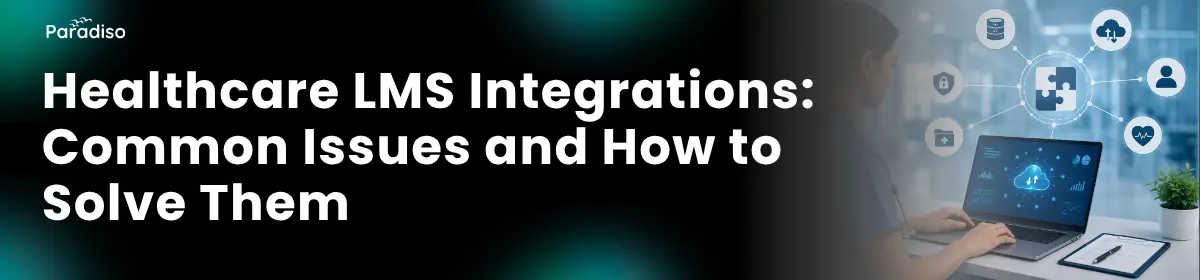




Healthcare organizations run on connected systems. An EHR talks to a billing platform. A lab system feeds results directly into a clinical chart. A credentialing database links to privileging decisions. When these connections work, workflows are seamless. When they do not, the consequences range from administrative overhead to genuine patient safety risk.
The same principle applies to training infrastructure. A learning management system that operates in isolation disconnected from EHR systems, HR platforms, credentialing databases, and clinical workflows creates compliance gaps, duplicates data entry, and leaves administrators with no reliable picture of whether their workforce is current on required competencies.
According to ONC data, only 43% of hospitals with certified EHR technology consistently engage in all four interoperability domains — send, receive, find, and integrate. The training layer faces the same fragmentation problem, and the consequences are equally concrete. Source: ONC Health IT Dashboard, 2023.
This guide covers the most common healthcare LMS integration issues, what causes them, and how healthcare organizations are resolving them in 2026.
Why Healthcare System Integration Matters for Training
A healthcare LMS that is not integrated with other organizational systems creates a parallel data environment. Training records live separately from HR records. Competency completion is not visible to credentialing staff. Onboarding cannot be triggered automatically when a new hire is added to the HRMS. Mandatory training deadlines are not connected to license renewal dates.
Nearly 70% of providers still struggle with seamless data exchange across platforms, according to the HIMSS 2024 Report. That figure reflects clinical data – but the training and workforce development layer faces the same fragmentation, often with less organizational attention directed at solving it.
When an LMS is fully integrated with the systems around it, training assignment becomes automatic, compliance reporting becomes real-time, and the distance between a staff member’s learning record and their clinical credential status shrinks to zero.
Common Healthcare LMS Integration Issues and Solutions
| Issue | Problem | Solution |
|---|---|---|
| LMS and EHR Data Silos | Clinical competency data sits in the LMS while clinical activity data sits in the EHR, with no technical connection enforcing training checks before access is granted. | EHR integration through HL7 FHIR-compliant APIs exchanges training completion data with EHR systems in real time, triggering access changes and credentialing actions automatically. |
| Disconnected HR and Workforce Systems | Manual user provisioning creates training gaps for new hires and ghost accounts for former employees, both of which create compliance exposure. | HRMS-to-LMS integration through SCIM or API-based sync automates provisioning – accounts are created, updated, and deactivated automatically based on HR events. |
| Credentialing and Privileging Disconnects | Credentialing staff manually verify training completion and update privilege records separately, introducing delay and a documented audit finding risk. | Direct API connections or a healthcare integration engine create a live link so credentialing records update automatically as training is completed or expires. |
| Legacy System Incompatibility | Older LMS or EHR systems running on HL7 v2 or proprietary formats can’t participate in modern data exchange without full replacement. | A healthcare integration engine or iPaaS middleware translates between legacy HL7 v2 messages and modern FHIR R4 APIs without requiring system replacement. |
| HIPAA Compliance in Integrated Data Flows | Every data transfer point between an LMS, EHR, HRMS, or credentialing system is a potential compliance exposure if not secured appropriately. | HIPAA-compliant integration architecture requires encrypted transmission (TLS 1.2+), access logging, audit trail preservation, and a BAA covering PHI handled through integrations. |
Issue 1: LMS and EHR Data Silos
Problem: Clinical competency data sits in the LMS while clinical activity data sits in the EHR. Neither system can see the other. A nurse who has not completed their medication administration competency module may still be independently administering high-risk medications – because there is no technical connection enforcing the check. EHR integration gaps also affect onboarding: when a new clinical staff member completes orientation modules in the LMS, that completion should automatically update their EHR user permissions. Without integration, IT teams manually update both systems – creating both a time cost and a risk window when permissions are granted before training is confirmed complete.
Solution: EHR integration through standardized APIs eliminates the silo. HL7 FHIR (Fast Healthcare Interoperability Resources) is now the widely accepted standard that enables structured, seamless data sharing across healthcare systems. An LMS that exposes and consumes FHIR-compliant APIs can exchange training completion data with EHR systems in real time – triggering access changes, competency record updates, and credentialing actions without manual intervention. The EHR integration API approach also scales as your system environment grows, unlike point-to-point connections that multiply in complexity with each new system added.
Issue 2: Disconnected HR and Workforce Management Systems
Problem: When an LMS is not integrated with the HRMS, training program enrollment is a manual process. Every new hire requires someone to create a user account and assign training tracks. Every role change or termination requires the same manual action in reverse. In a healthcare organization where annual nursing turnover exceeds 20% nationally, this overhead is substantial. The most common consequences are training gaps for new hires who access systems before enrollment is complete, and ghost accounts for former employees who retain LMS access after separation – both of which create compliance exposure.
Solution: HRMS-to-LMS integration through SCIM (System for Cross-domain Identity Management) or API-based data sync automates user provisioning. When a new employee is created in the HRMS, their LMS account is generated automatically with the correct role-based training assignments. When employment ends, the account is deactivated. Role-based training assignment rules mean that a staff member who transfers from general nursing to intensive care automatically receives the additional competency modules their new role requires – without anyone manually reviewing their training record.
Issue 3: Credentialing and Privileging Disconnects
Problem: Hospital privileging decisions are supposed to reflect current clinical competency. But when the LMS tracking training completion is not connected to the credentialing system governing privileges, the connection is theoretical rather than operational. Credentialing staff end up requesting training reports from the LMS team, manually verifying completion, and updating privilege records in a separate system – introducing both delay and the possibility of error. During Joint Commission surveys, the inability to produce an integrated, real-time competency record for any clinical staff member on demand is a documented audit finding.
Solution: Clinical data integration between the LMS and credentialing platforms – through direct API connections or a healthcare integration engine that serves as a middleware hub – creates a live link between training completion and privilege status. When a physician completes required competency training, the credentialing record updates automatically. When a required training expires, the credentialing system is alerted before the privilege renewal review date.
Issue 4: Legacy System Incompatibility
Problem: Many legacy LMS platforms were not built to connect with modern systems. Data may be locked in proprietary formats, or the system may not support current standards like FHIR. Healthcare organizations that adopted early LMS platforms, or that use EHR systems still running on HL7 v2 messaging, face a compatibility gap that requires either system replacement or middleware solutions.
Solution: A healthcare integration engine or middleware layer – an iPaaS (Integration Platform as a Service) designed for healthcare — can translate between legacy HL7 v2 messages and modern FHIR R4 APIs, enabling older systems to participate in data exchange without full replacement. For LMS platforms specifically, choosing a system that supports both legacy data formats and modern API standards including SCORM, xAPI, and REST APIs protects against future compatibility problems as the surrounding healthcare IT ecosystem evolves.
Issue 5: HIPAA Compliance in Integrated Data Flows
Problem: Healthcare integration involves moving data that may include PHI across system boundaries. Every data transfer point between an LMS, EHR, HRMS, or credentialing system is a potential compliance exposure if not secured appropriately. Many healthcare organizations discover their LMS does not enforce HIPAA-compliant data handling standards when connected to clinical systems a regulatory gap that is often invisible until an audit or incident surfaces it.
Solution: Any LMS deployed in a healthcare environment and connected to other clinical or administrative systems must be HIPAA-compliant in its integration architecture, not just in standalone operation. This means encrypted data transmission (TLS 1.2 or higher), access logging for all PHI that passes through the LMS, audit trail preservation, and Business Associate Agreements with the LMS vendor covering their handling of any PHI that enters the system through integrations.
Healthcare Integration Standards That Make It Work
Resolving healthcare data integration issues requires alignment around common technical standards. The most relevant for LMS integration in 2026 are:
What an Integrated Healthcare LMS Actually Changes
The practical difference between a standalone LMS and a connected healthcare learning platform is operational. When the LMS integrates with the EHR, HRMS, and credentialing systems around it, several things happen automatically that would otherwise require manual effort or simply not happen at all.
New employees are enrolled in the right training tracks on their first day. Role changes trigger updated training assignments without an administrator reviewing individual records. Compliance deadlines are visible to both the learner and the clinical manager in real time. Credentialing staff can pull a complete, current competency record for any clinical staff member without contacting the L&D team. Training completion data flows into EHR access control decisions without IT intervention.
The result is a training infrastructure genuinely embedded in the clinical and operational systems around it rather than an island of learning data that requires manual bridging to the systems where competency decisions are actually made.
Build a Healthcare Training System That Connects to Your Stack
An LMS that operates in isolation is an administrative burden. An LMS that integrates with your EHR, HRMS, and credentialing systems is part of your clinical infrastructure reducing manual effort, closing compliance gaps, and giving administrators a reliable, real-time picture of workforce competency.
For healthcare organizations evaluating LMS platforms or reviewing their integration architecture, the right questions are: Does this system support HL7 FHIR and xAPI? Does it integrate with your HRMS for automated user provisioning? Can it exchange data with your credentialing system? And does it handle HIPAA compliance in its connected data flows, not just in isolation?