



Healthcare organizations train for two outcomes simultaneously: regulatory survival and genuine clinical performance. Getting either wrong is expensive. Getting both right requires more than a library of courses delivered on a shared drive.
An LMS in healthcare is the infrastructure that connects the right skill training to the right person, at the right time, with the documentation to prove it. But the skills themselves vary considerably across clinical, compliance, soft-skills, and technology domains and how each type is best delivered through a learning management system is worth understanding clearly before building or evaluating any healthcare training program.
This guide breaks down which healthcare skills an LMS delivers best, how AI roleplay is changing the way soft skills and clinical communication are practiced, and what healthcare L&D teams should look for when building a skills-based training program.
What Are Healthcare LMS Skills?
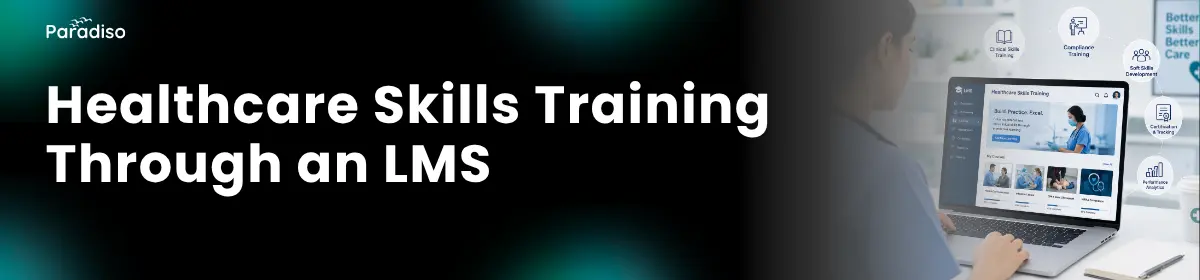
Healthcare LMS skills are the competencies that a learning management system is used to build, track, assess, and certify across a clinical or administrative workforce. They span four broad categories: clinical and procedural skills, compliance and regulatory skills, soft skills and communication, and digital and technology literacy.
The distinction between these categories matters for training design. Clinical skills often require simulation or hands-on practice an LMS delivers the knowledge layer and assessment, with in-person competency verification alongside. Compliance skills are rule-based and well-suited to online self-paced delivery. Soft skills, historically the hardest to train online, are increasingly addressed through scenario-based learning and AI roleplay within LMS environments. Digital literacy is delivered entirely online.
A healthcare learning platform that handles all four categories from a single interface with role-based assignment, completion tracking, and audit-ready records eliminates the fragmentation that plagues most healthcare training programs.
Clinical Skills Training Through an LMS
Clinical skills training covers the procedural, protocol-based, and evidence-based competencies that directly affect patient care quality. An LMS for healthcare training handles this category most effectively when it combines knowledge delivery with structured competency verification.
The knowledge component understanding a procedure, learning updated clinical guidelines, reviewing evidence-based protocols translates well to online delivery. Video demonstrations, interactive modules, and case-based learning scenarios allow clinical staff to build foundational understanding at their own pace, around shift patterns that make classroom training impractical.
The verification component is where the LMS connects with real-world practice. Staff complete the online knowledge module, then demonstrate the skill in a supervised setting. The LMS records both the online completion and the supervisor sign-off, creating a full competency record per individual. This approach covers skills including:
For clinical teams, simulation-based learning and virtual labs are becoming especially valuable — providing safe environments to practice high-stakes decision-making without risking patient harm. Source: V-Unite Healthcare LMS Report, 2026.
Compliance and Regulatory Skills
Compliance training is the category where LMS delivery is most straightforward and most critical from a documentation standpoint. Healthcare organizations must demonstrate that their workforce has been trained on applicable regulations and the LMS is the system of record that makes that demonstration possible.
Compliance and regulatory health care skills delivered through an LMS include:
Role-based assignment is particularly important in this category. Not every staff member needs every compliance course, but the right courses must reach the right people before their deadlines. An LMS that assigns training based on job role, department, and credential type reduces both administrative overhead and the risk of coverage gaps.
Soft Skills for Healthcare Professionals
Soft skills are the human-facing competencies that shape the patient experience, team functioning, and staff retention and they are the category where traditional eLearning has historically been weakest. A staff member who can click through a 30-minute module on empathy has not necessarily become more empathetic.
Soft skills in healthcare include communication, empathy, teamwork, and adaptability competencies that transform routine care into compassionate healing. Unlike clinical knowledge, they evolve through experience, reflection, and structured training. Source: Calibr.ai Healthcare Training Report, 2026.
The most effective LMS delivery of soft skills uses scenario-based learning that requires the learner to respond to realistic situations rather than passively absorb principles. Key soft skill categories delivered through healthcare LMS platforms include:
The gap between knowing a soft skill and applying it under pressure is where AI roleplay is changing what an LMS for healthcare training can actually deliver.
AI Roleplay for Healthcare Skills Development
AI roleplay is one of the most significant developments in healthcare skills training in recent years and it directly addresses the limitation that has always made soft skills training difficult to scale.
Traditional soft skills training relied on live role-play with a trainer or peer. These sessions are effective but expensive, difficult to schedule across shift-based workforces, inconsistent in quality, and impossible to track at the individual learner level. AI roleplay solves all four problems simultaneously.
How AI Roleplay Works in an LMS Environment
The learner interacts in a simulated conversation with an AI-generated patient, family member, or colleague. The AI responds realistically based on the scenario parameters escalating tension if the learner uses dismissive language, responding to empathy with reduced agitation, presenting clinical information the way a real patient would rather than a textbook would. The learner practices the skill repeatedly, with the AI adapting based on each response.
Healthcare-Specific AI Roleplay Use Cases
| Use Case | What the Learner Practices |
|---|---|
| Difficult patient conversations | Communicating a serious diagnosis, a treatment change, or a delay in care without causing distress |
| De-escalation scenarios | Responding to an agitated patient in the emergency department or a family member demanding immediate access to a loved one |
| End-of-life communication | Practicing compassionate, clear language in conversations that carry significant emotional weight for both patient and provider |
| Clinical handover and SBAR | Practicing the Situation, Background, Assessment, Recommendation framework in realistic handover scenarios between shifts |
| Informed consent conversations | Ensuring patients genuinely understand procedures and have the opportunity to ask questions without feeling rushed |
| Medication counseling | Practicing clear, accessible explanation of medication regimens with patients who have low health literacy |
Why AI Roleplay Works for Skills Development
AI roleplay provides the repetition that soft skill development requires. A nurse can practice the same de-escalation scenario five times in thirty minutes, receive feedback after each attempt, and develop genuine fluency in a way that one facilitated role-play session per quarter cannot achieve.
Mobile-friendly LMS content allows nurses, technicians, and physicians to engage with scenario-based training during short breaks or between shifts — transforming professional development from a once-a-year compliance event into a continuous journey of improvement. Source: Instructure Healthcare Training Report, 2026.
When AI roleplay is embedded in a healthcare LMS, every practice session is tracked, scored, and documented — giving L&D leaders visibility into both individual progress and organization-wide soft skills gaps that would otherwise be invisible.
Digital and Technology Skills
Digital literacy has become a baseline health care skill requirement across every role in modern healthcare delivery. In 2026, digital literacy is not a niche skill it is a baseline competency for every member of a clinical workforce.
An LMS medical training platform delivers digital skills in the same modular, self-paced format that works for compliance training, with the added benefit that content can be updated quickly when systems change. Digital and technology skills delivered through healthcare LMS platforms include:
How LMS Skills Tracking Works in Healthcare
A healthcare learning platform tracks skills at the individual level recording which competencies each staff member has demonstrated, when, and through which assessment method. This tracking serves two distinct purposes.
For individual learners, it provides a current picture of completed training, upcoming renewal deadlines, and any skills gaps flagged through assessment performance. For organizational administrators, it provides a real-time workforce competency dashboard showing which skills are covered across a department or facility, where gaps exist, and who is approaching certification renewal.
Health education learning management systems also connect skills tracking to credentialing and privileging workflows. When a physician needs to demonstrate completion of a specific competency to maintain clinical privileges, the LMS record becomes the documentation source for that verification.
Skills tracking through an LMS also enables gap-based training assignment identifying where specific competencies are not met across a team and automatically assigning the relevant training to close those gaps, rather than requiring administrators to manually audit individual records.
Build a Healthcare Skills Training Program That Covers Every Category
The most effective healthcare LMS skills programs combine knowledge delivery, competency verification, compliance tracking, soft skills practice, and AI-powered scenario training in a single platform with role-based assignment, automated reminders, and audit-ready records across all of it.
Paradiso LMS is built for this environment. It delivers clinical knowledge, compliance training, and soft skills development alongside AI Roleplay scenarios – giving healthcare organizations a single platform for every skill category their workforce needs.