
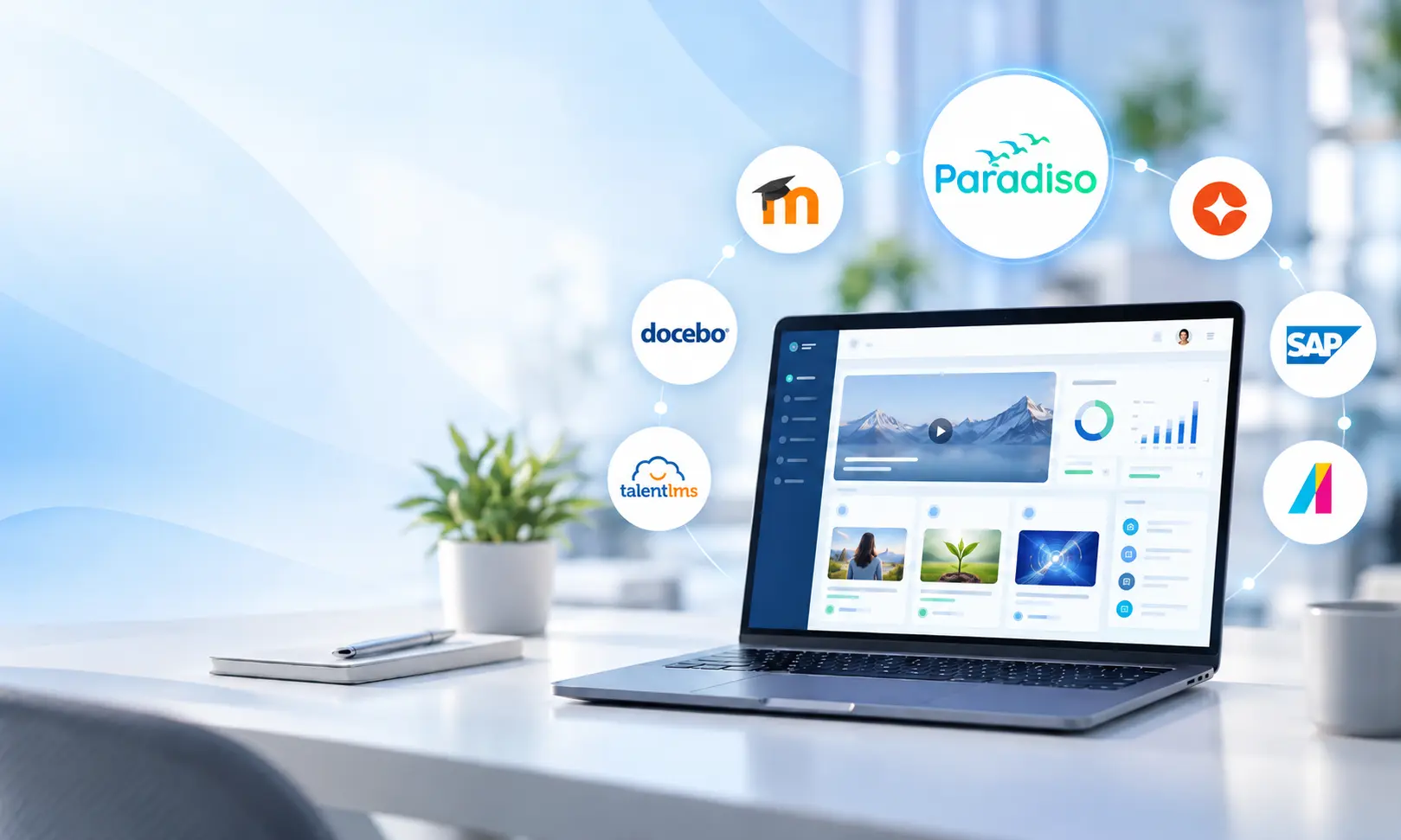




TalentLMS is one of the easier corporate LMS platforms to evaluate because it offers a relatively straightforward SaaS model and supports capabilities such as AI course creation, coaching, skills, branches, analytics, APIs, and integrations.
The question for most buyers researching TalentLMS alternatives is therefore not whether TalentLMS can run corporate training. It can. The more useful question is whether it still fits once your learning operation becomes more complex.
You may need deeper multi-audience administration, more control over integrations, advanced reporting, skills development, configurable automation, AI-supported practice, or an enterprise learning platform that can adapt around existing HR and business systems.
Quick Answer
- TalentLMS remains a practical choice for teams that value straightforward deployment, relatively simple administration, and a broad set of standard LMS capabilities.
- Paradiso LMS is worth considering when you need complex employee, customer, partner, or compliance training, deeper integrations, configurable enterprise workflows, AI roleplay, skills development, or deployment flexibility.
- Other strong TalentLMS competitors include Absorb LMS, Docebo, Cornerstone, LearnUpon, 360Learning, iSpring LMS, Moodle Workplace, Litmos, and D2L Brightspace.
Why do companies look for TalentLMS alternatives?
You should not replace an LMS simply because another platform has a longer feature list. The better question is whether your current platform can continue supporting your audiences, learning workflows, reporting requirements, and technology stack as training expands.
A regional sales team might initially need only onboarding courses and certifications. Two years later, the same L&D team may be training employees across several countries while also educating partners, customers, and contractors.
That shift changes what you need from an LMS. Multi-tenant administration, localized learning, automation, integrations, reporting, skills data, and different training experiences can become more important than simply uploading courses.
Most LMS shortlists are still built around feature checklists. That is backwards. The bigger buying risk is whether the platform fits your audiences, workflows, data flows, administration model, and future operating complexity.
Not Sure Which LMS Fits Your Training Requirements?
Not sure whether you need a new LMS or simply a better fit for your growing training requirements? Use our
LMS buyer’s guide to identify the capabilities, integrations, reporting requirements, and learner experiences to evaluate before building your shortlist.
How do the top TalentLMS alternatives compare?
The table below compares each platform by the situation where it is most likely to deserve a place on your shortlist.
| TalentLMS alternative | Best fit | Notable strength | What to evaluate closely |
|---|---|---|---|
| 1. Paradiso LMS | Complex corporate and extended enterprise training | Enterprise adaptability, integrations, AI roleplay, skills and multi-audience learning | Configuration and integration requirements |
| 2. Absorb LMS | Corporate and external training | Learner experience, reporting, eCommerce and administration | Quote-based commercial model |
| 3. Docebo | Large enterprise and extended enterprise programs | Scale, AI, automation and multi-audience learning | Packaging and add-ons |
| 4. Cornerstone | Enterprises connecting learning with broader workforce strategy | Skills, workforce intelligence and enterprise learning | Breadth and implementation scope |
| 5. LearnUpon | Employee, customer and partner academies | Multiple learning portals and integrations | Fit for smaller deployments |
| 6. 360Learning | Collaborative and SME-led learning | Collaborative authoring and internal knowledge sharing | Fit when decentralized creation is not a priority |
| 7. iSpring LMS | Rapid employee training and course development | Authoring workflow and mobile learning | Complex extended-enterprise requirements |
| 8. Moodle Workplace | Organizations wanting configuration and multi-tenancy flexibility | Customization and Moodle ecosystem | Hosting, partner and implementation model |
| 9. Litmos | Broad corporate learning and content-driven programs | Content, AI and multi-audience delivery | Plan-specific capabilities |
| 10. D2L Brightspace | Organizations emphasizing learning design and measurable development | Personalization and analytics | Fit versus a lighter LMS |
The right choice depends less on the number of features and more on how well the LMS matches your training model.
1. Is Paradiso LMS a good TalentLMS alternative?
Paradiso LMS is a strong TalentLMS alternative when your learning environment requires greater enterprise adaptability across audiences, systems, workflows, skills, and practical training.
Paradiso is a cloud-based e-learning solutions provider designed for corporate learning use cases such as employee training, onboarding, customer education, partner enablement, compliance learning, and sales development.
It combines LMS functionality with AI course creation, personalized learning, skills development, reporting, automation, gamification, and AI roleplay for scenario-based practice. If engagement matters to your program, capabilities such as gamification can help your L&D team introduce challenges, achievements, rewards, and other motivational elements into structured learning.
Integration becomes particularly important as training expands. Paradiso supports integration with more than 100 applications, helping learning data connect with HRIS, HCM, CRM, collaboration, SSO, content, and business systems.
Instead of manually moving employee information between an HR platform and the LMS, for instance, user provisioning and learner data can become part of a connected workflow.
Reporting matters for the same reason. An impressive reporting dashboard is useful when it helps your L&D team move beyond individual course completions and understand engagement, learner progress, certifications, skills, and training outcomes across programs.
Paradiso can also support a cloud-based learning management system model while providing deployment flexibility for organizations with more specialized infrastructure requirements.
TalentLMS may still be the better fit when simplicity and a standardized SaaS environment are your priorities. Paradiso becomes more relevant when multiple audiences, custom integrations, AI-supported practice, reporting needs, or enterprise workflows add complexity.
Best for: L&D teams that expect their learning ecosystem to become more complex as employee, customer, partner, and business-system requirements grow.
Need Better Connections Between Your Learning Systems?
If disconnected HR, CRM, collaboration, and learning systems are one reason you’re considering a TalentLMS alternative, look closely at how each platform handles data flow. Explore
Paradiso LMS integrations to see how learning can connect with the systems your teams already use.
2. When should you consider Absorb LMS?
Absorb LMS is a strong option when learner experience, corporate training, external learning, eCommerce, and administrative efficiency are high priorities.
Its platform supports corporate learning as well as customer and partner education. This makes it relevant if your learning operation extends beyond employees or if you plan on selling courses as part of a commercial training strategy.
If course commerce matters, look beyond whether a platform simply has a checkout function. Review payment workflows, catalogs, audience segmentation, reporting, tax requirements, and how commercial learners are separated from internal employees.
Best for: Corporate L&D teams that want a polished learner experience with strong external-training and commerce options.
3. When does Docebo make sense?
Docebo is designed for enterprises that need learning at scale across employees and external audiences.
Its enterprise platform emphasizes AI, personalization, extended enterprise learning, analytics, automation, integrations, and multiple learner audiences. It can be particularly relevant where learning needs to appear inside a broader digital ecosystem instead of existing only inside a standalone LMS.
Docebo is also suited to organizations combining formal courses with social, mobile, personalized, and blended learning experiences.
That breadth makes packaging important. When comparing Docebo with TalentLMS, identify which capabilities are included in the proposed package and which require additional products or services.
Best for: Large enterprises that need scalable employee, customer, and partner learning with substantial configuration options.
4. Is Cornerstone a suitable TalentLMS competitor?
Cornerstone is particularly relevant when learning is connected to a broader workforce, skills, and talent strategy.
Its learning ecosystem extends beyond course delivery into employee skills, workforce intelligence, content, talent processes, and development. That makes it a logical option for enterprises trying to create a culture of continuous learning rather than treating training as a series of isolated programs.
Picture an L&D team that wants employees to complete required training but also needs managers to understand skill gaps and guide longer-term development. That broader workforce lens is where a suite such as Cornerstone can become more relevant.
The tradeoff is scope. If your requirement is primarily straightforward LMS administration, consider whether you need the breadth of a wider talent ecosystem.
Best for: Large enterprises connecting learning, talent, skills, and workforce development.
5. Why consider LearnUpon?
LearnUpon is particularly strong for companies that need separate learning experiences for employees, customers, partners, or association members.
Its portal-based model allows different audiences to have their own learning environments while administrators maintain centralized oversight. This can work well if a single L&D team runs internal learning alongside customer or partner academies.
LearnUpon also supports common corporate learning requirements such as learning journeys, certifications, reporting, SSO, APIs, integrations, and eCommerce.
Best for: Customer education, partner training, employee development, and programs where separate branded learning portals matter.
6. What makes 360Learning different?
360Learning is a compelling TalentLMS alternative when internal experts need to create and improve learning collaboratively.
Its approach puts subject-matter experts closer to course creation. Instead of sending every training request through a centralized instructional-design queue, your sales leaders, product specialists, operations experts, or managers can contribute knowledge more directly.
Imagine a product team making weekly changes to a complex solution. Traditional course-production cycles may struggle to keep up, while collaborative authoring helps shorten the distance between the person who knows the work and the employee who needs to learn it.
Best for: Companies where decentralized content creation and knowledge sharing are central to the L&D strategy.
7. Is iSpring LMS better for rapid course development?
iSpring LMS deserves consideration when fast course production and straightforward corporate training are major requirements.
Its wider ecosystem is closely associated with rapid eLearning authoring, making it attractive to training teams that already build substantial amounts of learning content from presentations, assessments, simulations, and other internal material.
The platform also supports onboarding, employee development, assessments, learning paths, mobile training, and reporting.
Best for: L&D teams that want LMS delivery closely paired with rapid eLearning authoring.
8. Should you consider Moodle Workplace?
Moodle Workplace is more relevant than standard Moodle LMS when you are comparing TalentLMS for corporate learning.
The underlying open source LMS ecosystem is one reason Moodle remains familiar to many learning teams. Moodle Workplace builds additional corporate capabilities around that foundation, including multi-tenancy, programs, certifications, reporting, automation, and organizational structures.
This approach can appeal to companies that value configuration flexibility or already have Moodle expertise. However, evaluate hosting, implementation, ongoing administration, support, and partner requirements rather than treating “open source” as synonymous with “free.”
Best for: Organizations that value configuration flexibility, multi-tenancy, and the wider Moodle ecosystem.
9. Where does Litmos fit?
Litmos is a strong corporate learning option when you need employee, customer, partner, compliance, and content-driven training from one platform.
Its platform combines learning management with content, authoring, AI capabilities, integrations, and external training use cases.
Commerce may also influence your shortlist. If selling learning is part of your strategy, integrations such as Shopify illustrate the type of connection you should evaluate when deciding how courses will move from the LMS into a commercial storefront and purchasing workflow.
Do not compare LMS eCommerce only by asking whether payment is supported. Look at catalogs, user creation, enrollment automation, payment data, reporting, and what happens when a purchaser buys training for someone else.
Best for: Mid-market and enterprise companies looking for broad training capabilities plus content and AI options.
10. When is D2L Brightspace worth evaluating?
D2L Brightspace is worth considering when learning design, personalization, analytics, skills development, and learning services are central to your program.
The platform supports employee development, customer training, partner enablement, onboarding, role-based learning, certifications, analytics, and personalized learning experiences.
It can be especially relevant where your L&D team wants greater control over how learning experiences are designed and how learner progress is measured, rather than focusing primarily on straightforward course administration.
Best for: Organizations that want sophisticated learning experiences and measurement backed by broader learning expertise.
How should you compare TalentLMS alternatives?
Do not begin with 150 feature rows. Start with the operating requirements that will determine whether the LMS remains workable as your training program grows.
| TalentLMS alternative | Best fit | Notable strength | What to evaluate closely |
|---|---|---|---|
| 1. Paradiso LMS | Complex corporate and extended enterprise training | Enterprise adaptability, integrations, AI roleplay, skills and multi-audience learning | Configuration and integration requirements |
| 2. Absorb LMS | Corporate and external training | Learner experience, reporting, eCommerce and administration | Quote-based commercial model |
| 3. Docebo | Large enterprise and extended enterprise programs | Scale, AI, automation and multi-audience learning | Packaging and add-ons |
| 4. Cornerstone | Enterprises connecting learning with broader workforce strategy | Skills, workforce intelligence and enterprise learning | Breadth and implementation scope |
| 5. LearnUpon | Employee, customer and partner academies | Multiple learning portals and integrations | Fit for smaller deployments |
| 6. 360Learning | Collaborative and SME-led learning | Collaborative authoring and internal knowledge sharing | Fit when decentralized creation is not a priority |
| 7. iSpring LMS | Rapid employee training and course development | Authoring workflow and mobile learning | Complex extended-enterprise requirements |
| 8. Moodle Workplace | Organizations wanting configuration and multi-tenancy flexibility | Customization and Moodle ecosystem | Hosting, partner and implementation model |
| 9. Litmos | Broad corporate learning and content-driven programs | Content, AI and multi-audience delivery | Plan-specific capabilities |
| 10. D2L Brightspace | Organizations emphasizing learning design and measurable development | Personalization and analytics | Fit versus a lighter LMS |
Run your shortlist through these questions before scheduling demos. You will usually eliminate poor-fit platforms faster than you would by comparing another page of feature checkmarks.
Evaluate an LMS Against Your Actual Workflows
Your shortlist should reflect your actual workflows, not just a feature checklist. Explore
Paradiso’s corporate LMS to compare multi-audience training, AI-supported learning, reporting, integrations, automation, and enterprise learning requirements against your current setup.
What is the business case for switching LMS platforms?
An LMS migration only makes sense when the operational or business value exceeds the cost and disruption of switching.
The value may come from reducing manual administration, connecting systems, improving learner access, consolidating tools, accelerating content production, improving skills development, or getting better information about training outcomes.
Consider a simple illustrative example. If four L&D administrators each spend eight hours per week reconciling user records, exporting reports, and transferring information between systems at a loaded labor cost of $55 per hour, that work costs approximately $91,520 per year.
Reducing that manual effort by half would free roughly $45,760 annually before accounting for other improvements such as faster onboarding, reduced content-production time, better reporting, or system consolidation.
For a CFO, translate the LMS decision into total cost of ownership and avoided manual work. For your CLO or HR leader, connect the decision to capability development, learner experience, workforce readiness, and measurable training outcomes.
Which TalentLMS alternative should you choose?
There is no single best platform for every training team.
If straightforward administration and a standardized SaaS approach are your priorities, TalentLMS may remain a good fit. If collaborative knowledge creation drives your strategy, 360Learning deserves attention. If rapid authoring matters most, iSpring LMS is worth evaluating.
Cornerstone is more relevant when learning connects closely with wider talent and workforce processes. Docebo, Absorb, LearnUpon, Litmos, and D2L each offer different strengths around enterprise scale, learning experiences, external training, content, and administration.
If your biggest challenge is increasing organizational complexity, Paradiso LMS deserves a closer look. Its strongest use cases involve corporate learning across several audiences, extensive LMS integrations, AI-supported learning, skills development, configurable workflows, analytics, and enterprise deployment requirements.
If you are choosing one for the first time, define your business requirements before comparing product demos. If you are replacing TalentLMS, document what works in your current environment as carefully as what does not.
The right TalentLMS alternatives shortlist is the one built around your actual operating model, not someone else’s feature ranking.
Ready to Test Your LMS Requirements?
If TalentLMS no longer fits the complexity of your training environment, the next step is to test your requirements against a real platform rather than another comparison table. See how Paradiso LMS could support your employee, customer, partner, compliance, and extended enterprise training workflows.
Frequently Asked Questions
What are the best TalentLMS alternatives in 2026?
Is Paradiso LMS better than TalentLMS?
Does TalentLMS have AI features?
Which TalentLMS competitor is best for extended enterprise learning?
Is Moodle a free alternative to TalentLMS?
What should I check before migrating from TalentLMS?