




Quick Answer
What are microlearning examples?
Microlearning examples are short, focused learning experiences typically 3-10 minutes designed to teach a single concept, skill, or procedure. Common microlearning examples in corporate training include short video tutorials, interactive quiz modules, flashcard decks, scenario-based branching decisions, infographic explainers, podcast-style audio lessons, mobile push notifications with a daily tip, and AI roleplay simulations for skill practice. The best microlearning examples share two characteristics: they target one specific learning objective and they are accessible on any device at the moment the learner needs them.
- Ideal length: 3-10 minutes per module
- Best formats: Video, quiz, scenario, flashcard, infographic, audio, AI simulation
- Most common uses: Compliance refreshers, onboarding, product knowledge, sales enablement, soft skills
What Is Microlearning?
Microlearning is a learning design approach that delivers content in short, focused bursts rather than lengthy courses or multi-hour training sessions. Each microlearning unit addresses a single topic, skill, or task – and is designed to be completed in one sitting without the learner losing context or motivation.
The defining characteristic of microlearning is not just its length but its specificity. A 5-minute video that covers five topics is not microlearning – it is a short course. A 5-minute video that explains exactly how to handle one specific customer objection is microlearning. The focus on a single, actionable output is what separates effective microlearning examples from compressed traditional eLearning.
Microlearning works because it aligns with how adults actually learn on the job: in short bursts, triggered by an immediate need, on a device they already have in their hand. Research consistently shows that shorter, more frequent learning experiences produce better long-term retention than longer, infrequent ones – a principle known as spaced repetition. For a deeper look at the science behind this, see our guide to what is microlearning.
Types of Microlearning – 7 Core Formats
Before examining specific microlearning examples, it helps to understand the main microlearning formats available to L&D teams. Each format serves different learning objectives:
| Format | Typical Length | Best For | Delivery Method |
|---|---|---|---|
| Short video | 2–5 min | Demonstrations, process walkthroughs, explanations | LMS, app, email link |
| Quiz / knowledge check | 2–4 min | Compliance refreshers, spaced repetition, knowledge gaps | LMS, mobile push, email |
| Scenario / branching | 3–7 min | Decision-making, soft skills, ethical dilemmas | LMS (SCORM) |
| Flashcard deck | 2–5 min | Terminology, product knowledge, language learning | App, mobile, LMS |
| Infographic / visual | 1–3 min | Process steps, comparisons, statistics, checklists | Email, Slack, LMS |
| Audio / podcast-style | 5–10 min | Concept explanations, interviews, leadership skills | App, LMS, email |
| AI roleplay simulation | 3–8 min | Sales conversations, customer service, feedback skills | App, LMS, standalone |
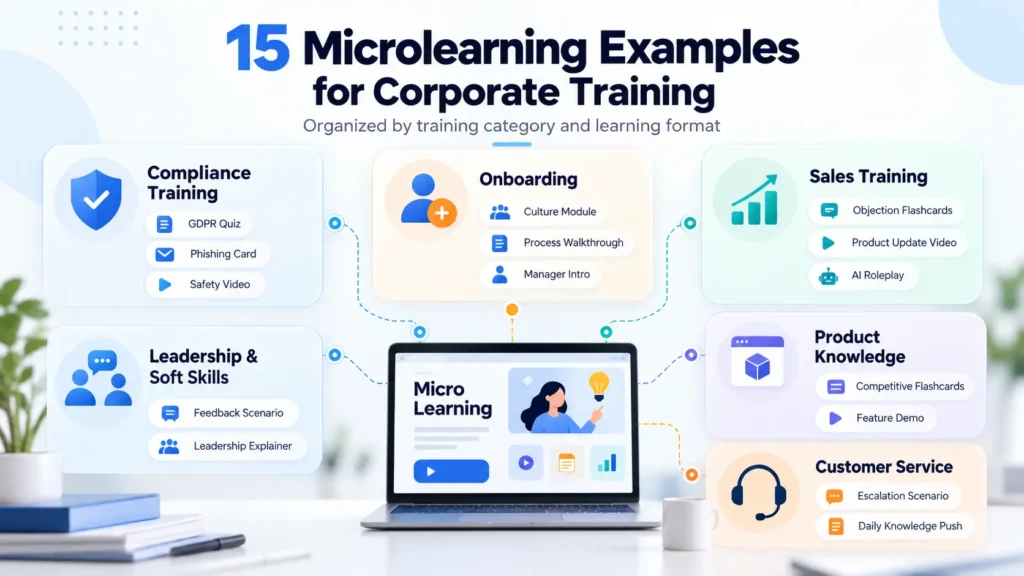
15 Microlearning Examples for Corporate Training
The following microlearning examples are organized by training category. Each example includes the format, delivery method, and why it works so you can adapt the approach for your own programs.
Compliance Training Microlearning Examples
1. Weekly GDPR Scenario Quiz
Format: Quiz module (3 questions, 3 minutes) | Delivery: LMS push notification, Monday morning
Instead of an annual 45-minute GDPR compliance course that employees forget within a week, a weekly 3-question scenario quiz presents one realistic situation: “A customer emails requesting their data be deleted. You have received it at 4:45 PM on a Friday. What do you do?” Employees choose from three options and receive immediate feedback explaining the correct procedure and the regulatory requirement behind it. Delivered every Monday, this example of microlearning uses spaced repetition to maintain compliance knowledge year-round rather than refreshing it once and hoping it sticks.
2. Phishing Recognition Training Card
Format: Interactive flashcard + quiz (2 minutes) | Delivery: Email or mobile app
A single-topic module showing one real phishing email (with identifying elements highlighted) and asking learners to spot the red flags before revealing the explanation. Published in response to new phishing tactics identified by the IT security team, this microlearning example reaches employees within hours of a threat being identified far faster than a full course update could be produced and deployed.
3. Safety Procedure Refresher Video
Format: Short video (4 minutes) | Delivery: LMS, triggered quarterly
A 4-minute narrated video demonstrating a single safety procedure how to correctly use a piece of equipment, how to report a near-miss, or what to do in an emergency delivered to relevant employees on a quarterly spaced repetition schedule. The video is specific to one procedure, not a general safety overview. This is one of the most widely used microlearning examples in manufacturing, healthcare, and logistics environments where procedural accuracy is safety-critical.
Onboarding Microlearning Examples
4. Day-1 Company Culture Micromodule
Format: Short video with quiz (5 minutes) | Delivery: LMS, automated on start date
A 5-minute module delivered automatically on the new hire’s first day covering one specific aspect of company culture how decisions are made, how the team communicates, or what “good work” looks like in this organization. Each aspect of culture gets its own module rather than being bundled into a single overwhelming orientation presentation. The new hire receives one module per day across the first two weeks making the onboarding microlearning series feel manageable rather than an information flood.
5. Role-Specific Process Walkthrough
Format: Screen-capture video (3–5 minutes) | Delivery: LMS or shared link
A short screen-capture recording showing a new hire exactly how to complete a specific task in the tools and systems they will use daily how to log a support ticket, how to submit a purchase order, how to update a CRM record. Each process gets its own short video rather than being documented in a written manual. New hires access the video at the moment they need to perform the task, not two weeks before during a systems training session they will not remember. These short process videos can be built and exported to your LMS in minutes using an AI-powered eLearning authoring tool no video production experience or instructional designer needed.
6. Manager Introduction Video
Format: Video (2–3 minutes) | Delivery: LMS, Day 1
A pre-recorded message from the new hire’s direct manager covering: what the team does, what success looks like in the first 30 days, and one piece of advice from someone who has been in the role before. This microlearning example builds psychological safety before the new hire’s first team meeting and sets expectations without requiring the manager’s time on day 1.
Sales Training Microlearning Examples
7. Objection Handling Flashcard Deck
Format: Flashcard deck (2–4 minutes) | Delivery: Mobile app, accessible anywhere
A deck of 10–15 cards, each presenting one customer objection on the front and the recommended response framework on the back. Sales reps review a few cards before a call, after a call where an objection came up, or during their commute. New objections identified by the sales team are added to the deck within hours. This microlearning example for sales works because it is accessible at the exact moment of need before a specific call, not after a monthly training session.
8. Product Update One-Pager Video
Format: Short video (3 minutes) | Delivery: Email, Slack, LMS
A 3-minute video produced whenever a product feature is released or updated, covering: what changed, what benefit it delivers to the customer, and the two or three points a sales rep should mention in their next call. This microlearning example replaces the all-hands product training session and gets the information to the sales team faster and in a format they can rewatch before specific conversations.
9. AI Roleplay Sales Conversation
Format: AI simulation (5–8 minutes) | Delivery: App or LMS
The sales rep engages in a realistic conversation with an AI-powered customer persona navigating discovery questions, responding to objections, and moving toward a close. The AI provides immediate feedback on response quality, tone, and missed opportunities after each exchange. Unlike a manager role-play session that requires scheduling, this microlearning example allows reps to practice the same conversation multiple times until they are consistently confident at any time, without requiring a human partner.
Leadership and Soft Skills Microlearning Examples
10. Difficult Feedback Conversation Scenario
Format: Branching scenario (5–7 minutes) | Delivery: LMS (SCORM)
A single scenario placing the learner in the role of a manager who needs to address a specific underperformance issue with a team member. At each decision point, the learner chooses how to open the conversation, how to respond to defensiveness, and how to end the meeting. Each path shows the consequence of the choice realistic dialogue responses from the team member that reflect how the conversation would likely proceed. This branching scenario microlearning example allows managers to experience difficult conversations in a safe context before they face them in reality.
11. Leadership Concept Explainer Card
Format: Infographic + short audio (3 minutes) | Delivery: LMS, email, mobile app
A single leadership concept psychological safety, delegation, giving positive feedback explained in a visual infographic with a 2-minute audio narration providing context and one concrete application example. Delivered weekly as part of a leadership development series, each card is standalone and complete managers do not need to have seen any previous card for the current one to make sense.
Product Knowledge Microlearning Examples
12. Competitive Comparison Flashcard
Format: Flashcard deck (3–5 minutes) | Delivery: Mobile app, LMS
A deck of competitive positioning cards, each presenting a competitor’s product and the one or two differentiation points that matter most in a head-to-head comparison. Updated by the product marketing team whenever competitive intelligence changes. Customer-facing employees access the deck before prospect meetings where a specific competitor has been mentioned. This microlearning example replaces the battlecard PDF that nobody reads with a format that takes 3 minutes to review and is accessible from a phone.
13. New Feature Demo Video
Format: Screen-capture video (3–4 minutes) | Delivery: Email, LMS, Slack
A short screen-capture walkthrough of a new product feature or software update, showing exactly what changed and how to use it. Produced and delivered the day a feature releases. An AI course creator can generate the quiz questions, narration script, and slide structure for this type of module from the product release notes in minutes removing the production bottleneck between a feature going live and employees being trained on it.
Customer Service Microlearning Examples
14. Handling an Escalation – Scenario Module
Format: Branching scenario (5 minutes) | Delivery: LMS
A realistic customer service escalation scenario – an angry customer, a delayed resolution, a request for a manager where the learner navigates the conversation by choosing responses at each stage. Each response path demonstrates the likely customer reaction, showing what de-escalation looks like in practice versus what makes the situation worse. This microlearning example is particularly effective because it is specific to one escalation type rather than covering all conflict types in a generic module.
15. Daily Knowledge Push Notification
Format: Text card / mobile notification (1–2 minutes) | Delivery: Mobile push, app
A single product fact, process reminder, or policy update delivered as a push notification each morning with a 2-question quiz embedded in the card. Customer service agents answer before starting their shift microlearning apps like this deliver content directly to employees’ phones without requiring them to log into an LMS. This microlearning example uses the spaced repetition principle with zero friction – there is no LMS to log into, no module to launch, and no completion to track. Engagement data comes from push notification analytics rather than SCORM reporting.
Microlearning Examples in the Workplace – Key Principles
Looking across these 15 microlearning examples, several design principles appear consistently in the ones that produce the best results:
One objective per module. Every effective microlearning example targets exactly one observable behavior or knowledge point. The moment a microlearning module tries to cover three related topics, it becomes a short course rather than microlearning.
Immediate accessibility. The best microlearning examples are accessed at the moment of need before a customer call, after an incident, at the start of a shift not on a scheduled training day. This requires delivery through channels employees already use: mobile apps, push notifications, email links, or embedded in the workflow tools they have open.
No prerequisite required. Each microlearning module must stand alone. Learners cannot be expected to have completed previous modules in a sequence before the current one makes sense. This is what makes microlearning usable at the moment of need rather than only in a prescribed order.
Feedback is immediate and specific. In quiz, scenario, and simulation microlearning formats, feedback must explain why the correct answer is correct – not just confirm it. Generic “correct!” responses produce lower retention than feedback that explains the reasoning or shows the consequence of the wrong choice.
AI Microlearning Examples in 2026
Artificial intelligence has expanded what is possible in microlearning, particularly in the practice and simulation category:
AI conversation simulations let learners practice realistic workplace conversations a sales call, a performance feedback discussion, a customer complaint with an AI that responds dynamically based on what the learner says rather than following a scripted branching path. Unlike traditional branching scenarios with 3-4 preset response options, AI simulations allow free-form response, making the practice more realistic and the skill transfer more direct.
AI-generated quiz content means L&D teams can produce knowledge check modules immediately after a process change, product update, or compliance update rather than waiting for an instructional designer to write questions from scratch. The quiz questions are generated from the source document, reviewed and published within hours.
Personalized microlearning paths use AI recommendations in the LMS to surface the specific microlearning module each learner needs based on their assessment performance, role, and learning history rather than delivering the same module to everyone in a job family regardless of what they already know.
Free · SCORM Export · No Credit Card
Build microlearning modules with AI in minutes
Paradiso Authoring Tool generates focused, SCORM-ready microlearning modules from a prompt or document. Quiz questions, narration, and slides — built automatically, fully editable, free to export.
Frequently Asked Questions
What are microlearning examples?
Microlearning examples are short, focused learning experiences typically 3–10 minutes that target a single learning objective. Common examples of microlearning in corporate training include: short explainer videos, scenario-based branching modules, interactive quiz refreshers, flashcard decks for product knowledge, screen-capture process walkthroughs, infographic explainers, audio/podcast lessons, and AI conversation simulations for sales or customer service practice. The best microlearning examples are accessible on mobile, require no prerequisite, and can be completed in one sitting without interruption.
What are the most effective microlearning formats?
The most effective microlearning formats depend on the learning objective. Short videos work best for process demonstrations and concept explanations. Quiz modules and flashcard decks work best for knowledge retention and spaced repetition of compliance or product information. Branching scenarios and AI simulations work best for decision-making, soft skills, and practice-based learning where the learner needs to experience the consequence of choices before facing them in real situations. Infographic cards work best for process steps, checklists, and reference information employees need to access quickly.
What is the ideal length for microlearning?
The ideal length for microlearning is 3–10 minutes per module. Research on optimal attention span for digital content consistently points to 3–5 minutes as the peak engagement window, with retention declining significantly beyond 10 minutes in self-paced digital learning. The target should be the minimum content required to address one specific learning objective not a predetermined time limit. A 7-minute module that fully covers one procedure is more effective than a 3-minute module that covers it superficially.
How is microlearning different from eLearning?
Microlearning and eLearning describe different learning design approaches rather than different technologies. Traditional eLearning courses typically run 20–60 minutes per module and cover a full topic area with multiple learning objectives. Microlearning modules run 3–10 minutes and address a single objective, designed to be consumed at the moment of need rather than in a scheduled training session. Microlearning is often delivered via mobile push, email link, or embedded in workflow tools; traditional eLearning is typically accessed through an LMS in a dedicated learning session. Both formats can use SCORM and be hosted in an LMS the difference is in design philosophy and scope.
What types of training benefit most from microlearning?
Training types that benefit most from microlearning are: compliance refreshers (spaced repetition of regulations and procedures), sales enablement (product knowledge, objection handling, competitive positioning), onboarding (delivering role-specific information at the moment new hires need it), customer service skills (scenario practice for specific situations), software and systems training (just-in-time how-to guidance), and leadership skill development (bite-sized concept introduction followed by on-the-job application). Microlearning is less effective for complex multi-step skills that require sustained practice sessions rather than brief exposure.
Conclusion
The 15 microlearning examples in this guide cover the most common and highest-impact applications in corporate training from compliance quiz refreshers that replace annual certification courses to AI roleplay simulations that let sales reps practice objection handling without requiring a human partner. What unites the best examples of microlearning is not the format or the technology it is the focus on a single learning objective, immediate accessibility at the moment of need, and feedback specific enough to produce genuine behavior change.
The practical starting point for any L&D team is to identify the training content that employees forget fastest or access least and replace it with the microlearning format most suited to that content type. Compliance knowledge that fades between annual training sessions becomes a weekly quiz. Process walkthroughs that employees search for during a task become short videos. Objection handling that sales reps struggle with in live calls becomes a flashcard deck or an AI simulation they can practice anytime.
Related resources:
- What Is Microlearning? – definition, science, and strategy
- Best Microlearning Platforms for Training – platform comparison and pricing
- Blended Learning – combining microlearning with other delivery formats
- eLearning Course Design Best Practices – design principles for all learning formats
- Adult Learning Theory – the science behind why microlearning works