





Quick Answer
What is a training needs assessment?
A training needs assessment (TNA) is a structured process of identifying the gap between where your employees are now and where they need to be and determining whether training is the right way to close it. It happens before any course is built, any budget is committed, or any content is written. The output is a clear, evidence-based brief: who needs training, on what, at what depth, and in what format. Without it, L&D teams build solutions to problems they have not actually diagnosed the leading cause of training that gets completed but changes nothing on the job.
- Also called: Training needs analysis (TNA), learning needs analysis (LNA)
- When: Before any training program is designed or built
- Output: A performance gap statement, target audience, and recommended learning solution
What Is a Training Needs Assessment?
A training needs assessment is the diagnostic step that prevents you from solving the wrong problem. It is a structured investigation using data, conversations, and observation to understand exactly what is causing a performance gap and whether training is the appropriate fix.
Here is why that distinction matters: not every performance problem comes from a lack of knowledge or skill. Some employees underperform because processes are unclear, tools are outdated, expectations were never communicated, or management hasn’t been holding the standard. None of those problems get solved by building a course but without a TNA, L&D teams often build one anyway.
A well-conducted training needs assessment answers four specific questions:
- What is the actual performance gap, measured in observable terms?
- Is this gap caused by a deficit in knowledge, skill, or behavior or something else?
- Who specifically is affected, and to what degree?
- What training solution, if any, will close this gap and at what priority?
The process can take anywhere from two days to six weeks, depending on the complexity of the gap and the scale of the audience. What it cannot do is take zero time which is what happens when an L&D team gets a training request and immediately opens an authoring tool.
Training Needs Assessment vs. Training Needs Analysis Cleared Up
You will see both terms used in job descriptions, textbooks, and conversations with senior HR leaders. They mean the same thing in almost every corporate context.
“Training needs assessment” is the more common term in the United States particularly in government, healthcare, and enterprise corporate training environments. “Training needs analysis” is more common in UK-based L&D practice and academic literature.
Some practitioners draw a subtle distinction: assessment is the broader survey process (identifying whether a gap exists across a population), while analysis is the deeper diagnostic investigation (understanding the root cause of a specific gap). In practice, most organizations use both terms to mean the same end-to-end process from gap identification through to training brief.
Other terms you will encounter that describe the same fundamental process: learning needs analysis (LNA), learning needs assessment, skills gap analysis, and training gap analysis. All roads lead to the same destination: a clear picture of what training is needed and why.
Why a Training Needs Assessment Matters and What Skipping It Costs
Most L&D teams know they should conduct a training needs assessment. Many do not, because there is always pressure to move faster the stakeholder needs the training by next quarter, the compliance deadline is in six weeks, the new process launches in a month.
Here is what the data says about the cost of that shortcut:
- Organizations waste approximately $13.5 million per 1,000 employees annually on ineffective training most of it on programs that were built without a proper needs assessment (Accenture)
- Only 12% of employees apply what they learn in training back to their jobs, according to research by the Association for Talent Development and misaligned training design is a primary factor
- L&D leaders who conduct training needs assessments consistently report measurably higher training effectiveness and stronger business alignment than those who respond reactively to stakeholder requests
The time a TNA takes even a two-day rapid version is consistently recovered in reduced revision cycles, fewer misdirected training programs, and the ability to show business leaders exactly what problem the training is designed to solve and how success will be measured.
The 3 Levels of a Training Needs Assessment
A complete training needs assessment operates across three levels. Each level answers a different question and skipping any of them produces gaps in the analysis that affect the quality of the training solution.
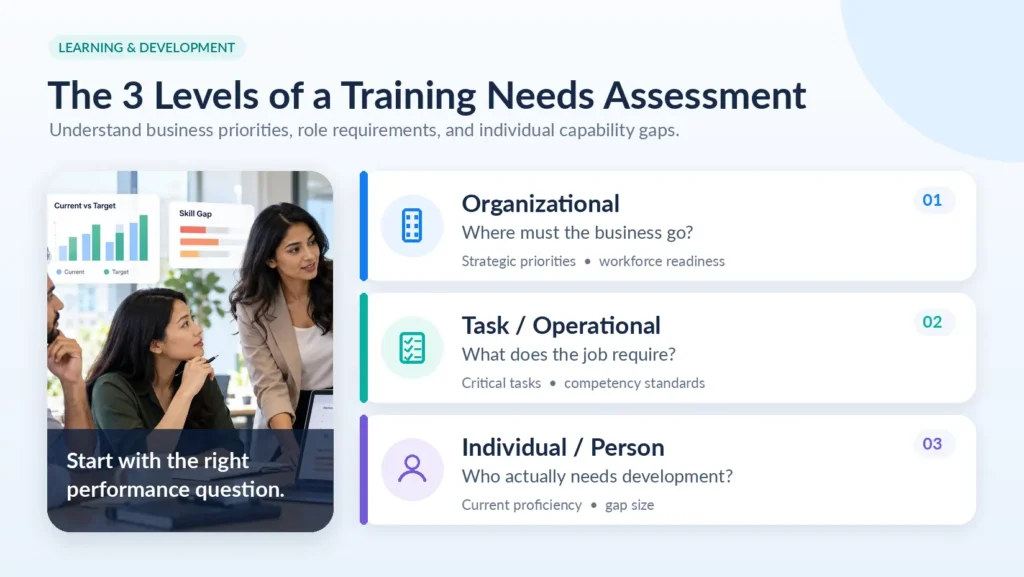
| Level | Core Question | What You Are Looking For | Data Sources |
|---|---|---|---|
| Organizational | Where does the business need to go, and what capability gaps are standing in the way? | Strategic priorities, workforce readiness, alignment between L&D investment and business goals | Business strategy documents, HR workforce data, exit interview themes, engagement surveys |
| Task / Operational | What does the job actually require, and what knowledge and skills are needed to do it at the required standard? | Task breakdown, competency requirements, proficiency standards, where performance errors concentrate | Job descriptions, competency frameworks, high-performer observation, SME interviews |
| Individual / Person | Which specific people have the gap and how large is it for each of them? | Who needs training vs who already performs at the required level | Performance reviews, assessment scores, error logs, manager observations, self-assessments |
Most organizations default to the individual level they notice some employees are underperforming and build training for all of them. The organizational and task levels exist to ensure you are solving the right problem, for the right people, in a way that connects to what the business actually needs to achieve.
When to Conduct a Training Needs Assessment and When Not To
A training needs assessment is worth the time investment in specific situations. Here is when you should run one and the scenarios where skipping it is legitimate.
Run a TNA when:
- A performance gap has been identified through data or consistent management observation
- A new process, system, regulation, or product is being launched that requires behavior change
- You are redesigning or auditing an existing training program that is not producing results
- Significant organizational change is underway restructuring, M&A, new strategy
- Onboarding programs are producing inconsistent time-to-productivity
- Employee survey data shows consistent skill-related feedback
You may skip a TNA when:
- The training requirement is legally mandated and the content is externally defined annual compliance certifications where a regulator specifies exactly what must be covered do not need internal analysis to justify the training
- A rapid operational need requires a same-week response a new tool is launching Tuesday, you need a quick how-to guide by Monday. A TNA would take longer than the problem it is solving.
- The gap is already fully evidenced you have test scores, observation data, and performance metrics that already answer every TNA question. Document the evidence and move directly to design.
The point is not that a TNA is always mandatory it is that the decision to skip one should be conscious and evidence-based, not the default because there is no time.
How to Conduct a Training Needs Assessment 7 Steps
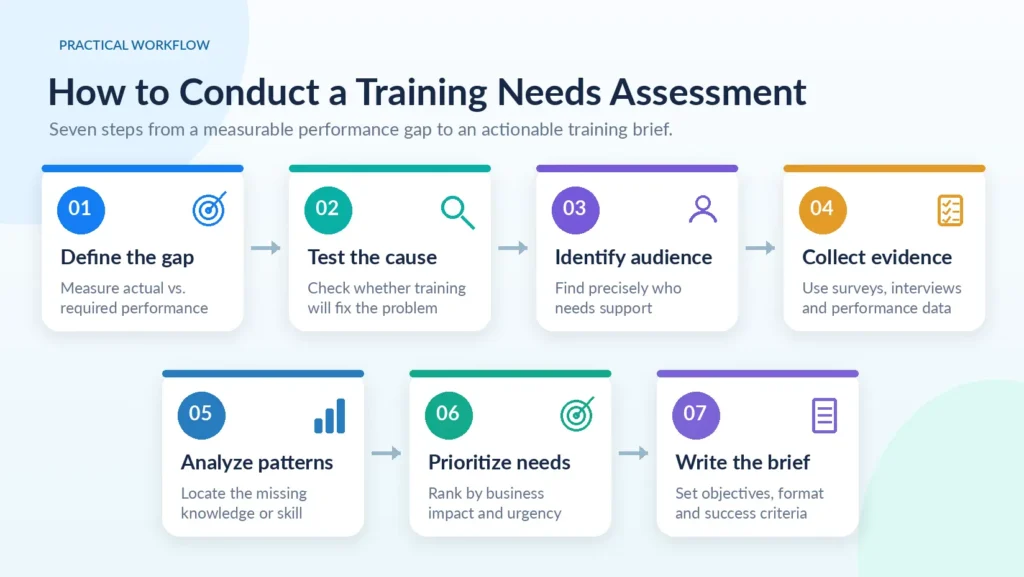
Step 1 – Define the Performance Gap Precisely
Start with a specific, measurable description of the gap between current performance and required performance. “Sales performance is poor” is not a gap statement. “Our account executives are closing 18% of qualified opportunities against a target of 35%” is a gap statement you can investigate. The more precise your gap definition, the more focused every subsequent step becomes.
Work with the stakeholder requesting the training to push past their symptom description to the underlying measurement. Ask: how is current performance tracked? What does success look like in numbers? When did this gap first appear and did anything change around that time?
Step 2 – Test Whether Training Is the Right Answer
Before any design work begins, ask the single most important question in the TNA process: could these employees perform correctly if their job depended on it? If the honest answer is yes they know how, they just are not doing it the gap is not a training problem. It may be a motivation, management, incentive, or process problem.
Common non-training causes that often masquerade as training needs: unclear performance expectations, absence of feedback on current performance, processes or tools that make the desired behavior difficult, incentive structures that reward different behaviors, and management tolerance of the gap itself.
Step 3 – Identify Your Audience
Define exactly who needs training not everyone in a job title, but the specific individuals whose performance has the gap. Run a person-level analysis using performance data, manager observation, or assessment scores to determine who is actually below the required standard. This step is where “the whole team needs this” gets tested against evidence.
Step 4 – Collect Data Using Multiple Methods
Use at least two data collection methods to triangulate your findings. A single stakeholder interview reflects one person’s perception. Multiple methods a survey to establish breadth, interviews to explore root cause, performance data to quantify the gap give you a finding you can defend to business leadership. See the Methods section below for a breakdown of options.
Step 5 – Analyze and Identify Patterns
Review everything you have collected and look for the patterns that explain the gap. What specific knowledge or skill is missing? Is it consistent across everyone in the audience, or concentrated in a subset? Are there contextual factors team, location, shift, tenure, manager that correlate with the gap? Patterns tell you both what the training should address and who it should prioritize.
Step 6 – Prioritize Training Needs
Not every gap you uncover will be equally urgent or equally addressable through training. Prioritize based on two dimensions: business impact (how significantly does this gap affect performance, compliance, or revenue?) and urgency (how soon does the gap need to be closed, and what happens if it is not?). High-impact, high-urgency gaps get built first. Lower-priority gaps go into the planning queue – or get addressed through less resource-intensive approaches like job aids and performance support.
Step 7 – Write the Training Brief
The output of a training needs assessment is not a report nobody reads it is an actionable brief that specifies: the precise learning objectives training must address, the target audience with any segmentation, the recommended format and rationale, the timeline and resource requirements, and the evaluation criteria that will confirm training worked. This brief hands off directly to the design and development phase. Once the TNA confirms training is the right solution, an AI-powered eLearning authoring tool can generate course content from the brief document in hours significantly compressing the time between needs identification and training delivery.
Training Needs Assessment Methods – Compared
| Method | Best For | Pros | Watch Out For |
|---|---|---|---|
| Surveys | Large audiences, initial gap screening, self-reported skill confidence levels | Scalable, fast, anonymous responses reveal what interviews might not | Self-reporting bias – people over- or underestimate their gaps |
| Interviews | Root cause exploration, context understanding, building stakeholder alignment | Rich qualitative insight, surfaces issues surveys cannot capture | Time-intensive, small sample, interviewer bias risk |
| Focus Groups | Team-level dynamics, process-related gaps, compliance and culture gaps | Surfaces group norms and peer dynamics that individual interviews miss | Groupthink – dominant voices can skew findings |
| Performance Data | Quantifying the gap, identifying who is affected, establishing evaluation baselines | Objective, measurable, provides the baseline for post-training ROI | Shows what the gap is but not why – needs qualitative methods alongside |
| Observation | Procedural and behavioral gaps, safety training, customer service | Sees actual performance rather than reported performance | Observer effect behavior changes when someone is watching |
| Skills Testing | Person analysis, compliance knowledge gaps, technical proficiency baseline | Objective skill level measurement, comparable across individuals | Assessment design requires expertise; test anxiety can skew results |
Training Needs Assessment Questions – What to Actually Ask
The quality of your TNA findings depends heavily on the quality of your questions. Here is a practical set organized by stakeholder group:
Questions for Managers
- What specific behaviors or outputs tell you an employee is performing at the required standard – and what does falling short of that look like?
- When did you first notice this performance gap? Did anything change around that time?
- Do all employees in this role have the gap, or is it concentrated in a subset? What do the high performers do differently?
- If an employee had everything they needed to perform correctly – the tools, the process clarity, the authority – would they perform at the required standard? Or is there a genuine knowledge or skill gap?
- What has already been tried to close this gap, and what happened?
Questions for Employees
- What parts of this role do you feel most confident in? Where do you feel least prepared?
- When you encounter a situation where you are unsure what to do, what do you do? Who do you go to?
- What information or support would help you perform this part of your role more effectively?
- Are there situations where you know what you should do but something makes it difficult to do it?
- How do you prefer to learn new things for your role – on the job, from colleagues, through formal training, through written resources?
Questions for Stakeholders and Business Leaders
- How does this performance gap connect to the business objectives you are responsible for this year?
- What does success look like in six months if this training works? How will you measure it?
- Is this a priority that warrants dedicated L&D resource, or is it a supporting development need?
- Are there organizational or process constraints that affect performance here that training alone will not solve?
Training Gap Analysis – How It Connects to Your TNA
A training gap analysis is the component of your training needs assessment that quantifies the specific knowledge and skill deficits. While the TNA asks whether training is the right solution, the training gap analysis asks how large the gap is and exactly what competencies are missing.
A solid training gap analysis produces three things:
- A current-state baseline – where employees are now in terms of specific knowledge, skill, or competency, measured before any training is delivered
- A required-state definition – the precise level of knowledge or skill employees need to reach for effective performance
- A gap measurement – the distance between those two points, often expressed as a competency rating or assessment score, segmented by individual or team where relevant
The training gap analysis baseline serves double duty: it tells you what to design the training to address, and it establishes the pre-training measurement against which post-training performance improvement will be evaluated. Without it, you cannot demonstrate that training produced any change at all.
Training Needs Assessment Template
Copy and adapt this template for your next TNA. It works for both rapid assessments (one or two days) and comprehensive assessments (multi-week programs).
TRAINING NEEDS ASSESSMENT – WORKING TEMPLATE
SECTION 1 — PROGRAM CONTEXT
Request submitted by: ___________________________
Business unit / Department: ___________________________
TNA conducted by: ___________________________
Date: ___________________________
SECTION 2 — PERFORMANCE GAP
Current performance (with measurement): ___________________________
Required performance (with measurement): ___________________________
Gap description: ___________________________
Evidence source: ___________________________
SECTION 3 — ROOT CAUSE
Is this a knowledge/skill gap? Yes / No / Partially
Non-training contributing factors: ___________________________
Training recommended? Yes / No / Partially — Rationale: ___________________________
SECTION 4 — TARGET AUDIENCE
Roles affected: ___________________________
Number of employees: ___________________________
Experience / prior knowledge level: ___________________________
Audience segmentation (if applicable): ___________________________
SECTION 5 — DATA COLLECTION
Methods used: Survey / Interview / Focus Group / Performance data / Observation / Assessment
Sample size and representation: ___________________________
Key findings: ___________________________
SECTION 6 — TRAINING GAP ANALYSIS
Specific knowledge gaps: ___________________________
Specific skill gaps: ___________________________
Priority ranking of gaps: High / Medium / Low — Rationale: ___________________________
SECTION 7 — RECOMMENDED TRAINING SOLUTION
Learning objectives: ___________________________
Recommended format: eLearning / ILT / Blended / Microlearning / Job aid / Other
Format rationale: ___________________________
Delivery timeline: ___________________________
Estimated development effort: ___________________________
SECTION 8 — EVALUATION PLAN
Level 1 (Reaction): Survey immediately post-training — ___________________________
Level 2 (Learning): Assessment score target — ___________________________
Level 3 (Behavior): On-the-job measure at 30/60/90 days — ___________________________
Level 4 (Results): Business metric target — ___________________________
Success criteria: ___________________________
Common Training Needs Assessment Mistakes
Accepting the solution before diagnosing the problem.
When a manager says “my team needs a course on X,” the natural instinct is to build a course on X. A TNA challenges that instinct by investigating whether a course on X will actually solve the problem – and often finds it will not, at least not on its own. The TNA is not about slowing things down; it is about ensuring the solution matches the problem.
Relying on a single stakeholder’s view.
A TNA based entirely on one senior manager’s description of the problem is a TNA built on one person’s perception. Triangulating across manager interviews, employee surveys, and performance data produces findings that are defensible and that represent the actual gap rather than the most vocal opinion about it.
Treating all gaps as equal priority.
TNA findings frequently uncover more training needs than the L&D team has capacity to address immediately. Without a prioritization framework business impact and urgency teams either try to build everything (and deliver nothing on time) or default to whatever the most senior stakeholder asked for last.
No baseline measurement for evaluation.
If you do not measure current performance levels during the TNA, you have no starting point to compare to after training. Level 3 and Level 4 Kirkpatrick measurement becomes impossible, and the L&D team loses the ability to demonstrate that training produced any change at all. The TNA baseline is the foundation of every ROI conversation you will have later. An LMS makes this easier than it sounds once the training is deployed, completion and assessment data is captured automatically, giving you a clean before-and-after dataset without extra effort.
Skipping the root cause question.
Confirming that a performance gap exists is not the same as confirming training will close it. Many TNAs proceed from “there is a gap” to “we need training” without asking whether knowledge or skill is actually the cause. This single question – could they perform correctly if their job depended on it? is the most important one in the entire process.
Frequently Asked Questions
What is a training needs assessment?
A training needs assessment (TNA) is a structured process of identifying the gap between current employee performance and required performance, determining whether that gap is caused by a knowledge or skill deficit, and specifying what training – if any – is needed to close it. It is conducted before any training program is designed or built, and its output is an evidence-based brief that specifies who needs training, on what, in what format, and how success will be measured. Also called training needs analysis, learning needs analysis, and training gap analysis.
What are the 3 levels of a training needs assessment?
A training needs assessment is typically conducted across three levels: (1) Organizational level examining business strategy, workforce capability requirements, and whether training investment is aligned with what the business needs to achieve; (2) Task/Operational level analyzing specific job roles to identify the knowledge, skills, and tasks training must address; (3) Individual/Person level identifying which specific employees have the gap and to what degree, rather than assuming everyone in the same role needs the same training.
What is the difference between training needs assessment and training needs analysis?
In corporate practice, training needs assessment and training needs analysis (TNA) describe the same process. “Training needs assessment” is more common in US corporate and government settings; “training needs analysis” is more common in UK-based L&D practice and academic literature. Some practitioners draw a subtle distinction assessment for broader population surveys, analysis for deeper root-cause investigation but most organizations use both terms interchangeably to mean the same end-to-end process.
How do you conduct a training needs assessment?
The seven steps of a training needs assessment are: (1) define the performance gap precisely in measurable terms; (2) determine whether the gap is caused by a knowledge or skill deficit rather than a process, motivation, or management issue; (3) identify which specific employees are affected; (4) collect data using at least two methods surveys, interviews, performance data, observation, or skills testing; (5) analyze findings to identify the specific knowledge and skill gaps; (6) prioritize gaps by business impact and urgency; (7) write a training brief specifying learning objectives, target audience, recommended format, timeline, and evaluation plan.
What methods are used in a training needs assessment?
The six main methods used in a training needs assessment are: surveys and questionnaires (scale to large audiences, capture self-reported skill confidence), interviews (explore root cause and context in depth), focus groups (surface team dynamics and shared patterns), performance data analysis (quantify the gap using existing KPI and error data), observation (see actual on-the-job performance), and skills testing or assessment (objectively measure current proficiency levels). Best practice is to use a minimum of two methods and triangulate findings a single data source, particularly one senior leader’s view, is not sufficient for a reliable TNA.
What is a training needs assessment template?
A training needs assessment template is a structured document that guides an L&D professional through the TNA process from performance gap statement through root cause analysis, audience identification, data collection findings, training gap analysis, recommended solution, and evaluation plan. A usable training needs assessment template is provided in full above copy and adapt it for your organization’s context. The sections can be expanded for comprehensive programs or condensed for rapid two-day assessments.
What is a training gap analysis?
A training gap analysis is the component of the training needs assessment that quantifies the specific knowledge and skill deficits measuring the distance between where employees are now and where they need to be. While the full TNA determines whether training is the right solution, the training gap analysis measures the precise size of the gap, identifies which competencies need development, and establishes the pre-training baseline used for post-training evaluation. Without it, L&D teams cannot demonstrate the impact of training on the skills gap they identified.
When should you conduct a training needs assessment?
Conduct a training needs assessment when: a performance gap appears in business data or management observation; a new process, system, regulation, or product requires employee behavior change; an existing training program is not producing the expected results; significant organizational change is underway; or onboarding is producing inconsistent new hire performance. You may skip a formal TNA when training is legally mandated and the content is externally defined, when a same-week operational need is more urgent than analysis allows for, or when sufficient performance data already answers every TNA question. The decision to skip should be deliberate, not a default.
Conclusion
A training needs assessment is not a bureaucratic hurdle before training gets built it is the step that determines whether the training you build will actually change anything. The L&D teams that consistently demonstrate business impact are the ones that diagnose before they prescribe: they know what gap they are closing, who has it, what is causing it, and how they will measure whether training moved the needle.
The seven-step process and template in this guide give you a practical framework regardless of whether you have three weeks for a comprehensive assessment or two days for a rapid one. The questions are the same; the depth scales to the situation. What does not scale is skipping the root cause step that one is always worth the time.
Once your TNA confirms training is the solution and your brief is ready, your LMS handles delivery, completion tracking, and the Level 2 evaluation data automatically. At Paradiso, both the authoring tool for building the training solution and the LMS for delivering and tracking it are available free to start, with no complexity in the handoff between design and deployment.
Related resources:
- What Is the ADDIE Model? – the TNA sits in ADDIE’s Analysis phase
- What Is Instructional Design? – how TNA connects to the full ID process
- What Is Adult Learning Theory? – applying learning science to the training design phase
- eLearning Course Design Best Practices – designing the training solution your TNA specifies