





A modern customer education strategy is one of the most effective levers for improving product adoption, reducing churn, and turning users into long-term advocates. When supported by the right customer training LMS, well-designed education programs help customers understand your product, achieve their goals faster, and rely less on support—directly driving satisfaction and loyalty.
1. Align Education Goals with Business Outcomes
Customer education should start with clear, measurable goals that tie directly to business priorities such as retention, expansion, Net Promoter Score (NPS), or support-ticket reduction. This ensures programs are not run as training for training’s sake, but as a strategic growth driver.
Define specific outcomes for different audiences, such as reducing time-to-first-value for new customers or increasing advanced feature adoption within a defined timeframe. Measurement frameworks like the Kirkpatrick Model help track impact from learner satisfaction and knowledge gain through to behavior change, renewals, and revenue.
2. Design Education Around Customer Value
Rather than teaching every feature in isolation, effective customer education focuses on helping customers solve real problems and achieve tangible outcomes. Education should reflect how customers actually use your product in real-world scenarios.
Start by mapping core use cases and customer jobs-to-be-done, then build learning paths that mirror these workflows. Each course or resource should answer a clear question such as “How do I launch my first campaign?” or “How do I report ROI to stakeholders?”
This outcome-centric design makes education immediately relevant, increases engagement, and reinforces product value at every step.

3. Use Multi-Channel and Multi-Format Learning
Customers consume information in many different ways, so a successful customer education strategy requires a deliberate mix of formats and delivery channels.
- Short videos and GIFs for quick visual walkthroughs
- Live and on-demand webinars for deeper dives and Q&A
- Interactive modules, simulations, and quizzes for hands-on practice
- Articles, how-to guides, and FAQs for searchable self-service support
- In-app tooltips and product tours for just-in-time guidance
Leading programs ensure all content is mobile-friendly so customers can learn on any device, at any time. A multi-channel learning ecosystem reinforces key concepts, improves retention, and meets customers where they already are.
4. Personalize Learning with Segmentation and Adaptive Paths
High-performing customer education programs rely heavily on segmentation and personalization. Learners can be grouped by role, industry, plan tier, geography, or maturity level, with tailored learning paths designed for each segment.
Administrators may require configuration and security training, while front-line users benefit from task-focused guidance. Adaptive learning further refines experiences by using assessments and usage data to skip known content and surface what learners need next.
This approach ensures each customer journey feels relevant, efficient, and aligned with individual goals.
5. Embed Education Across the Entire Customer Lifecycle
Customer education should not be limited to onboarding alone. Modern strategies embed learning touchpoints across every stage of the customer lifecycle.
- Onboarding: Welcome series, quick-start checklists, guided tours, and foundational courses to reduce time-to-value
- Adoption & Expansion: Advanced feature training, use-case playbooks, and expert tracks that encourage deeper usage
- Retention: Refresher modules, product update webinars, and optimization clinics that keep customers current
- Advocacy: Certification programs and advanced academies that turn power users into champions and internal trainers
Mapping education to lifecycle stages ensures content remains timely and aligned with what customers are trying to accomplish at each phase.
6. Make Self-Service Education Simple and Discoverable
Customers increasingly expect to solve issues on their own without waiting for support. A strong customer education strategy includes a well-organized knowledge base, a searchable help center, contextual in-app resources, and a centralized client portal where customers can easily access support materials, account information, and self-service tools.
Content should be structured around real tasks and questions rather than internal feature names. Consistent tagging, intuitive navigation, and strong search functionality help learners move smoothly from basic concepts to advanced topics.
Combining written articles with videos, screenshots, and step-by-step workflows significantly improves self-service success and reduces support ticket volume.
7. Foster Community, Interaction, and Peer Learning
Best-in-class customer education programs go beyond one-way content delivery and foster interactive, community-driven learning.
- Live office hours and Q&A sessions with product experts
- Online communities and discussion forums where users help each other
- Customer panels and peer-led webinars showcasing real implementations
- User groups or cohorts working toward certifications together
Community learning builds trust, surfaces new use cases, and scales support by allowing peers to answer questions that would otherwise reach internal teams.
8. Measure, Analyze, and Optimize Your Customer Education Strategy
Data should guide every major decision in your customer education strategy. Tracking performance reveals what content drives engagement and where learners struggle.
- Enrollment and completion rates
- Assessment scores, quizzes, and certifications
- Time-to-proficiency and time-to-first-value
- Impact on product usage, support tickets, renewals, and expansions
Dashboards help uncover patterns, such as which courses correlate with higher renewals or where learners drop off. Combining data with qualitative feedback ensures continuous improvement.
9. Scale and Standardize with Paradiso LMS
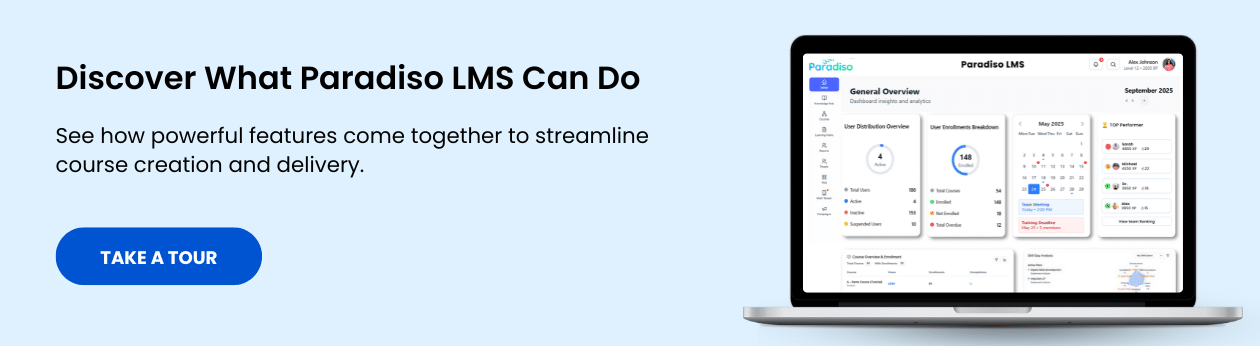
As customer bases grow, scattered content and manual processes become difficult to manage. A learning management system like Paradiso LMS centralizes customer education and provides the infrastructure to scale delivery consistently.
- Structured role-based and lifecycle-based learning paths
- Support for videos, SCORM courses, PDFs, quizzes, and simulations
- Automated enrollments, reminders, and certifications
- Integrations with CRM, analytics, and support tools
- Detailed reporting on engagement and learning impact
This foundation enables organizations to replicate best-practice education across hundreds or thousands of customers without losing quality.
10. Close the Loop with Feedback and Success Stories
A mature customer education strategy continuously listens and showcases impact. Collect feedback on courses and channels to identify friction, improve relevance, and uncover new opportunities.
Capturing success stories—such as faster onboarding, higher adoption, or improved ROI—helps demonstrate the value of education and encourages deeper customer engagement.
Conclusion: Turn Customer Education into a Strategic Advantage
A thoughtful customer education strategy is no longer optional—it is a core driver of engagement, loyalty, and growth. When aligned with business outcomes, focused on customer value, and delivered through a scalable LMS for customer training, education becomes a strategic asset.
Platforms like Paradiso LMS make it possible to deliver education at scale, transforming scattered resources into a cohesive, measurable engine for customer success. Organizations that treat customer education as a strategic advantage gain higher satisfaction, stronger advocacy, and a durable competitive edge.