





Quick Answer
What is adult learning theory?
Adult learning theory is the body of research and frameworks that explains how adults acquire, process, and retain new knowledge and skills differently from children. Unlike children who are dependent learners accepting content from teachers, adults are self-directed, bring existing life experience to new learning situations, are motivated primarily by immediate relevance to real problems they need to solve, and need to understand why something is worth learning before they engage with it. The most widely applied adult learning theories in corporate L&D are Malcolm Knowles’ Andragogy (6 principles of how adults learn), David Kolb’s Experiential Learning Theory (learning through experience and reflection), and Self-Directed Learning Theory (learners taking initiative in their own development). Together, these frameworks explain why training designed using classroom teaching methods produces poor outcomes in adult learners – and what approaches produce better ones.
- Most cited theory: Andragogy (Malcolm Knowles, 1968) – 6 principles of adult learning
- Core distinction from child learning: Adults are self-directed, experience-based, and problem-centered learners
- L&D application: Design training around real problems and immediate relevance, not subject coverage
What Is Adult Learning Theory?
Adult learning theory is a collection of frameworks and research findings that describe how adults learn most effectively. The central insight across all adult learning theories is that adults are not simply older versions of child learners they are fundamentally different in their motivation, their relationship to prior experience, their orientation toward new content, and their expectations about control over their own learning process.
The field emerged formally in the mid-20th century, primarily driven by the work of Malcolm Knowles, who challenged the assumption that the pedagogical methods used in K-12 education were appropriate for adult learners. Knowles’ 1968 work introduced the term andragogy to describe a distinct approach to facilitating adult learning – one built around the learner’s autonomy, experience, and need for immediate relevance rather than around a teacher’s curriculum and schedule.
Adult learning theory is not a single, unified model. It is an umbrella term covering multiple theoretical frameworks, each offering a different lens on why and how adults learn. For L&D practitioners, understanding these frameworks is foundational to designing training that produces behavior change rather than completion certificates.
Why Adult Learning Theory Matters in Corporate Training
The gap between what corporate training typically delivers and what adult learners actually need is explained almost entirely by adult learning theory. Most corporate training particularly compliance and mandatory annual training – violates the core principles of adult learning at nearly every design decision:
- Mandatory modules with no explanation of why the content matters for this specific learner → violates the “need to know why” principle
- Linear content covering a topic comprehensively before showing its relevance → violates the “problem orientation” principle
- Identical training delivered to all employees regardless of experience level → violates the “experience” principle
- External compliance mandates as the only motivation → violates the “internal motivation” principle
- No learner control over pace, sequence, or content selection → violates the “self-direction” principle
The result is the completion-retention gap that every L&D team knows: high completion rates, low knowledge retention, minimal behavior change, and no measurable business impact. Adult learning theory explains the mechanism behind this gap and provides the design principles to close it.
The 6 Major Adult Learning Theories
Six major theories form the foundational framework of adult learning in corporate L&D contexts:
| Theory | Theorist & Year | Core Idea | Key L&D Application |
|---|---|---|---|
| Andragogy | Malcolm Knowles, 1968 | Adults have 6 characteristics that distinguish them from child learners: self-direction, rich experience, readiness tied to real need, problem-centered orientation, need to know why, and internal motivation | Design training around problems, not topics. Explain relevance before content. Give learners some control over their experience. |
| Experiential Learning Theory | David Kolb, 1984 | Learning is a four-stage cycle: Concrete Experience → Reflective Observation → Abstract Conceptualization → Active Experimentation. Adults learn most deeply from experience, not from information transfer. | Use scenarios, simulations, and role-play. Build in reflection phases. Connect new learning to the learner’s existing experience. |
| Self-Directed Learning | Philip Candy, 1991 | Adults who take personal initiative in diagnosing their own learning needs and managing their own development learn more effectively than those who are passive recipients of instruction. | Provide access to learning resources, let learners choose paths, support performance support tools and on-demand learning libraries. |
| Transformative Learning Theory | Jack Mezirow, 1991 | Deep adult learning occurs when a disorienting experience challenges existing assumptions and triggers critical reflection, transforming the learner’s frame of reference. | Use case studies and perspective-taking scenarios that challenge existing mental models. Support reflection through discussion and journaling. |
| Communities of Practice | Lave & Wenger, 1991 | Adults learn most naturally through participation in communities of shared practice – doing real work alongside experienced practitioners, not from formal instruction. | Peer learning programs, mentoring, on-the-job learning structures, social learning platforms, community of practice forums. |
| Cognitive Load Theory | John Sweller, 1988 | Working memory is limited. Learning design must manage cognitive load – the mental effort required to process new information – to prevent overload and support long-term memory formation. | Chunk content into small focused units. Remove redundant or competing information. Sequence from simple to complex. Use worked examples. |
Knowles’ Adult Learning Theory (Andragogy): The 6 Principles in Depth
Malcolm Knowles’ andragogy framework – the most widely cited adult learning theory in corporate L&D – identifies six core assumptions about adult learners. Each has direct design implications for training programs:
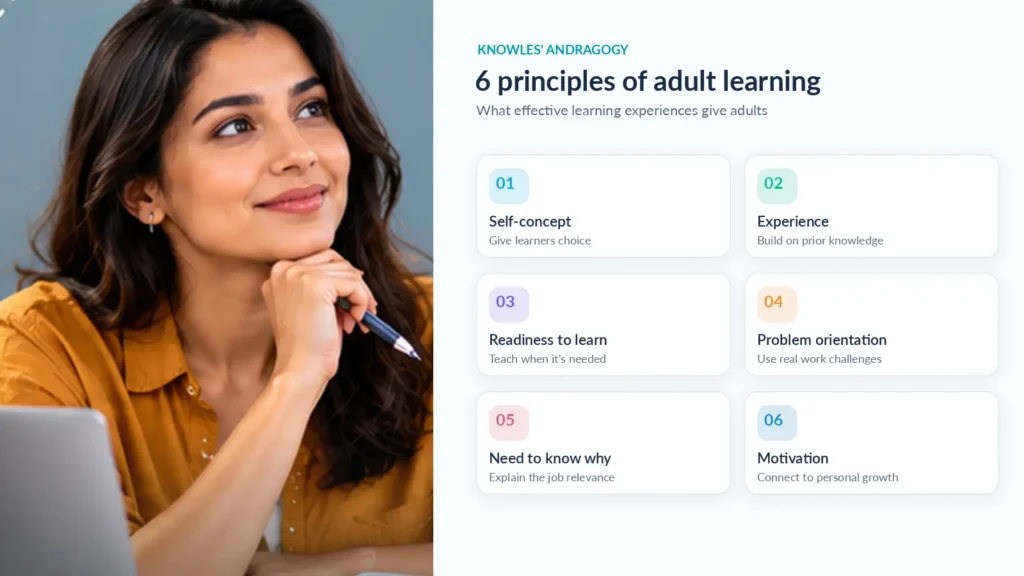
1. Self-Concept – Adults Are Self-Directed
Adult learners have an established sense of self and resist being treated as passive recipients of instruction. They want agency in their own learning – control over what they focus on, at what pace, and in what format. Effective corporate training respects this by providing meaningful choices within a structured program rather than rigid mandatory linear pathways.
Design implication: Offer learner-paced delivery, optional advanced content, pre-assessments that let learners skip content they already know, and non-linear navigation where appropriate to the content.
2. Experience – Adults Bring Rich Prior Experience
Adult learners arrive with significant accumulated knowledge, skills, and experiences that shape how they interpret new information. New learning is filtered through this existing framework – training that ignores what learners already know wastes their time and creates disengagement. Training that contradicts their experience without acknowledging it creates resistance.
Design implication: Use scenarios and examples drawn from learners’ actual work contexts. Surface prior knowledge through pre-assessments or reflection prompts before introducing new content. Acknowledge when new information challenges existing practice and explain why.
3. Readiness to Learn – Adults Learn What They Need Now
Adult readiness to learn is triggered by the need to apply knowledge to a real-life situation they are currently facing a new responsibility, a process change, an upcoming performance challenge. Adults are far less motivated to learn content that might be useful someday than content that helps them solve a problem they are dealing with right now.
Design implication: Time training to land close to when learners will use the knowledge. Microlearning modules, just-in-time performance support, and job aids reach adult learners at the moment of need the most effective delivery timing for adult readiness. AI-powered eLearning authoring tools make it possible to produce focused microlearning modules quickly so content reaches learners close to when they need it rather than months after the training need was identified.
4. Problem Orientation – Adults Are Problem-Centered
Adults organize their learning around problems to solve and decisions to make, not around subjects to master. A training module covering “everything about GDPR” engages adult learners less effectively than one organized around “what you do when a data incident occurs.” The content may be identical; the organization determines whether the learner connects it to their real situation.
Design implication: Structure all training around the problems, decisions, and situations the learner actually faces. Lead with the scenario or challenge, then provide the knowledge needed to address it – not the reverse.
5. Need to Know Why – Adults Require Relevance Before Engagement
Before investing attention in new content, adult learners need to understand why it is worth their time – specifically, what they will be able to do differently after learning it and why that matters for their work or their career. Adult learners who open a training module without understanding its relevance disengage within minutes and retain very little.
Design implication: Open every course, module, and session with an honest answer to “why does this matter for you?” – framed around the performance outcome, not a list of learning objectives. A 60-second video introduction from a manager or business leader explaining the real-world impact of the training significantly increases engagement compared to compliance framing alone.
6. Motivation – Adults Are Internally Motivated
While adults can be motivated externally by certifications, compliance requirements, or career advancement, the most durable motivation for adult learners is internal – the desire to become more competent, solve problems that matter, and contribute meaningfully to their work. Training that relies entirely on external motivation (complete this or face consequences) produces compliance without learning.
Design implication: Connect training to the learner’s career development and competence growth where possible. Even mandatory compliance training can be framed around professional competence and role effectiveness rather than checkbox completion.
Kolb’s Experiential Learning Theory – The Four-Stage Cycle
David Kolb’s 1984 experiential learning theory provides the mechanism that explains how adults actually process and retain new knowledge. Kolb proposed that learning is not simply the transfer of information but a four-stage cycle that requires both experience and reflection to complete:

Stage 1 – Concrete Experience: The learner has a new experience or revisits an existing one. In corporate training, this is the scenario, simulation, role-play, or on-the-job experience that forms the starting point for learning.
Stage 2 – Reflective Observation: The learner steps back and reviews the experience – what happened, what worked, what did not, what was unexpected. Reflection is the phase most consistently eliminated in time-pressured corporate training, and its elimination is the primary reason much training does not transfer to on-the-job behavior.
Stage 3 – Abstract Conceptualization: The learner draws conclusions from the experience and builds a generalized understanding – a mental model or principle that applies beyond the specific situation encountered. This is where the “learning” in the traditional sense occurs.
Stage 4 – Active Experimentation: The learner applies the new understanding to a new situation, which creates a new concrete experience and begins the cycle again.
Kolb’s framework explains why scenario-based learning and deliberate practice produce better retention than lecture-based instruction. A well-designed branching scenario activates all four stages: the learner makes a decision (Concrete Experience), sees the consequence and reflects on what they would do differently (Reflective Observation), develops a principle from the feedback (Abstract Conceptualization), and applies it in the next scenario (Active Experimentation).
Self-Directed Learning Theory
Self-directed learning theory builds on Knowles’ self-direction principle to describe a learning process where the learner takes complete initiative in diagnosing their learning needs, identifying resources, implementing learning strategies, and evaluating outcomes – without depending on an instructor or formal program to structure the experience for them.
Philip Candy’s 1991 work identified four dimensions of self-directedness: personal autonomy (the disposition to think and act independently), self-management in learning (taking control of the organizational aspects of learning), independent pursuit of learning (learning outside formal institutional settings), and learner control of instruction (control within formally provided instruction).
In corporate L&D, self-directed learning manifests most visibly in the design of learning libraries, learning experience platforms (LXPs), and performance support tools. Rather than assigning all learners the same mandatory content, self-directed L&D designs give employees access to a curated library of resources and the skills to identify and address their own gaps. A modern LMS with AI-powered recommendations supports this – surfacing relevant content based on the learner’s role, skill gaps, and learning history without requiring manual assignment for every module. The 70-20-10 learning model, which allocates 70% of development to on-the-job experience, 20% to social and peer learning, and 10% to formal training, reflects a self-directed learning philosophy applied to organizational development strategy.
Cognitive Load Theory and Adult Learning
John Sweller’s Cognitive Load Theory (1988) is not strictly an “adult learning” theory – it applies to all learners – but it is essential context for understanding why adult learning experiences designed without attention to cognitive capacity consistently fail to produce retention.
Sweller’s theory proposes that working memory – the mental space where active processing happens – has a limited capacity. When learning design demands more from working memory than it can handle simultaneously (cognitive overload), information fails to transfer to long-term memory. No retention occurs regardless of how good the content is.
Three types of cognitive load affect learning design:
- Intrinsic load: The inherent complexity of the content itself – some topics are genuinely more cognitively demanding than others. Instructional designers cannot reduce intrinsic load but can sequence content to build complexity gradually.
- Extraneous load: Cognitive demand created by poor design – confusing navigation, redundant information that repeats what narration already says, competing visual elements, or irrelevant content. This load is entirely within the designer’s control to eliminate.
- Germane load: Cognitive effort directed toward building new knowledge structures and understanding. This is the productive load that results in learning. Good design minimizes extraneous load to maximize the cognitive capacity available for germane load.
For L&D practitioners, cognitive load theory provides the scientific rationale for chunking content into small focused units, removing redundant text from slides with narration, sequencing from simple to complex, and using worked examples to reduce the effort required to understand a new concept before practicing it.
How to Apply Adult Learning Theory in Corporate Training
Adult learning theory is most useful when it translates from frameworks into practical design choices. Here is how each major theory maps to specific decisions L&D teams make when building corporate training programs:
Onboarding Design
Applying andragogy to onboarding means answering “why does this matter for your role?” for every module before content begins, sequencing content to arrive just before the new hire needs it on the job (readiness principle), using job-specific scenarios drawn from the actual work the new hire will be doing (experience + problem orientation), and providing a self-directed learning library for deeper exploration alongside the mandatory core program (self-direction principle). An LMS that automatically assigns onboarding modules based on a new hire’s start date and role supports the readiness principle directly – content arrives when the learner is ready to use it on the job.
Compliance Training
Compliance training most frequently violates adult learning principles – mandatory, externally motivated, topic-organized, with no learner control. Applying adult learning theory: open the course with a realistic incident scenario that shows the consequence of the behavior the training aims to prevent (need to know why), organize content around the decisions employees will face rather than the regulation that governs them (problem orientation), and use branching scenarios that let employees experience the consequence of wrong decisions in a safe context (experiential learning cycle). Building and updating these compliance modules as regulations change is significantly faster with an eLearning authoring tool that generates SCORM-ready content from a source document and exports directly to your LMS.
Leadership Development
Leadership development is where transformative learning theory and communities of practice apply most directly. Effective leadership programs challenge participants’ existing mental models about their role and relationships – the disorienting dilemma Mezirow describes. Peer cohort groups, 360-degree feedback, and action learning projects (doing real work while reflecting on leadership behavior) activate the communities of practice model. Knowledge delivery alone has minimal impact on leadership behavior.
Skills Training
Applying Kolb’s cycle to skills training means building in deliberate practice that activates all four stages: a realistic scenario (concrete experience), immediate structured feedback (reflective observation), an explicit principle drawn from the feedback (abstract conceptualization), and a new scenario to apply the principle (active experimentation). Skills that require practice – sales conversations, difficult feedback discussions, software workflows – require iteration through the full cycle multiple times to reach proficiency.
Frequently Asked Questions
What is adult learning theory?
Adult learning theory is the body of research and frameworks that explains how adults acquire, process, and retain new knowledge and skills. The central finding across all adult learning theories is that adults learn differently from children – they are self-directed, bring rich prior experience to new learning situations, are motivated primarily by immediate relevance to problems they need to solve, and need to understand why something is worth learning before they engage with it. The most widely cited adult learning theories in corporate L&D are Malcolm Knowles’ Andragogy, David Kolb’s Experiential Learning Theory, Self-Directed Learning Theory, Transformative Learning Theory, Communities of Practice, and Cognitive Load Theory.
What are the main types of adult learning theory?
The six major adult learning theories applied in corporate L&D are: (1) Andragogy (Malcolm Knowles) – six principles of how adults learn, including self-direction, experience, problem orientation, and internal motivation; (2) Experiential Learning Theory (David Kolb) – learning occurs through a four-stage cycle of experience, reflection, conceptualization, and experimentation; (3) Self-Directed Learning (Philip Candy) – learners who take initiative in their own development learn more effectively; (4) Transformative Learning Theory (Jack Mezirow) – deep learning occurs when disorienting experiences challenge existing assumptions; (5) Communities of Practice (Lave and Wenger) – adults learn most naturally through participation in communities of shared real-world practice; (6) Cognitive Load Theory (John Sweller) – learning design must manage working memory limits to prevent cognitive overload.
What is Knowles’ adult learning theory?
Knowles’ adult learning theory – formally called andragogy – is a framework built on six assumptions about adult learners: adults are self-directed learners who want agency over their own development; they bring rich life and work experience that forms the foundation for new learning; their readiness to learn is tied to the need to perform a specific real-life task; they are problem-centered rather than subject-centered; they need to understand why something is worth learning before they engage; and they are primarily internally motivated by competence growth and self-worth. Originally published in 1968 and refined through several editions of Knowles’ work, these six principles remain the most frequently cited framework for corporate training design.
What are the 6 principles of adult learning?
The six principles of adult learning from Malcolm Knowles’ andragogy framework are: (1) Self-concept — adults are self-directed and want control over their learning; (2) Experience – adults bring rich prior experience that shapes how they process new information; (3) Readiness to learn – adults are motivated to learn content that addresses an immediate real-life need; (4) Problem orientation – adults are problem-centered, not subject-centered, and learn best through solving realistic problems; (5) Need to know why – adults require an understanding of why content is relevant before they invest attention in it; (6) Motivation adults are primarily internally motivated by competence, career growth, and meaningful contribution.
What is Kolb’s experiential learning theory?
Kolb’s experiential learning theory, developed in 1984, proposes that learning occurs through a four-stage cycle: Concrete Experience (having a new experience), Reflective Observation (reviewing and reflecting on that experience), Abstract Conceptualization (drawing conclusions and forming new understanding from the reflection), and Active Experimentation (applying the new understanding in a new situation). The theory explains why hands-on, scenario-based, and practice-based learning produces stronger retention than passive information consumption in adult learners. In corporate training, it provides the mechanism for understanding why role-play, case studies, and simulation produce better behavior transfer than lecture-based instruction.
How does adult learning theory apply to eLearning design?
Adult learning theory applies to eLearning design through specific design decisions at each stage of course development. Andragogy’s “need to know why” principle drives opening every module with a clear explanation of the performance outcome not just a list of objectives. The “problem orientation” principle drives scenario-based design over topic-coverage organization. The “experience” principle drives using learner-specific work contexts in examples and scenarios. Kolb’s experiential learning cycle drives building in reflection, feedback, and multiple practice opportunities. Cognitive load theory drives chunking content, removing redundant elements, and sequencing from simple to complex. Together, these principles explain most of what distinguishes high-impact eLearning design from content delivery masquerading as training.
What is self-directed learning?
Self-directed learning is a process in which the learner takes the initiative with or without help in diagnosing their learning needs, setting goals, identifying resources, implementing learning strategies, and evaluating outcomes. In corporate L&D, self-directed learning is supported by learning libraries, learning experience platforms, performance support tools, and on-demand content that allow learners to address specific gaps at the moment of need. The 70-20-10 model which frames 70% of development as on-the-job experience, 20% as social learning, and 10% as formal training reflects a self-directed philosophy applied to organizational development strategy.
What is transformative learning theory?
Transformative learning theory, developed by Jack Mezirow in 1991, proposes that the most significant adult learning occurs when a “disorienting dilemma” an experience that does not fit the learner’s existing frame of reference triggers critical self-reflection and ultimately transforms the learner’s worldview or perspective. Unlike andragogy, which focuses on optimizing the conditions for adult learning, transformative learning focuses on how deep perspective change occurs. In corporate L&D, it applies most directly to leadership development, diversity and inclusion programs, and culture change initiatives where the goal is a fundamental shift in how learners see a situation not just acquisition of a new skill or knowledge item.
Conclusion
Adult learning theory is the explanatory framework behind every effective corporate training design decision. It explains why some training changes behavior and other training simply gets completed. It explains why compliance modules with high completion rates produce no measurable change in compliance incidents. And it provides specific, actionable principles that translate directly into design choices: lead with relevance, organize around problems, activate prior experience, build in practice and reflection, manage cognitive load, and connect to internal motivation.
For L&D practitioners, the most practical starting point is Knowles’ six principles they cover the most common design failures in corporate training and provide the clearest design guidance. Kolb’s cycle adds the mechanism for understanding how practice and reflection produce retention. Cognitive load theory adds the capacity constraint that determines how much learning is possible in a given session. Applied together, these frameworks produce training that adult learners engage with, retain, and apply.
Related resources:
- What Is Instructional Design? – applying adult learning theory through the ADDIE framework
- What Is the ADDIE Model? – the instructional design process built on adult learning principles
- eLearning Course Design Best Practices – translating adult learning theory into eLearning decisions
- What Is Microlearning? – short-form learning designed around adult attention and relevance principles
- What Is Blended Learning? – combining formats to address different adult learning principles