





Quick Answer
What is the 70-20-10 learning model?
The 70-20-10 learning model is an L&D framework that describes where employee development actually comes from: 70% from on-the-job experience challenging assignments, real work, and stretch responsibilities; 20% from social learning coaching, mentoring, feedback, and peer observation; and 10% from formal structured training courses, workshops, and certifications. Developed from research by Morgan McCall, Michael Lombardo, and Robert Eichinger at the Center for Creative Leadership in the 1980s, it is used as a strategic planning lens for L&D investment not as a precise formula to apply literally.
- 70% – Experience: Challenging projects, stretch assignments, new responsibilities
- 20% – Social: Coaching, mentoring, feedback, peer observation
- 10% – Formal: Courses, workshops, eLearning, certifications
The 70-20-10 Learning Model Explained
The 70-20-10 learning model makes a claim that surprises most organizations when they first encounter it: the formal training programs that L&D teams spend most of their time and budget building represent only about 10% of how employees actually develop.
The remaining 90% happens through work itself – the challenging projects that push people into unfamiliar territory (70%) and the relationships, feedback, and conversations that surround those experiences (20%). These two channels are where most real capability development occurs. They are also the channels that most L&D functions have the least direct control over, which partly explains why they receive the least investment.
The model is not an argument against formal training. It is an argument for designing learning architectures that intentionally support all three channels – and for L&D teams to expand their remit beyond course production into the experience design and coaching capability investment that drives the larger portion of development impact.
Origins – Who Created the 70-20-10 Model?
The 70-20-10 model came from research conducted at the Center for Creative Leadership (CCL) in the late 1980s. Morgan McCall, Michael Lombardo, and Robert Eichinger studied how senior executives had developed their leadership capabilities across their careers. They asked a large sample to look back and estimate what proportion of their development came from three sources: challenging job experiences, significant people in their career, and formal coursework.
The aggregated self-reports produced figures roughly in line with 70-20-10. The framework was published in Eichinger and Lombardo’s 1996 book The Career Architect Development Planner and gained broad corporate L&D adoption through the early 2000s. It is now one of the most cited frameworks in organizational learning strategy globally.
Breaking Down 70 20 10 model for learning and development
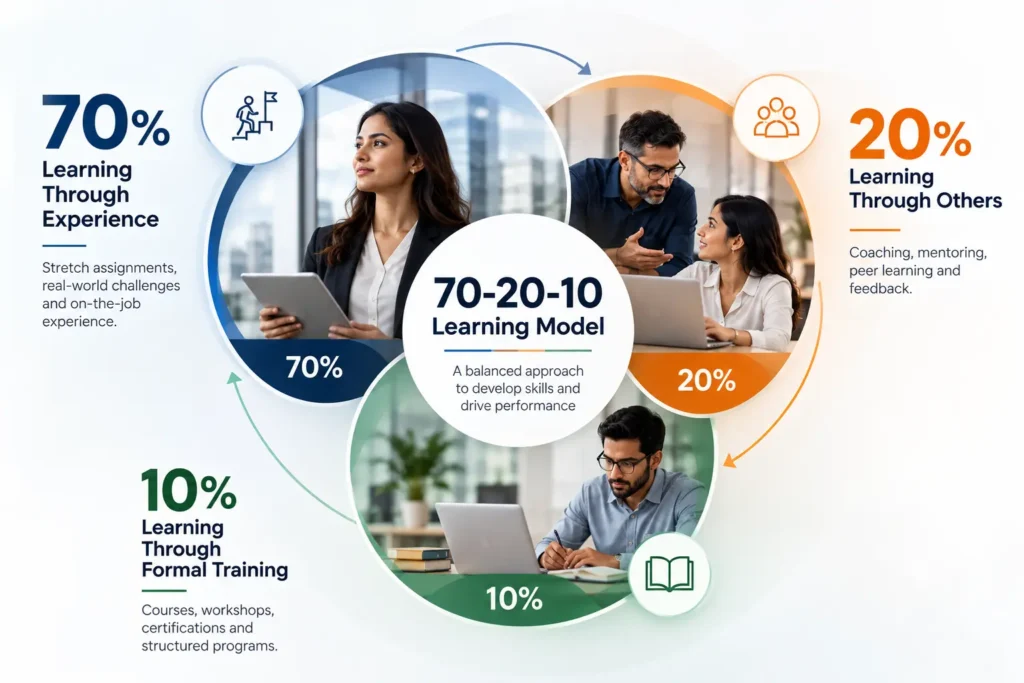
The 70% – Learning Through Experience
The largest development channel is challenging on-the-job experience. Not routine work that maintains existing skills but rarely builds new ones. The development value is in the stretch: assignments that sit at the edge of a person’s current capability, where the demands of the situation require them to figure out new approaches, make consequential decisions, and adapt to unfamiliar complexity.
What qualifies as developmental experience in the 70% category: stretch project assignments with real accountability, leading a cross-functional team for the first time, managing through a significant business challenge, job rotations into unfamiliar functions, increased scope or complexity of existing responsibilities, and action learning projects that address real organizational problems with observable outcomes.
The implication for organizations is significant. If 70% of development comes from work experience, then talent management decisions – who receives stretch assignments, how managers structure challenging work, whether the organization creates visible opportunities for growth through doing have more development impact than any training program. L&D teams that only build courses miss the largest development lever available to them.
The 20% – Learning Through Others
Even the most challenging assignment produces limited development without the feedback, coaching, and reflection that helps the person make sense of what they experienced and extract transferable lessons from it. The 20% channel is the relational infrastructure that surrounds experience and converts it into capability growth.
This channel includes: manager coaching conversations, mentoring relationships with senior colleagues, peer feedback, 360-degree feedback processes, observation of how experienced colleagues handle similar challenges, communities of practice, and team-based knowledge sharing.
The quality of this channel is almost entirely determined by manager capability and organizational culture. A manager who provides specific, developmental feedback after a stretch assignment accelerates the employee’s development measurably. A manager who only completes annual performance reviews provides almost none. Investing in manager coaching skills is frequently the highest-leverage L&D action available because it multiplies the value of every stretch experience across the entire team.
The 10% – Learning Through Formal Training
Formal training eLearning courses, classroom workshops, certifications, structured programs is the channel most L&D functions know best and invest most heavily in. The 70-20-10 model does not argue that formal training is unimportant. It argues that formal training is most effective when it connects to and is supported by the other two channels.
A leadership program that runs as a standalone event produces limited behavior change when participants return to an environment with no stretch assignments and no manager reinforcing the new skills. The same program, followed by a stretch assignment that requires applying what was learned and a coaching conversation about how it went, produces substantially better transfer. Formal training works best as an accelerator for experience, not a substitute for it.
70-20-10 Examples by Development Area
| Role / Goal | 70% Experience | 20% Social | 10% Formal |
|---|---|---|---|
| New Manager | Lead a real project team through a business challenge with full accountability | Senior manager mentor, monthly coaching sessions, peer manager group | Management foundations program, difficult conversations workshop |
| Sales Rep | Live calls with real customers, losing and winning deals, larger account responsibility | Call reviews with manager, ride-alongs with top performers, deal debrief sessions | Product knowledge eLearning, sales methodology certification |
| New Hire Onboarding | Real work from week 2, escalating responsibility across the first 90 days | Buddy assignment, weekly manager check-ins, team introductions | Company policy modules, role-specific skills training, systems orientation |
| Technical Expert | Lead a high-complexity technical project, solve novel problems, cross-functional exposure | Senior engineer mentoring, code/work reviews, communities of practice | Technical certification, structured learning path, skills course |
| Compliance Role | Handle real compliance scenarios and edge cases on the job | Team compliance check-ins, peer consultation on ambiguous cases, manager reinforcement | Annual compliance eLearning, regulatory update training |
Does the 70-20-10 Model Work? The Evidence
The 70-20-10 learning model is more widely cited than it is rigorously evidenced. Understanding the strength and limits of its evidence base matters for L&D teams deciding how much weight to give it.
The original data came from retrospective self-reports by successful senior executives not from controlled studies measuring learning outcomes. Executives were asked to look back and estimate the sources of their development. Several methodological issues follow from this:
- Recall bias: Memorable, dramatic experiences (a challenging project, a formative mentor) are more salient in memory than routine training events, which may inflate the perceived contribution of the 70% and 20% channels.
- Survivorship bias: The sample was senior executives who had succeeded. People who had significant experiential learning and did not develop effectively are not in the sample.
- Self-report limitations: People are not accurate observers of their own learning processes attribution of development to specific sources is genuinely difficult.
The ATD has published directly on this: “70-20-10: Where Is the Evidence?” questions whether the model should be applied as a prescriptive formula. CIPD has echoed similar concerns in its guidance on workplace learning.
The balanced position: The 70-20-10 model is most useful as a strategic philosophy and conversation starter, not as a precise formula. The underlying argument that organizations over-invest in formal training relative to the other channels that drive most real development is consistent with adult learning research, even if the exact percentages are not empirically validated. Use the framework to challenge assumptions about L&D investment allocation, not to calculate exactly how many hours should go to each channel.
How to Apply the 70-20-10 Framework in Your L&D Strategy
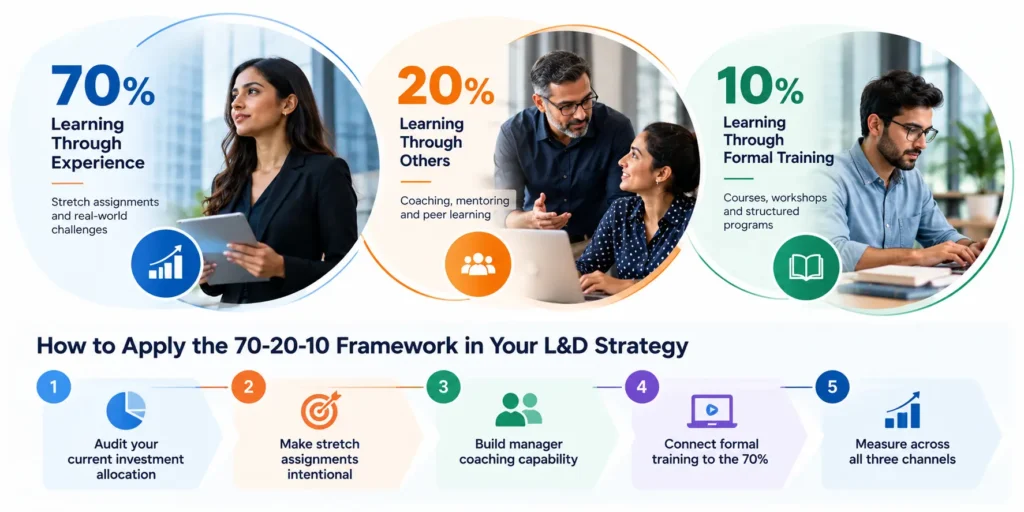
1. Audit your current investment allocation
Map where your L&D budget and team time currently goes across the three channels. Most organizations find their actual investment ratio is inverted closer to 70% formal training, 20% social, 10% experience design. The audit makes the gap visible and provides the basis for a strategic conversation with business leadership about rebalancing.
2. Make stretch assignments intentional
The 70% channel produces development only when challenging experiences are deliberately structured into employees’ work. Work with managers and talent management to identify available stretch assignments, ensure they are allocated for development purposes (not just operational needs), and that employees understand the development expectations of each assignment before they begin.
3. Build manager coaching capability
The 20% channel depends almost entirely on manager behavior. A manager who provides specific, developmental feedback after challenging assignments multiplies the impact of every stretch experience on their team. Invest in manager coaching skills particularly the ability to conduct development-focused conversations, give meaningful feedback, and act as an active sponsor of team members’ growth.
4. Connect formal training to the 70%
Redesign formal training programs so they connect explicitly to on-the-job application rather than operating as standalone events. Pre-work that surfaces a current stretch challenge the participant is facing, workshop content that provides frameworks for that challenge, and post-program application with manager coaching support produces significantly better transfer than the same content delivered without this architecture.
5. Measure across all three channels
Extend evaluation beyond completion rates and assessment scores. Track stretch assignment availability and allocation, manager coaching quality (through 360 data or direct observation), and the performance outcomes that result from the full learning architecture not just the formal training component.
Free · SCORM Export · No Credit Card
Build the formal 10% faster with AI
Paradiso Authoring Tool generates SCORM-ready eLearning courses from a prompt or uploaded document in minutes – so your team spends less time building the 10% and more time designing the 70%.
Frequently Asked Questions
What is the 70-20-10 learning model?
The 70-20-10 learning model is an L&D framework proposing that employee development comes from three sources: 70% from on-the-job experience (challenging assignments, real work), 20% from social learning (coaching, mentoring, peer feedback), and 10% from formal structured training (courses, workshops, certifications). Developed from research at the Center for Creative Leadership by Morgan McCall, Michael Lombardo, and Robert Eichinger, it is used as a strategic lens for L&D investment allocation rather than a precise mathematical formula.
Who created the 70-20-10 model?
The 70-20-10 model was developed from research by Morgan McCall, Michael Lombardo, and Robert Eichinger at the Center for Creative Leadership (CCL) in the late 1980s. It was first widely published in Eichinger and Lombardo’s 1996 book The Career Architect Development Planner and subsequently adopted widely in corporate L&D practice through the early 2000s.
What is the 70-20-10 rule?
The 70-20-10 rule is another name for the 70-20-10 learning model the framework that attributes employee development to three sources: 70% experiential (on-the-job), 20% social (people), and 10% formal (training). The word “rule” is sometimes used to suggest it is a prescription for how L&D investment should be allocated, though the model’s researchers did not intend the numbers as a formula they are descriptive of how development was reported to occur, not prescriptive of how organizations must structure it.
What are examples of the 70-20-10 model in practice?
A practical 70-20-10 learning model example in sales enablement: a new sales rep is assigned to lead a real customer account independently (70%), paired with a senior rep for weekly call reviews and feedback (20%), and enrolled in a product knowledge eLearning module and sales methodology certification (10%). In leadership development: a manager leads their first cross-functional project with full accountability (70%), meets monthly with an executive mentor and receives 360-degree feedback (20%), and attends a management skills workshop and difficult conversations training (10%).
Is the 70-20-10 model evidence-based?
The model’s evidence base is weaker than its adoption suggests. The original data was based on retrospective self-reports from successful senior executives not controlled outcome studies. The precise 70/20/10 ratios are not empirically validated as optimal development allocations. CIPD and ATD have both questioned the strength of the evidence behind the specific percentages. The model is more defensible as a strategic philosophy challenging over-investment in formal training than as a formula to apply precisely.
How do you apply the 70-20-10 framework in L&D?
Applying the 70-20-10 framework in L&D means intentionally designing all three learning channels rather than only building formal training programs. Practically: work with business leaders to structure stretch assignments as deliberate development investments (70%); invest in manager coaching skills and mentoring programs to strengthen the social learning channel (20%); and redesign formal training to connect to on-the-job application rather than operating as standalone events (10%). Extend evaluation metrics beyond training completion to include stretch assignment allocation, coaching quality, and performance outcomes.
Conclusion
The 70-20-10 learning model’s enduring value lies in the question it asks, not the numbers it proposes: if most development comes from experience and the relationships that surround it, what is your L&D function doing about the 90% that happens outside the classroom? The precise percentages are contested. The underlying challenge to L&D investment strategy is not.
Used as a conversation starter with business leadership “we’re over-indexed on formal training relative to where development actually happens” the 70-20-10 framework consistently produces more productive L&D investment discussions than any other single model in the field.
Related resources:
- What Is the ADDIE Model? – process framework for designing the formal 10%
- What Is Blended Learning? – connecting formal and experiential learning in practice
- Adult Learning Theory – the learning science behind the 70-20-10 model
- What Is Learning and Development? – where the 70-20-10 framework fits in L&D strategy
- Training Needs Assessment – diagnosing which channel to invest in before building