Instructional Designer - eLearning Developer · Paradiso Solutions Blog
Summarise this page with
Quick Answer: What Can Organizations Learn From AT&T’s Reskilling Strategy?
AT&T’s reskilling strategy shows how organizations can prepare employees for future technology changes by investing in continuous learning, skills development, and internal mobility. The company focused on identifying future skill requirements, creating targeted learning paths, and helping employees transition into emerging roles in areas such as cloud computing, cybersecurity, software, and advanced networking.
Modern organizations can apply the same approach by using skills assessments, personalized learning paths, and digital learning platforms to identify skill gaps, deliver relevant training, and measure workforce progress. A structured employee reskilling strategy helps businesses retain talent, improve agility, and build a workforce ready for changing business needs.
Introduction
When AT&T discovered nearly 100,000 of its 250,000 employees lacked the skills needed for a digital-first future, it didn’t resort to mass layoffs. Instead, it invested $1 billion in reskilling—retrained 180,000+ workers, cut long-term talent costs, and built one of the most studied workforce transformation programs in corporate history. This blog breaks down exactly how they did it, why it worked, and how a modern LMS gives any organization the infrastructure to replicate this success.
Key Takeaways
AT&T identified a structural skills gap affecting nearly 100,000 roles—and chose reskilling over replacement, saving more than the $1B investment in avoided rehiring costs.
The World Economic Forum projects that 6 in 10 workers globally will need retraining by 2027, making large-scale reskilling an urgent priority, not a long-term option.
Replacing a single mid-level employee costs 21% of their annual salary—reskilling existing talent is almost always the more cost-efficient path.
AT&T’s program succeeded because it mapped learning directly to future business roles—not generic training—a methodology modern LMS platforms are built to replicate.
Organizations using digital learning platforms reduce employee time-to-proficiency by up to 50%, according to case studies from structured reskilling deployments.
The Crisis No One Saw Coming—Until It Was Almost Too Late
A decade ago, AT&T ran one of the largest and most complex workforces in the world. Then leadership looked at the numbers—and what they saw was alarming.
Nearly half of their 250,000 employees lacked the skills required to keep the company competitive in an increasingly software-defined, cloud-first, AI-enabled world. Worse, an estimated 100,000 hardware-focused jobs were set to become obsolete within ten years. Cloud computing, automation, advanced networking, and data analytics were reshaping the entire telecom industry from the ground up.
AT&T faced a binary choice: shed tens of thousands of workers and recruit new talent at enormous cost and disruption—or retrain the workforce they already had.
They chose to retrain. And what followed became one of the most referenced workforce transformation case studies in modern business.
What Exactly Is the AT&T Employee Reskilling Strategy?
AT&T’s employee reskilling strategy is a $1 billion, multi-year initiative called “Future Ready”—designed to systematically retrain existing employees for emerging roles in software, cloud infrastructure, cybersecurity, data science, and advanced networking, rather than replacing them with external hires.
Launched in partnership with Coursera, Udacity, and leading universities, the program offered online courses, nanodegrees, and an internal career center where employees could identify which skills the company needed next—and chart a personal path to get there.
It was not a one-size-fits-all training catalogue. It was a strategic alignment between business roadmap and workforce capability—built role by role, skill by skill.
The Scale of the Problem: Why AT&T Had No Choice But to Act
To understand why the AT&T employee reskilling strategy was so necessary, you have to understand the scale of the disruption it was responding to.
The Four Forces Driving Workforce Obsolescence
Cloud migration was eliminating entire categories of hardware infrastructure roles that had existed for decades.
AI and automation were absorbing routine operational tasks, reducing demand for traditional field service and support functions.
Data-driven decision-making meant every business unit now needed analytical capability—not just the IT department.
Next-generation networking (fiber, 5G) demanded new technical and engineering competencies that simply didn’t exist inside the company at sufficient scale.
These weren’t temporary pressures. They were structural shifts with no reversal.
Reskilling vs. Rehiring: The $1 Billion Business Case
AT&T’s leadership ran the numbers. The results made the decision obvious.
The True Cost of Mass Rehiring
Replacing an employee costs, on average, 21% of their annual salary. For a workforce of 100,000 people earning median enterprise salaries, the replacement math runs well into the billions—before you account for:
Knowledge loss: decades of institutional understanding that new hires can’t replicate for at least 12–18 months
Cultural disruption: the erosion of team trust, morale, and collaboration during mass turnover
Productivity gaps: the months between a departure and a replacement reaching full effectiveness
Recruitment premium: the market rate for already-scarce software engineers and data scientists
Why Reskilling Won the Argument
AT&T’s reskilling investment—substantial as it was—delivered a lower total cost than replacement would have. The company retained the institutional knowledge embedded in long-tenured employees, preserved team stability, and avoided the compounding costs of external talent acquisition in a fiercely competitive market.
As one Georgetown University researcher put it, when workers already possess much of what you need, it makes far more sense to retrain them than to hire externally—because long-tenure employees bring two or three tiers of embedded organizational knowledge that new hires simply cannot.
Factor
Mass Rehiring
AT&T Reskilling
Per-employee transition cost
21%+ of annual salary
Fraction of replacement cost
Institutional knowledge
Lost
Retained
Time to full productivity
12–18 months
Faster with embedded context
Employee morale
Severely disrupted
Increased engagement scores
Skills alignment
Generalist market supply
Mapped to specific business needs
Long-term cost
Higher
Lower
Inside the Future Ready Program: How AT&T Actually Did It
The AT&T employee reskilling strategy wasn’t just a training budget—it was a complete rethinking of how the company developed talent. Here’s what made it work.
Mapping Future Roles to Required Skills
The first step was not writing courses. It was identifying which roles AT&T would need in three, five, and ten years—and reverse-engineering the skills required to perform them.
This is a critical distinction. Generic training improves general knowledge. Role-mapped training changes the trajectory of a business.
Personalised Learning Paths, Not Generic Catalogues
Employees were given access to an internal career center that allowed them to identify skill gaps relative to their target roles and select learning paths designed to close those gaps. The result was that workers had agency in their own development—which dramatically increased engagement and completion rates.
Partnerships with Universities and Digital Platforms
AT&T partnered with Udacity, Coursera, and Georgia Tech to deliver nanodegrees and even an online master’s in computer science. These credentials were recognized externally—giving employees genuine career capital, not just internal badges.
Embedding Learning Into the Workflow
Rather than treating training as an event separate from daily work, AT&T integrated it into how people actually spent their time. This is the principle modern learning scientists call “job-embedded training”—and it’s one of the most evidence-backed approaches to making skills stick.
Results That Justified Every Dollar
Over 180,000 of 203,000 employees participated in the program
50% of 45,000 open roles were filled internally in a single recent year
AT&T was ranked the best place to grow your career among the 250 largest US public companies (American Opportunity Index)
Employee engagement scores showed a direct positive correlation with program participation
The Broader Context: Why Every Organization Now Faces This Problem
AT&T’s experience wasn’t an outlier—it was a preview.
The World Economic Forum projects that 6 in 10 workers will require significant retraining before 2027, with employers expecting 44% of existing skill sets to shift within that window. McKinsey research confirms that digital transformation is accelerating role churn across every industry, from manufacturing to banking to healthcare.
Meanwhile, the cost of inaction is not neutral. Organizations that fail to address skills gaps face declining productivity, loss of competitive edge, disengaged workforces, and an inability to fill critical roles from an already-constrained external talent market.
A recent survey found that lack of career growth is one of the strongest drivers of voluntary attrition—across every industry. The irony is that reskilling is simultaneously the solution to skills gaps and one of the most powerful retention tools available.
Lessons Organizations Can Learn From AT&T’s Reskilling Strategy
AT&T’s Future Ready program shows how large organizations can prepare employees for technology changes by investing in continuous workforce development. As industries adopt AI, automation, and digital platforms, companies are increasingly focusing on upskilling and reskilling strategies to close skills gaps and build future-ready teams.
Telecommunications and technology companies are moving toward skills-based workforce planning, where employees receive targeted learning opportunities based on future business needs. This approach helps organizations improve internal mobility, retain experienced talent, and prepare employees for evolving roles.
A successful reskilling program combines skills assessments, personalized learning paths, and measurable training outcomes. With the right learning infrastructure, organizations can create scalable development programs that support both employee growth and long-term business goals.
The Role of an LMS in Making Reskilling Scalable
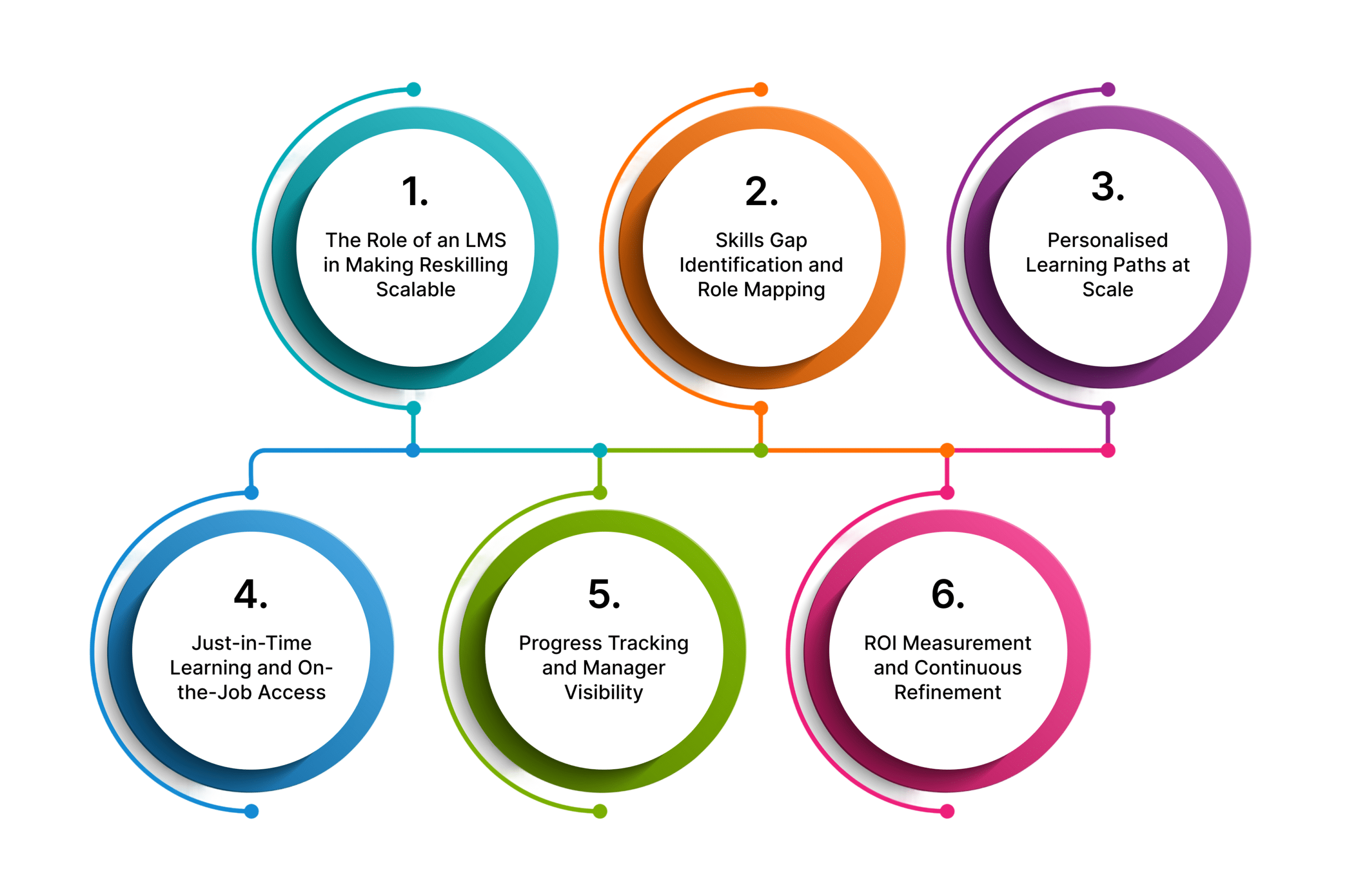
AT&T could run a $1 billion program because it had the scale and infrastructure to support it. But the methodology—mapping skills to roles, delivering personalized learning paths, tracking progress at the individual level—is exactly what a modern Learning Management System (LMS) is built to do.
A corporate LMS helps organizations turn workforce transformation goals into measurable learning programs by connecting skills assessments, personalized learning paths, training delivery, and reporting.
Here’s where the right LMS becomes the operational backbone of any reskilling initiative.
Skills Gap Identification and Role Mapping
Before you can train anyone, you need to know what they don’t know—and what the business needs them to know. An enterprise LMS allows L&D leaders to conduct organization-wide skills assessments, map current competencies against future role requirements, and generate gap reports that drive training prioritization. This is the “Evaluate” step that underpins every successful reskilling program.
Personalised Learning Paths at Scale
What AT&T did for 180,000 employees with a $1 billion investment, a well-configured LMS can replicate for organizations of any size. Role-based enrollment, adaptive learning paths, and AI-driven content recommendations mean every employee follows a path calibrated to their specific gaps—not a generic catalogue.
Just-in-Time Learning and On-the-Job Access
One of the most powerful shifts in modern L&D is the move from event-based training to continuous, just-in-time learning. An LMS with mobile access allows employees to pull up instructions, SOPs, and job aids exactly when they need them—on the factory floor, in the field, or at a remote workstation. Research shows this approach can reduce onboarding time dramatically: in one documented case, a manufacturing client cut new employee onboarding from 538 days to 125.
Progress Tracking and Manager Visibility
Reskilling at scale fails without visibility. A modern LMS gives managers real-time dashboards showing which employees have completed which training, where gaps remain, and who is approaching proficiency milestones. This transforms skills development from an HR exercise into a measurable operational outcome.
ROI Measurement and Continuous Refinement
The final piece is accountability. An LMS enables L&D leaders to track completion rates, assessment scores, performance improvements, and ultimately business outcomes—so the investment in reskilling can be measured, reported to leadership, and refined over time.
What Other Organizations Can Learn From AT&T
Organizations looking to replicate AT&T’s approach often use employee training software to deliver continuous learning, track skill development, and support internal mobility.
1. Treat Skills Gaps as Strategic Risks, Not HR Problems
AT&T’s reskilling program wasn’t owned by HR in isolation—it was driven by business strategy. When 100,000 roles face obsolescence, that’s a business continuity issue. Leadership at the highest level needs to own the skills agenda.
2. Map Learning to the Work You Actually Need Done
Generic training improves morale but rarely moves business metrics. The programs that work—like AT&T’s Future Ready—are built backward from the roles and capabilities the business will need in three to five years.
3. Give Employees Agency in Their Own Development
AT&T’s internal career center gave employees the tools to understand their own gaps and choose their own paths. This ownership effect is one of the strongest predictors of training completion and long-term skill retention.
4. Make Learning Continuous, Not Episodic
The organizations winning the skills race aren’t running annual training events—they’re embedding learning into the fabric of daily work. The 70-20-10 model for L&D suggests 70% of effective learning comes from on-the-job experience, 20% from coaching and social learning, and only 10% from formal instruction. An LMS that supports all three modes is essential infrastructure.
Reskilling vs. Upskilling: Understanding the Distinction
Before building your own program, it’s worth being precise about what type of intervention you need.
Reskilling prepares employees for entirely new roles—often driven by automation or strategic pivots. AT&T’s program was primarily reskilling: transitioning hardware engineers into software developers and network architects.
Upskilling deepens capability within existing roles—training a data analyst to handle more complex modeling, or a customer service rep to use AI-assisted tools.
Most organizations need both, and the most sophisticated learning programs deliver both simultaneously through a single platform.
Conclusion: The AT&T Reskilling Playbook Is Available to Every Organization
AT&T proved something that many business leaders still resist believing: investing in your existing workforce is not just the humane choice—it is the strategically and financially superior one.
The AT&T employee reskilling strategy succeeded because it treated learning as a core business function, not a support activity. It mapped training to real roles. It gave employees agency. It measured outcomes. And it committed resources at a scale commensurate with the challenge.
Most organizations won’t need a $1 billion program. But the methodology is entirely transferable—and the infrastructure that makes it possible at any scale is a modern, enterprise-grade Learning Management System.
If your organization is facing skills gaps, talent retention challenges, or a looming technology transition, the question isn’t whether to invest in reskilling. The evidence is decisive on that point.
The question is: do you have the platform to deliver it?
Instructional Designer - eLearning Developer · Paradiso Solutions Blog
Pradnya Maske is a Product Marketing Manager with over 10+ years of experience serving in the eLearning industry. She is based in Florida and is a senior expert associated with Paradiso eLearning. She is passionate about eLearning and, with her expertise, provides valued marketing services in virtual training.
Our website uses cookies to ensure it functions properly and provides a safer experience. Some cookies are necessary for the website to operate. By clicking 'Accept,' you agree to the use of cookies as outlined in our Privacy Policy. If you click 'Decline,' only essential cookies will be used.