


Blackboard remains an established learning management system for universities, colleges, and other structured learning environments. However, institutions and organizations increasingly need different combinations of usability, analytics, AI, integrations, open-source flexibility, employee training, customer education, and extended-enterprise learning.
That is why comparing Blackboard alternatives should start with your actual learning model rather than a checklist of features.
A university replacing Blackboard may prioritize academic workflows, accessibility, assessment, and SIS integrations. An enterprise L&D team may instead need employee onboarding, compliance training, skills development, customer education, and connections with HR or CRM systems.
This guide compares eight Blackboard competitors across both education and enterprise learning so you can build a shortlist around your real requirements.
Quick Answer: What Are the Best Blackboard Alternatives?
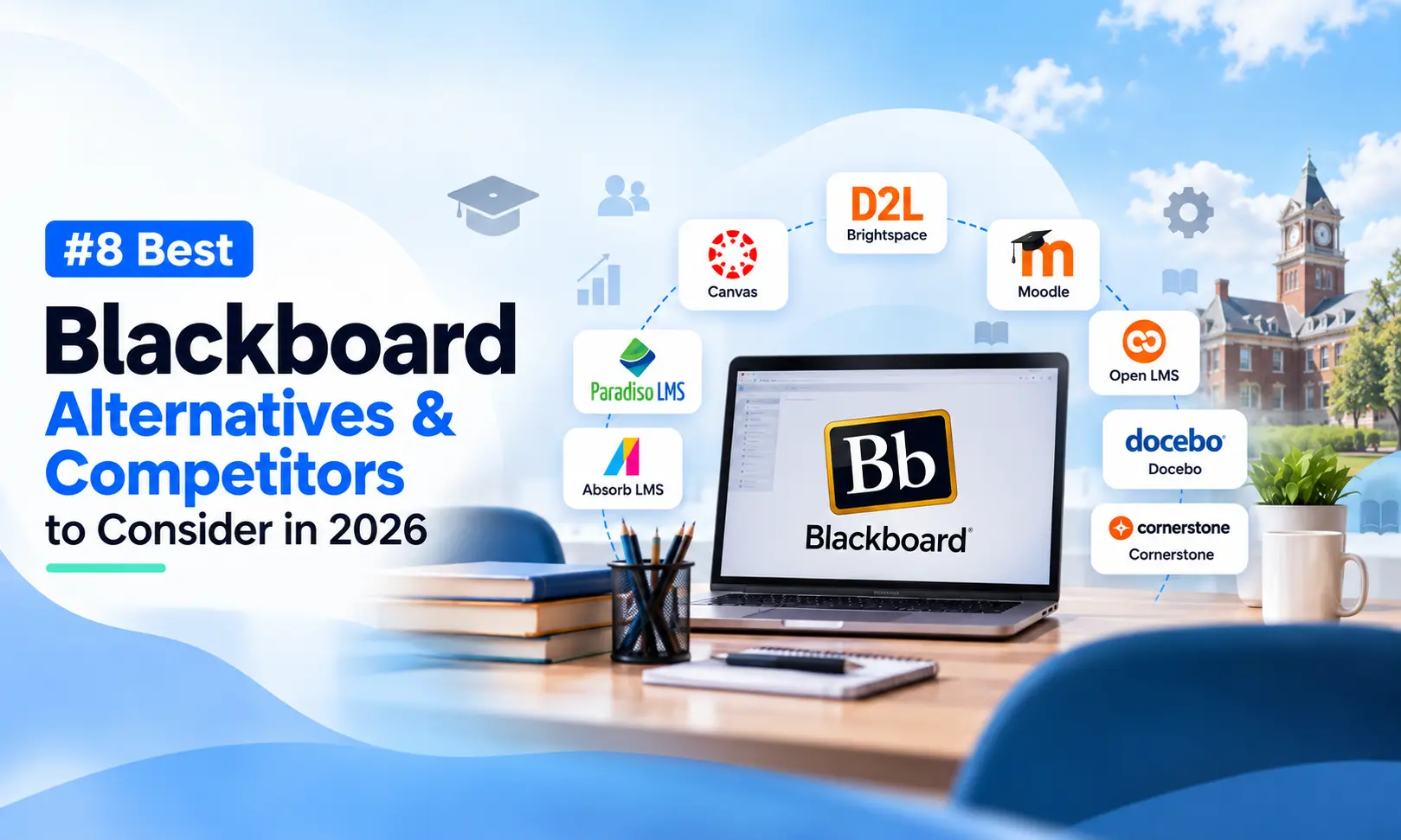
The leading Blackboard alternatives to consider in 2026 include Canvas LMS, Moodle, D2L Brightspace, Paradiso LMS, Open LMS, Absorb LMS, Docebo, and Cornerstone Learning.
Canvas, Moodle, Brightspace, and Open LMS are especially relevant when academic learning is the primary requirement. Paradiso LMS can support both education and enterprise learning, while Absorb, Docebo, and Cornerstone are stronger options for organizations moving toward employee, customer, partner, compliance, or workforce development.
The best Blackboard replacement depends on your audience, existing content, integrations, reporting needs, administrative model, and how you expect your learning programs to grow.
What Is Blackboard and Why Consider an Alternative?
Blackboard Learn is a learning platform associated most strongly with higher education and structured academic learning.
Its current capabilities extend beyond basic course delivery. Blackboard supports content creation, assessment, grading, accessibility, analytics, competency-based learning, and AI-assisted teaching workflows. Anthology also continues to update Blackboard through its SaaS release cycle.
Organizations therefore do not need to evaluate alternatives because Blackboard is incapable of modern digital learning.
The more practical question is whether another platform better matches your operating model.
A university might want a different authoring experience or a more open technology ecosystem. An organization using Blackboard for professional development may decide it needs a dedicated corporate LMS that handles employees, customers, partners, and recurring compliance programs more naturally.
Your reason for switching should guide the entire evaluation.
What Should You Evaluate Before Replacing Blackboard?
Begin with the workflows that would actually change after migration.
If your institution is education-focused, examine course creation, assessment, grading, accessibility, faculty experience, mobile access, academic integrations, learner analytics, and SIS connectivity.
If your needs are moving toward enterprise training, assess how the platform supports employee training, customer education, partner enablement, certification, automation, skills, and role-based learning.
Content portability also matters. Existing courses may include SCORM packages, assessments, multimedia, instructor resources, and external learning tools. Confirm how each candidate supports SCORM, xAPI, AICC, and related learning standards before assuming your course library will migrate cleanly.
Integrations deserve the same attention. A modern LMS rarely works alone. Your replacement may need LMS integrations with SIS, HRIS, CRM, SSO, video conferencing, content libraries, business intelligence, and other applications.
Feature parity is not the same as workflow parity. A replacement can technically contain every feature you used in Blackboard and still make everyday teaching or administration harder.
Blackboard Alternatives Compared
| Platform | Primary Fit | Strongest Reason to Consider It |
|---|---|---|
| Canvas LMS | Higher education and K-12 | Academic learning ecosystem and integrations |
| Moodle | Education and flexible deployments | Open-source control and customization |
| D2L Brightspace | Education and training | Personalization, analytics, accessibility |
| Paradiso LMS | Education and enterprise learning | Multi-audience training, AI, integrations |
| Open LMS | Higher education and managed open source | Moodle flexibility with managed delivery |
| Absorb LMS | Corporate learning | Employee and customer training administration |
| Docebo | Enterprise and extended enterprise | AI, skills, automation and multiple audiences |
| Cornerstone Learning | Large enterprises | Learning connected with skills, compliance and talent |
The platforms serve different markets, so the goal should be to narrow the list rather than identify one universal winner.
Evaluating a Blackboard replacement for broader training?
If your requirements now include employees, customers, partners, compliance, reporting, and business-system integrations, explore how Paradiso approaches enterprise learning.
1. Canvas LMS
Canvas by Instructure is one of the most direct Blackboard competitors for higher education.
It provides course management, assignments, assessments, grading, communication, mobile learning, analytics, and a broad integration ecosystem. Instructure also supports skills-based, professional, and continuing education through its wider Canvas portfolio.
Canvas is particularly relevant when your institution wants to remain in an academic LMS model but prefers a different instructor experience or technology ecosystem.
Instructure continues to expand Canvas in 2026, including new AI and analytics capabilities across its tiered platform.
Best fit: Universities, colleges, and education providers looking for a mature academic alternative to Blackboard.
2. Moodle
Moodle takes a fundamentally different approach because the core LMS is open source.
Institutions can customize the interface, workflows, functionality, integrations, and hosting model rather than depending entirely on a proprietary platform roadmap. Moodle also supports courses, assessments, competency frameworks, accessibility, mobile learning, integrations, and multilingual education.
That flexibility comes with operational decisions.
Your institution needs to determine who will manage hosting, security, upgrades, plugins, customization, and support. Moodle Certified Partners and managed services can reduce that burden, but the implementation model should be part of the comparison.
Moodle continues to position its LMS as an open-source, customizable platform for higher education and other learning environments.
Best fit: Institutions that value open-source control and have a clear technical or managed-hosting strategy.
3. D2L Brightspace
D2L Brightspace is a particularly important Blackboard alternative for institutions focused on personalized and data-informed education.
The platform supports content delivery, assessments, accessibility, learning analytics, adaptive experiences, and AI-assisted learning and course development.
Its relevance as a Blackboard replacement is not theoretical. In April 2026, Rasmussen University announced that it had selected Brightspace to replace Blackboard across its programs.
That makes Brightspace especially worth evaluating when your institution wants to modernize academic workflows while retaining a structured enterprise education environment.
Best fit: Higher-education institutions and learning organizations prioritizing analytics, accessibility, personalization, and AI-supported learning.
4. Paradiso LMS
Paradiso LMS is relevant when an organization needs to support more than one type of learning audience.
A university might need academic programs alongside staff development, continuing education, certifications, or external training. An enterprise may need onboarding, compliance training, customer education, partner enablement, and professional development from the same learning environment.
Paradiso combines course management with reporting, integrations, mobile learning, multilingual delivery, virtual learning, and AI-assisted capabilities. Its AI-powered LMS features are designed to support activities such as course creation, learning assistance, personalization, and practice.
The platform can also work with external business applications and reporting tools, which is useful when learning data needs to connect with employee, customer, or operational information.
Best fit: Organizations that want one configurable platform across education, employee training, customer learning, partners, and other learning audiences.
5. Open LMS
Open LMS provides a managed learning environment based on Moodle.
This can be attractive for institutions that like the flexibility of open-source learning but do not want to take full responsibility for hosting, upgrades, security, and platform administration.
Open LMS unified its former education and corporate platforms into Open LMS 5.1 in July 2026, creating one Moodle-based environment designed to serve different learning contexts.
For a university leaving Blackboard, this can provide a middle ground between adopting a proprietary SaaS platform and operating Moodle completely in-house.
Best fit: Higher-education institutions and organizations that want managed Moodle-based learning.
6. Absorb LMS
Absorb LMS is more directly aligned with corporate training than traditional academic learning.
Its environment supports online courses, instructor-led training, curricula, third-party eLearning content, reporting, ecommerce, and different learner experiences. Current Absorb documentation also confirms support for SCORM, AICC, and Tin Can content.
Absorb becomes more relevant when your reason for leaving Blackboard is a shift from academic course management toward employee, customer, or partner education.
Its 2026 releases have continued to expand administration, reporting, and integration capabilities.
Best fit: Organizations focused on employee training, customer education, partner learning, and scalable corporate training administration.
7. Docebo
Docebo is an enterprise learning platform designed around multiple learning audiences.
Organizations can use it for employees, customers, partners, and extended-enterprise learning while managing distinct experiences from a shared platform. Docebo also emphasizes AI, personalization, skills, content management, analytics, and workflow automation.
Its extended-enterprise product specifically supports different branded experiences for employees, customers, and partners.
Compared with Blackboard, Docebo is most relevant when the learning strategy has moved away from primarily academic course administration and toward large-scale enterprise enablement.
Best fit: Larger organizations managing several learning audiences and looking for AI-supported enterprise learning.
8. Cornerstone Learning
Cornerstone Learning is suited to organizations that want learning connected closely with wider workforce and talent processes.
Its value proposition is broader than course administration. Large organizations often evaluate Cornerstone when learning needs to work alongside skills, compliance, employee development, talent management, and workforce planning.
This makes Cornerstone different from an education-first Blackboard replacement such as Canvas or Brightspace.
The trade-off is that organizations should evaluate how much of the broader talent ecosystem they actually need. A more extensive platform is not necessarily an advantage when the requirement is simply straightforward learning delivery.
Best fit: Large enterprises that want learning integrated with skills, compliance, talent, and wider workforce processes.
Which Blackboard Alternative Fits Your Use Case?
For a university or college that wants to remain in a traditional academic LMS environment, start with Canvas, Brightspace, Moodle, and Open LMS.
Canvas and Brightspace offer mature proprietary education ecosystems. Moodle provides greater open-source control, while Open LMS provides a managed route to a Moodle-based environment.
If your organization’s requirements are shifting toward corporate training, start with Paradiso LMS, Absorb, Docebo, and Cornerstone.
Paradiso can be particularly relevant when you need several learner audiences without separating them across multiple learning systems. Absorb focuses strongly on corporate training administration, Docebo emphasizes enterprise AI and extended learning, while Cornerstone ties learning more closely to talent and workforce processes.
The distinction is more useful than asking which LMS has the longest feature list.
What Should You Consider During a Blackboard Migration?
Migrating away from Blackboard is not simply a matter of exporting courses and importing them into another LMS.
Before committing to a replacement, document the content, data, integrations, permissions, and reporting processes that need to survive the move.
Your migration plan should cover:
- Course packages, multimedia, assessments, question banks, and instructor resources
- SCORM and other third-party eLearning content
- Users, enrollments, roles, permissions, and groups
- Historical learning records and grades where they must be retained
- SIS, HRIS, SSO, API, LTI, video conferencing, and other integrations
- Accessibility and mobile-experience testing
- Reporting continuity, administrator training, and a controlled cutover plan
If your content needs substantial rebuilding rather than simple migration, evaluate whether a modern eLearning authoring tool should also be part of the project.
A pilot migration is usually more informative than relying only on vendor assurances. Move a small but representative set of courses, users, assessments, and integrations before finalizing the migration approach.
How Does Paradiso LMS Compare as a Blackboard Alternative?
Paradiso is most relevant when the problem you are solving extends beyond academic course administration.
An L&D team, for example, may need onboarding for employees, product education for customers, certifications for partners, and recurring compliance assignments. Running those programs requires different enrollment rules, branding, automation, reporting, and integrations from a traditional university course structure.
Paradiso supports these multi-audience use cases while also providing learning administration, course delivery, AI capabilities, and LMS reporting and analytics.
Reporting is particularly important during a Blackboard replacement because changing systems should not mean losing visibility into learner progress, assessment performance, certification status, or historical training activity.
The platform should still be evaluated against the same scenarios as every other finalist. Paradiso will not be the right option simply because it has more enterprise features if your institution primarily needs a conventional academic LMS.
See Paradiso LMS in practice
Explore the learner, instructor, reporting, AI, and administration experience before deciding whether Paradiso belongs on your shortlist.
Conclusion: Choosing the Right Blackboard Alternative
The best Blackboard alternative depends on why you are considering a change.
Canvas, Moodle, Brightspace, and Open LMS deserve closer attention when academic teaching and higher-education workflows remain the core requirement.
Paradiso LMS, Absorb, Docebo, and Cornerstone become more relevant when the learning strategy includes employees, customers, partners, compliance, workforce skills, or extended-enterprise learning.
Before selecting a platform, document the Blackboard workflows your users rely on today, identify what genuinely needs to improve, and ask shortlisted vendors to demonstrate those same scenarios.
That approach gives you a much stronger basis for choosing a replacement than comparing feature checklists alone.
Comparing Blackboard with an enterprise LMS?
If your organization needs learning across employees, customers, partners, compliance, reporting, and integrations, explore how Paradiso could fit your requirements.
Frequently Asked Questions
What are the best Blackboard alternatives in 2026?
Which Blackboard alternative is best for higher education?
Which Blackboard alternative is best for corporate training?
Is Moodle a good alternative to Blackboard?
Can Blackboard courses be migrated to another LMS?
What should I look for in a Blackboard replacement?