
AI
Roleplay
Practice with AI. Prepare for Reality.

AI Roleplay Training: The Complete Guide for Enterprise L&D Teams
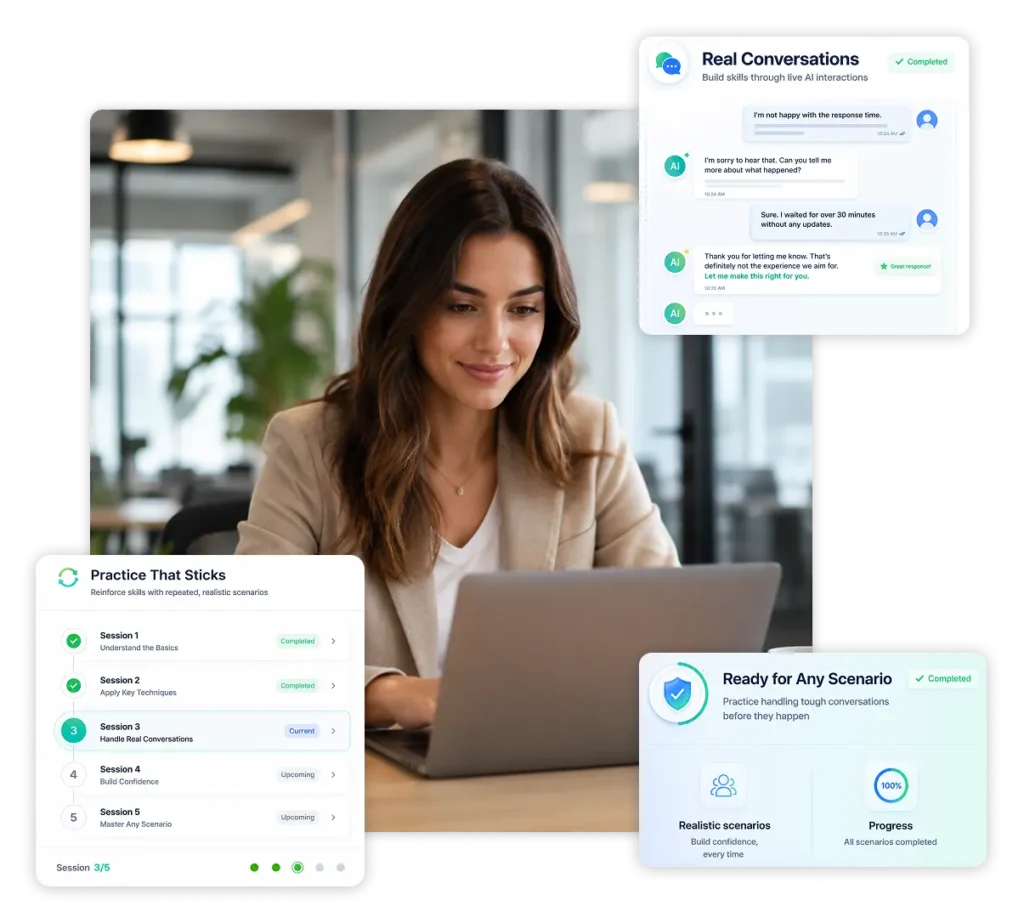
Learn how AI roleplay streamlines practice, improves adoption, accelerates team readiness, and measures real performance impact.
AI roleplay training

Overview

Most professionals get almost no practice at the conversations that matter most.
A sales rep closes a deal through a combination of luck, instinct, and trial-and-error. A manager delivers difficult feedback without training, hoping not to damage the relationship. A customer success rep handles their first angry escalation by improvising. A healthcare worker navigates a sensitive patient conversation based mostly on experience with colleagues.
This isn’t because practice doesn’t work. Everyone knows that deliberate practice builds skill. Athletes drill. Musicians rehearse. Surgeons simulate. But workplace conversations, especially high-stakes ones, are treated differently. There’s an implicit assumption that some instinct or natural ability carries you through. When it doesn’t, the cost falls on the conversation outcome, not on the organization’s training approach.
The reason: traditional practice doesn’t scale. Manager-led roleplay requires finding a skilled partner. It happens on someone else’s schedule. It’s awkward. And there’s never enough of it. A rep might get two roleplay exercises during a training session. That’s nowhere near the repetitions required to build real fluency.

This gap is where conversational simulation powered by AI enters. It’s not about replacing human judgments or making conversations transactional. It’s about enabling the volume of deliberate practice that builds genuine capability.

This guide walks you through everything enterprise teams need to know: the framework, the benefits, real-world use cases, how to choose the right platform, and how to track measurable impact.

What is AI Roleplay Training?

AI roleplay training is a form of simulation-based learning where an employee has a two-way conversation with an AI-powered virtual character instead of a script, a video, or a live actor. The learner speaks or types as they would in a real situation, handling an objection, delivering feedback, de-escalating a complaint, and the AI responds in character, adapting its tone and pushback based on what the learner actually says.

A sales rep practices a pricing objection. The AI, playing a prospect who just heard the quote, pushes back with realistic concerns. Depending on how the rep responds, the conversation either opens or closes. Some reps defuse tension through acknowledgment and discovery. Others get defensive, which the AI reflects back immediately.
After the session ends, the rep sees feedback: what worked, where the conversation stalled, what they might try differently next time. Then they can practice the same scenario again, try a different approach, see what lands better. They can do this the night before a big call, without bothering a manager or waiting for the next training session.
This changes the economics of practice entirely. What wasn’t available to most people, repetitive practice on high-stakes conversations, suddenly becomes accessible.

How AI Roleplay Differs from Other Learning Methods

Traditional training often separates knowledge from real performance. Employees learn frameworks in workshops or courses, then are expected to apply them in real situations. However, applying learned concepts consistently in high-pressure scenarios is difficult. For example, understanding objection handling techniques does not ensure confident and effective responses during live customer interactions.

This gap is often mistaken as a lack of motivation or effort. In reality, it is a lack of structured practice. Knowing a concept and executing it effectively under pressure require different skill sets.

Here’s a quick comparison:

Traditional Training AI Roleplay Training
Fragmented Learning Experiences: Learners juggle multiple platforms for training, breaking focus and engagement. Unified Learning Ecosystem: Everything happens in one platform where learners flow without switching.
Insufficient Practice Volume: One or two exercises per month can't build the fluency that dozens of repetitions create. Flexible Practice Repetitions: Learners practice 20+ times per week until responses become automatic.
Delayed & Inconsistent Feedback: Feedback comes late, varies by instructor skill, and loses its learning power. Instant, Specific Feedback: Immediate, actionable feedback after every session, identical in quality.
Real Stakes & Relationship Risk: Manager and peer roleplay create pressure that discourages experimentation and bold tries. Consequence-Free Experimentation: Complete safety to fail, experiment, and learn without damaging real relationships.
Limited Performance Visibility: Training tracks completion, not actual skill improvement or individual learning gaps. Real-Time Skill Measurement: Data shows progress, identifies skill gaps, and predicts real-world performance.
One-Size-Fits-All Design: All learners get identical training regardless of experience level or current capability. Adaptive Difficulty & Personalization: AI adjusts scenario difficulty based on performance, matching each learner's level.
What’s missing from all of these is volume of practice that’s realistic, available on demand, and consequence-free. That’s where conversational AI training fills a genuine gap.

The Practice Gap AI Roleplay Solves

Here’s the core problem most organizations face critical conversations that are treated as something people should be able to handle with minimal preparation.
A newly hired sales rep closes their first deal by jumping on calls with minimal roleplay. A manager delivers their first negative performance review based mostly on common sense. A customer success rep handles their first renewal negotiation live with the customer.
Some people navigate these situations well anyway. Others stumble. The difference isn’t always talent or effort. It’s often accumulated practice. A manager who’s handled 50 difficult feedback conversations has better instincts than one handling their first. A sales rep who’s practicing objection handling 100 times sounds more confident than one flying blind.
But how do you build those reps and managers without making actual customers and employees the training ground?
Traditional approaches try to compress the practice into a few sessions before the real situation. A new manager gets a workshop on difficult conversations, then delivers their first feedback session to an employee. They’ve had maybe two roleplay exercises. That’s not nearly enough to build the automatic responses that fluency requires.
High-performing organizations recognize this gap. They provide additional practice time. But this requires trainer resources. More managers mean more coaches. More trainers mean higher overhead. On scale, this becomes expensive.
This is exactly what makes AI practice valuable. Not because AI is a better coach than a good manager. But because one good manager can coach 5 people effectively. One AI system can coach 5,000 people simultaneously, each getting whatever volume of practice they need.
The result isn’t that everyone becomes brilliant overnight. But readiness improves measurably. Sales reps hit productivity 40% faster when they’ve had structured practice. Customer success teams reduce churn-saving conversation failures. Managers handle difficult feedback with more confidence. Healthcare professionals have clearer, more compassionate conversations with patients.

How AI Roleplay Training Works

How AI Roleplay training works
Most modern platforms follow a similar structure, though the details vary.

Starting with scenarios:

Every roleplay begins with a scenario: a situation, a persona, and context the learner needs. What’s the prospect’s objection? What’s the employee’s concern? What background information matters? Good scenarios pull from real situations, not hypotheticals. They’re based on calls that actually happen in your business, objections that come up repeatedly, conversations that consistently give people trouble.
The power here is that your existing knowledge becomes your practice library. A sales playbook that documents common objections becomes objection-handling scenarios. An onboarding guide that explains policies becomes scenarios where employees need to explain those policies clearly to colleagues.

Building realistic conversations:

During the roleplay itself, the AI doesn’t follow a script. It understands what the learner says and responds appropriately. A sales rep who gets defensive about price triggers a resistant prospect. A manager who acknowledges an employee’s concern opens up the conversation. This dynamic responsiveness is what makes it feel real instead of artificial.
The conversation adaptation matters because it prevents people from gaming into the system. You can’t memorize the right response because the AI adapts based on your actual approach.

Providing actionable feedback:

After the conversation ends, feedback comes fast. Not generic feedback like “good job” or “needs improvement.” Specific, useful feedback tied to frameworks you’ve actually taught.

“You spent 65% of the call talking instead of listening. Try asking discovery questions before presenting the solution. Here’s what that sounded like…”
“You acknowledged the concern but then immediately pivoted to your talking points. Pause after acknowledgment. Give them space to respond. Often they’ll reveal what actually matters to them.”
This specificity is what transforms practice into improvement.

Tracking development over time:

Systems typically track performance across multiple practice sessions. Not just “did you complete the scenario” but “how are your scores trending on objection handling” or “which specific skills improved this week.” This data serves learners, who see their own progress. It serves managers, who get visibility into who’s developing and who might need support. It serves L&D teams, who can measure training effectiveness beyond completion rates.

What Makes AI Roleplay Effective

Understanding why this works helps explain where it works best.

Real pressure without real consequences:

Practice that doesn’t create some pressure isn’t very useful. You need to feel the stakes enough to concentrate, to care about the outcome, to stretch a bit. But you also need to be able to fail without actual damage. A botched roleplay teaches you something. A botched customer call costs you the deal.

AI roleplay creates this specific balance:

The conversation feels real enough that you engage seriously. But the outcome doesn’t matter. You can bomb an objection handling scenario, see what went wrong, try again immediately, and learn from the cycle.

Adaptivity and personalization:

Not everyone needs the same difficulty level. A new rep needs foundational scenarios that feel achievable. A seasoned rep needs advanced scenarios that stretch their capability. Good systems adjust difficulty based on performance. If you’re nailing discovery questions, they move you to more complex objection scenarios. If you’re struggling with de-escalation, they give you repeated practice on that specific skill.
This prevents two problems: boredom, when scenarios are too easy, and demoralization, when they’re too hard.

Volume of repetition:

This is maybe the most important factor. Fluency requires dozens of repetitions. A manager-led roleplay happens a few times a month. AI role-play can happen daily, multiple times daily if someone wants. A sales rep can practice the same pricing objection 20 times in a week, learning a little more each repetition, until the response becomes automatic.

This volume is what builds real skill, not just intellectual understanding.

Safe experimentation:

In real conversations, there’s risk to trying new approaches. You might damage a relationship. You might lose a deal. This creates conservative behavior. People stick with what they know works, even if something else might work better.
In practice, you can experiment with it. Try a more direct approach. Try more empathy. Try asking different discovery questions. See what lands. The worst outcome is a learning experience.

Contextual practice:

The best practice matches the real situations you face. A sales rep in the tech industry practices with AI buyers who understand tech. They encounter competitive objections relevant to their market. A healthcare administrator practices patient communication scenarios relevant to their clinical setting.
This specificity means what you learn transfers directly. You’re not practicing generic objection handling. You’re practicing the objections you actually face.

Benefits of AI Roleplay Training for Enterprise L&D

When implemented well, these benefits compound.

Faster time to productivity:

New hires ramp faster because they’ve had structured practice before their first real conversation. Instead of learning by making mistakes on actual customers or employees, they’ve learned through consequence-free repetition. Organizations report new sales reps reaching productivity 40% faster. Onboarding teams see newly hired employees become fully productive weeks earlier than traditional paths.

Measurable skill development:

Traditional training measures for completion. Someone finished the course or attended the workshop. But that doesn’t tell you if they actually improved the skill. Conversation simulation provides behavioral measurement. You can see how a rep’s objection handling score improves over 10 practice sessions. You can track whether a manager’s feedback conversations are getting more productive. You can measure whether a healthcare worker’s patient communication is becoming clearer.
This measurement serves multiple purposes. It motivates learners who can see their own progress. It guides managers who know where coaching would help most. It justifies continued investment when L&D can show that practice correlates with performance improvement.

Consistency in quality:

With manager-led roleplay, quality depends on the manager. Some managers are excellent at creating realistic pressure and providing useful feedback. Others phone it in. This variation means some employees develop skills faster than others based on which manager they report to, not based purely on their own effort.
Simulation reduces this variation. The AI provides consistent challenge and consistent feedback quality. Everyone gets practice that meets a standard, not one that depends on their manager’s bandwidth or skill.

Scalability without proportional cost increases:

Manager-led coaching doesn’t scale linearly. One manager can coach maybe 5-7 people effectively. To coach 100 people, you need roughly 15-20 managers dedicated to coaching. That’s expensive and often not practical.
Simulation scales differently. One system can support thousands of people simultaneously. The marginal cost of one additional practitioner is nearly zero. This makes it economically possible to provide practice opportunities that would otherwise require unrealistic trainer investment.

Data-driven coaching:

When managers can see simulation data, they coach more effectively. Instead of guessing where someone needs help, they see exactly which skills are lagging. Instead of generic feedback, they can reference specific moments from practice sessions.
For example: “I saw your roleplay from yesterday. You did well acknowledging the concern, but you pivoted too quickly back to your talking points. Let’s practice that pause. Here’s what your best rep does…”
This specific, data-informed coaching is more effective than general observation.

Risk reduction in sensitive conversations:

Some conversations have legal or compliance implications. A manager delivering a termination, an HR person handling a discrimination allegation, a healthcare worker navigating consent conversations. The wrong approach can create liability.
Practice in these areas reduces risk. It’s better to fumble through difficult feedback with an AI than with an actual employee. It’s better to refine your approach to sensitive compliance conversations before doing them with someone who has legal standing.

AI Roleplay Training Use Cases Across the Enterprise

AI Role Play Training Use Cases Across the Enterprise
Sales gets the most attention, but the application is broader.

How to Choose the Right AI Roleplay Platform

The market is evolving quickly. Some considerations:

Integration with existing systems:

Does it connect with your LMS? Your HRIS? Your CRM? Or does it require separate logins and manual data transfer? Integration affects adoption and data consistency. You want practice data connecting to learning records and performance data.

Scenario customization capability:

Can you build scenarios from your own materials, or are you limited to a pre-built library? The power of this approach depends on having scenarios that match your actual business. A pre-built library gives you something to start with quickly, but custom scenarios based on your playbooks and real challenges drive better results.

Breadth of use cases:

Many platforms focus on sales. If you need practice beyond sales, assess whether the system supports your broader use cases. Some are designed for multi-use; others are purpose-built for specific domains.

Feedback quality:

This matters enormously. Generic feedback is worse than no feedback. Get examples of what feedback actually looks like. Does it reference frameworks you teach? Is it actionable? Is it specific enough to guide improvement?

Implementation support:

Rolling out something new requires change management. Does the vendor help with scenario development, rollout strategy, adoption encouragement? This matters more than the underlying technology.

Data and privacy standards:

Especially for sensitive use cases like healthcare, compliance matters. What certifications does the platform have? Can you maintain data residency? What’s their audit trail capability?

Measuring AI Roleplay Training Effectiveness

Measurement prevents AI roleplay from becoming just another training initiative that gets checked off without real impact.

Real Results: What Enterprises are Seeing with AI Roleplay

Organizations that implement this systematically report measurable outcomes.

A telecommunications company used conversation simulation to train telesales teams. Within three months, average handle time dropped 20%. Customer satisfaction scores increased 15%. Teams that previously needed three weeks to ramp reached productivity in two weeks.

A financial services organization implemented roleplay practice for compliance-sensitive conversations. Employee accuracy on regulatory scenarios improved measurably. Audit findings dropped. The organization reduced compliance risk while improving employee confidence.
Sales organizations report that reps who practice objection handling consistently achieve 31% higher quota attainment than those without structured practice. Not because practice makes you brilliant, but because it removes uncertainty. You’ve been through the scenario before. You know what tends to work.
Customer success teams that implemented renewal conversation practice improved retention by 15-25% on those conversations. The difference: reps approached renewals as conversations, not transactions. They asked better questions. They understood the customer’s actual constraints.
Healthcare providers report that clinicians who practice patient communication scenarios have higher patient satisfaction scores and fewer escalated complaints. They communicate treatment options more clearly. They navigate difficult conversations with more compassion because they’ve rehearsed them.

Future of AI Roleplay in Professional Development

The capability is expanding rapidly.
The underlying trend: as organizations recognize that conversation skill matters and practice truly develops skill, demand for high-volume, on-demand, personalized practice will keep growing.

Which AI Roleplay Platform Drives the Highest ROI for Your Team? Expert Comparisons

The organizations seeing the biggest impact aren’t applying AI roleplay generically. They’re customizing it to specific roles, where the conversation patterns and pressure points differ significantly.

Want to see how it works in your department? We’ve published detailed implementation guides for the three areas where AI roleplay shows the strongest ROI:
Best AI Roleplay for Sales Training in 2026: An Expert Review That Closes More Deals – How sales teams practice objection handling, discovery, and negotiation to hit quota 31% faster.
Best AI-Driven Roleplays for Leadership Training: 10 Proven Ways to Train Leaders Faster – How managers develop difficult feedback, delegation, and conflict resolution skills without putting employees at risk.
8 Best AI Roleplay Tools for Corporate Training – How HR, compliance, and onboarding teams compare platforms and choose the right tool for multi-department rollout.
Each guide compares the best AI roleplay platforms across your department’s specific needs.

Build Your AI Roleplay Training Program with Paradiso AI Roleplay

Most organizations add roleplay as a separate tool – different logins, fragmented data, learners switching between platforms. Paradiso AI roleplay is different. It’s built directly into the LMS as a native feature.

Scenarios live in the same course library as videos and assessments. Learners practice without context switching. Managers coach using unified data: practice scores sit next to course completion and performance metrics in one dashboard.
Upload your playbooks once. The system generates scenarios matched to your context. Managers coach from the same interface they use for learning records. One vendor, one contract, one integration point. Organizations go live in 10 days with faster implementation, zero data silos, and lower total cost than stacking separate tools. The result: practice adoption rates 3-5x higher than standalone solutions, with skill development accelerating because coaching and learning happen in the same system.

The organizations getting the most value embed AI role-play into learning design from the start – product training, onboarding, leadership development. They use unified data to optimize both practice design and coaching. They treat practice as part of the learning workflow, not a separate initiative.

Ready to see how it works?

Book a personalized demo to see Paradiso AI Roleplay integrated into your learning programs.
Share This :

Table of Contents

Got Questions?

Frequently Asked Questions

Can’t find what you’re looking for? Talk to our team.

AI roleplay training uses artificial intelligence to simulate realistic workplace conversations. Employees interact with AI personas in scenarios such as sales calls, customer complaints, negotiations, or difficult conversations. After each session, they receive feedback that helps identify strengths, improve skills, and prepare for real-world interactions.
Conversational simulations let employees practice real workplace situations in a safe environment. They can respond to challenging questions, try different approaches, and repeat scenarios without needing a trainer or colleague. This helps build confidence, improve communication skills, and apply training more effectively.
The platform can evaluate skills such as communication, active listening, empathy, objection handling, and accuracy against predefined criteria. After each session, learners receive feedback on their strengths and areas for improvement, allowing them to repeat scenarios and track their progress.
Yes. Organizations can create scenarios based on specific roles, customer personas, products, policies, workflows, and learning objectives. Sales teams can practice objections, customer service teams can handle escalations, and managers can practice coaching or difficult feedback conversations.
No. AI roleplay expands access to practice but does not replace expert human facilitation. Facilitators can focus on strategic coaching, complex debriefs, leadership development, and identifying skill gaps, while AI handles repeatable practice. Combining AI-powered practice with human coaching creates a more effective blended learning experience.
Look for realistic conversations, customizable scenarios, performance scoring, actionable feedback, analytics, LMS integration, security, and scalability. The platform should also support role-specific training and align simulations with your organization’s learning objectives and workflows.
Many platforms can integrate with existing learning ecosystems through LMS integrations, APIs, or standards such as SCORM, depending on the provider. Integration can help organizations include simulations within learning paths and connect practice results with broader employee training programs.
Organizations can track scenario performance, skill scores, feedback trends, improvement across attempts, and completion rates. These learning metrics can also be compared with business outcomes such as sales performance, customer satisfaction, or employee ramp time to assess training impact.

Try AI Roleplay Simulation
for Business Use Cases

eva img

50+

SCENARIOS

Real-time

AI FEEDBACK

10K+

USERS

WhatsApp Chat