HIPAA Compliance Training:
The Complete Guide (2026)
Everything your organisation needs to train staff, meet federal requirements, and stay audit-ready.
Overview:
This guide covers the complete picture of HIPAA compliance training for healthcare organisations across the United States. Use it to understand your legal training obligations under HHS and OCR, find role-specific requirements for physicians, nurses, dental offices, medical couriers, and business associates, compare free training options against paid and certified programs, learn what HIPAA Privacy Rule and Security Rule training must each include, understand how often training is required and what triggers additional sessions, and build a documented compliance program that holds up under audit. Whether you are a solo practice or a multi-site health system, every section is written to give you a direct, actionable answer.
If you work in healthcare, handle patient data, or manage staff who do, HIPAA compliance training is not optional. It is a federal requirement, and getting it wrong does not just mean an awkward audit. It can mean fines ranging from $100 to $50,000 per violation, plus reputational damage that takes years to recover from.
HIPAA compliance training is the process of educating employees, contractors, and business associates about the Health Insurance Portability and Accountability Act, specifically about how to handle protected health information (PHI) lawfully and responsibly. Under 45 CFR 164.530(b), the Department of Health and Human Services (HHS) requires covered entities to train all workforce members on their privacy policies and procedures.
What Is HIPAA Compliance Training?
HIPAA compliance training is formal instruction that teaches workforce members how to protect patient health information in line with federal law. It covers the HIPAA Privacy Rule, the Security Rule, and the Breach Notification Rule, and applies to every person who has access to PHI, whether they work at a hospital, dental office, insurance company, or as an independent contractor.
The Office for Civil Rights (OCR) within HHS enforces HIPAA, and one of the first things they look for during an investigation or audit is documentation that staff received training. Without it, your organization is exposed, even if no actual data breach occurred.
Why HIPAA Training Is Legally Required
Under 45 CFR 164.530(b)(1), covered entities must train all workforce members on HIPAA privacy policies and procedures as necessary and appropriate for them to carry out their functions. This is not a suggestion. It is written into the law.
The Security Rule under 45 CFR 164.308(a)(5) adds another layer, requiring covered entities to implement a security awareness and training program for all workforce members. Together, these regulations create a clear legal obligation: if your staff touch PHI and have not been trained, you are out of compliance.
The consequences are real. OCR has levied multi-million dollar penalties against healthcare organizations specifically because their training programs were inadequate, infrequent, or undocumented. The data is public and the names are recognizable.
What the Training Covers
A complete HIPAA training program touches three core areas. The Privacy Rule governs who can access PHI, for what purposes, and under what circumstances it can be shared. The Security Rule covers the technical, physical, and administrative safeguards required to protect electronic PHI (ePHI). The Breach Notification Rule explains what your organization must do if PHI is exposed, including timelines for notifying affected individuals and HHS.
Good training does not stop at definitions. It uses real scenarios, role-specific examples, and clear guidance on what to do when something goes wrong.
Who Needs HIPAA Compliance Training?
Almost everyone who interacts with PHI needs HIPAA training. This includes full-time employees, part-time staff, temporary workers, volunteers, students, contractors, and business associates. The determining factor is not job title or employment status. It is whether the person can access, use, or disclose protected health information as part of their work.
Healthcare Professionals and Providers
HIPAA training for healthcare workers covers every clinician and support professional who comes into contact with patient information, from physicians and nurses to medical assistants, therapists, and radiologists. Physicians, nurses, medical assistants, therapists, radiologists, and any other clinician who directly handles patient records or discusses patient care must receive HIPAA training. For healthcare professionals and providers, training needs to go beyond basic awareness. It should address how to share information appropriately between care team members, how to respond to patient requests for records, and what to do if a colleague appears to be mishandling PHI.
The frequency and depth of training should reflect the access level. A physician with full access to the electronic health record system needs more comprehensive training than a receptionist who only sees appointment data.
New and Existing Employees
New employees must receive HIPAA training before they begin accessing PHI, or as early in their employment as possible. This applies regardless of whether they come from another healthcare organization that already trained them. Your policies, your systems, and your specific workflows require organization-specific training.
Existing employees need refresher training whenever your privacy policies change, when a new system or process is introduced, or when an incident suggests a knowledge gap. For a deeper look at structuring employee training programs, see our HIPAA Awareness Training for Employees guide.
Dental Offices
Dental practices are covered entities under HIPAA and carry the same training obligations as hospitals and clinics. The challenge is that many dental offices operate with small teams where the same person handles scheduling, billing, and clinical support. That overlap means everyone in the office likely touches PHI in some form, and everyone needs training.
Dental offices also frequently combine HIPAA training with OSHA bloodborne pathogen training, which makes sense from a logistics standpoint. We cover this combination in detail in our HIPAA and OSHA Training for Dental Offices guide.
Medical Couriers
Medical couriers are classified as business associates under HIPAA because they transport items that may contain PHI, including lab specimens, medical records, and prescription medications. Many courier operations overlook this classification, which creates real liability.
Couriers need training on PHI handling, chain of custody protocols, what to do if a package is lost or compromised, and how to recognize when information they encounter should be treated as confidential. See our full HIPAA Training for Medical Couriers guide for the complete breakdown.
Business Associates and IT Professionals
HIPAA requires covered entities to have signed Business Associate Agreements (BAAs) with these partners, and those partners have independent obligations under the law, including training their own staff. IT professionals working with ePHI systems need particularly thorough security-focused training, covering access controls, encryption requirements, and incident response procedures.
Medical Office Staff
HIPAA requires covered entities to have signed Business Associate Agreements (BAAs) with these partners, and those partners have independent obligations under the law, including training their own staff. IT professionals working with ePHI systems need particularly thorough security-focused training, covering access controls, encryption requirements, and incident response procedures.
HIPAA Compliance Officer and Privacy Officer Training
Every covered entity should have a designated Privacy Officer and, depending on their size and complexity, a Security Officer as well. These roles are more than job titles. They carry legal responsibility for the organization’s HIPAA compliance program, and they need training that goes well beyond what general staff receive.
A HIPAA Privacy Officer needs to understand the full scope of the Privacy Rule, including patient rights such as the right to access records, request amendments, and receive an accounting of disclosures. They are responsible for developing and enforcing internal policies, handling patient complaints, and serving as the organization’s primary contact with HHS during investigations.
The Security Officer is responsible for managing the technical and administrative safeguards that protect ePHI. This includes conducting and documenting risk analyses under 45 CFR 164.308(a)(1), managing access controls, and overseeing the organization’s security awareness training program.
Security awareness and training for officers should include topics like phishing recognition, password management, multi-factor authentication, and incident response planning. These are not one-time lessons. Threat landscapes change, and security training needs to keep pace.
If you are responsible for HIPAA compliance at your organization, or you manage the people who are, see our dedicated HIPAA Compliance Officer and Privacy Officer Training guide for role-specific requirements and certification paths.
HIPAA and OSHA Combined Training
For many healthcare organizations, particularly smaller practices, clinics, and dental offices, HIPAA and OSHA training are often delivered together. This is not just a matter of convenience. The two regulatory frameworks share overlapping goals around workplace safety, documentation, and staff accountability.
OSHA’s Bloodborne Pathogen Standard (29 CFR 1910.1030) requires annual training for workers who may be exposed to blood or other potentially infectious materials. In a healthcare setting, the staff who need this training are very often the same people who need HIPAA training on PHI handling. Combining the two into a single, cohesive program reduces training fatigue and administrative overhead without sacrificing compliance.
For dental and medical offices, a combined HIPAA and OSHA training program typically covers PHI privacy and security basics, bloodborne pathogen exposure control, OSHA’s Hazard Communication Standard, and workplace safety procedures specific to the clinical environment. Some states have additional requirements layered on top of federal rules, so it is worth checking your state’s occupational health regulations alongside federal requirements.
Several providers offer bundled HIPAA and OSHA training packages specifically for dental offices, medical offices, and smaller clinical practices. These often come with completion certificates for both programs, which simplifies documentation. We cover the specifics in our HIPAA and OSHA Training for Dental Offices guide.
Free HIPAA Training: What Is Actually Free
Yes, free HIPAA training exists. But before you sign up for the first free course you find, it is worth understanding what free actually means in this context and where the real limitations are.
Free HIPAA Training With a Certificate
Several organizations offer genuinely free HIPAA training with a certificate of completion. The U.S. Department of Health and Human Services offers educational materials and videos on its website. Some healthcare associations and accrediting bodies provide free foundational courses. Independent providers have offered free HIPAA training with certificate options, though the depth and currency of these vary.
A free course with a certificate can satisfy the basic requirement that training happened and was documented. What it cannot always do is tailor the training to your specific policies and procedures, which is part of what 45 CFR 164.530(b) actually requires.
Free HIPAA Training and Certification: Are They the Same?
This is where a lot of confusion happens. Free HIPAA training is a course you complete. A certificate of completion is the document you receive afterward. Neither of these is the same as a formal HIPAA certification.
There is no government-issued HIPAA certification. HHS does not certify individuals or organizations as HIPAA compliant. What reputable HIPAA certification training programs do provide is a structured curriculum, an assessment, and a dated certificate that demonstrates your workforce met a defined competency standard at a specific point in time. The certificates you receive from training providers are records of completion, not official credentials. This distinction matters because some vendors market their products using the word certified in ways that can mislead buyers. We break this down fully in our HIPAA Training Certification guide.
Free HIPAA Compliance Training for Employers
Free options exist for employers too, particularly for training small teams or covering the foundational layer of a broader compliance program. However, free training typically comes with trade-offs: limited customization, no tracking or audit trail, no automatic updates when regulations change, and no way to assign and monitor completions across a team.
For a solo practice or a very small operation, free training may be enough to get started. For any organization that needs to document compliance, demonstrate training completion to auditors, or manage training across multiple roles and locations, a platform with proper learning management capabilities becomes necessary.
The Real Limitations of Free Training
The three things free HIPAA training almost never provides are audit-ready documentation, role-specific content, and regulatory updates. When OCR investigates a complaint or conducts an audit, they ask for evidence of training: who completed it, when, and what was covered. A screenshot of a completed video does not meet that standard.
For a complete breakdown of what free options are available, what they include, and where you genuinely need to invest, see our Free HIPAA Training guide.
HIPAA Training Certification: What It Actually Means
What a HIPAA Training Certificate Should Include
A valid certificate of completion should show the name of the person trained, the date of completion, the course name and content overview, the name of the training provider, and ideally a course ID or version number that corresponds to the current version of the Privacy and Security Rules.
When an auditor or OCR investigator asks for proof of training, this certificate is what you present. The stronger and more specific it is, the better your documentation holds up.
How to Get HIPAA Certified: A Step-by-Step Overview
- 1. Choose a training program appropriate to your role. Frontline staff, compliance officers, IT professionals, and business associates each have different training needs.
- 2. Complete the required course modules covering the Privacy Rule, Security Rule, and Breach Notification Rule at minimum.
- 3. Pass the assessment. Most reputable training providers include a knowledge check or quiz.
- 4. Receive and store your certificate in your compliance documentation.
- 5. Set a renewal reminder. Even without a hard requirement, annual refresher training is best practice.
How Long Does HIPAA Certification Last?
For a full breakdown of certifications, renewals, and what to look for in a training provider, see our HIPAA Training Certification Explained guide.
HIPAA Training Requirements and Frequency
One of the most common questions healthcare organizations ask is: how often is HIPAA training required? The direct answer is that HIPAA does not specify a fixed annual requirement. What it requires is training when workforce members are hired, when functions change, and whenever policies or procedures are updated. It also requires that training be appropriate to each person’s role.
In practice, annual training has become the industry standard. Most healthcare organizations train all staff at least once per year, and their compliance programs are built around that cycle. Auditors and investigators expect it, and skipping a year is the kind of gap that looks bad in an investigation even if the law does not technically mandate a twelve-month interval.
HIPAA Privacy and Security Training: What Each Type Must Cover
The Privacy Rule and Security Rule address different things. Privacy training focuses on the appropriate use and disclosure of PHI: who can see it, who can share it, under what circumstances, and what patients have the right to request. Security training focuses on protecting ePHI from unauthorized access, theft, or breach, including controls like password policies, device encryption, and access management.
Privacy training covers how your organization handles protected health information in its day-to-day operations. Staff need to understand patient rights under the Privacy Rule, including the right to access their records, request corrections, and receive an accounting of disclosures. They also need to know what counts as a permitted use or disclosure of PHI, when patient authorization is required, what the minimum necessary standard means in practice, and how to respond if a patient files a privacy complaint.
Security training focuses specifically on electronic PHI and the safeguards that protect it. Under 45 CFR 164.308(a)(5), covered entities must implement a security awareness and training program that includes guidance on malicious software protection, login monitoring, password management, and procedures for guarding against unauthorized access. For IT staff and system administrators, this training goes deeper into topics like access controls, encryption standards, audit log review, and incident response procedures.
In practice, most organizations deliver a combined HIPAA privacy and security training course to all staff, then layer additional security-specific training for IT and technical roles. This two-tier approach satisfies the requirements for both rules without overwhelming clinical staff with technical content that falls outside their daily responsibilities.
What Triggers Additional Training Requirements
Beyond the annual cycle, specific events require retraining. These include changes to your privacy or security policies, implementation of a new electronic health record or data management system, a security incident or breach, a complaint or OCR investigation, and the onboarding of new workforce members or contractors.
Course Formats: Online, Self-Paced, and Video Training
Healthcare organizations have more options for delivering HIPAA training than ever before, and the format you choose matters as much as the content itself.
Online HIPAA training has become the dominant format for most organizations, and for good reason. It is flexible, documentable, scalable, and can be completed on any device. Staff can complete training during quiet periods without needing to gather in a room at a specific time. For organizations with shift workers, remote staff, or multiple locations, online delivery is often the only practical option.
Self-paced HIPAA training allows learners to move through content at their own speed, pausing, reviewing, and returning to sections as needed. This works particularly well for staff who are new to healthcare or whose first language is not English. It reduces the pressure of live instruction and tends to produce better retention when paired with a knowledge check at the end.
Instructor-led training still has a place for small teams, onboarding sessions, or deep-dive compliance workshops. The limitation is scale and documentation. Without a learning management system capturing attendance and completion, instructor-led sessions leave you with manual records that are harder to audit.
For most organizations managing HIPAA training across a workforce, the most effective approach is online, self-paced courses delivered through a HIPAA LMS a learning management system built specifically for healthcare compliance environments that assigns training by role, tracks completion automatically, sends reminders, and stores certificates for audit purposes.
Organizations that also need HIPAA courses built to their specific workflows, rather than off-the-shelf content, can benefit from a platform that supports both content delivery and custom course creation. Paradiso LMS is HIPAA-compliant and provides pre-built HIPAA training courses alongside tools to customize content for your organization’s policies, role requirements, and documentation standards.
Building a HIPAA Training Program for Your Organization
A HIPAA training program that actually protects your organization is not a single course delivered once. It is a structured, documented, and maintained system that evolves with your organization and the regulatory environment.
- Step 1: Identify Who Needs Training and What Type
Start by mapping your workforce roles to their PHI access levels. Not everyone needs the same training. Frontline clinical staff, administrative staff, IT personnel, contractors, and business associates each have different risk profiles and different responsibilities under HIPAA. Your training program should reflect that.
- Step 2: Choose Content That Matches Your Policies
Generic HIPAA training is better than nothing, but it is not ideal. The regulation requires training on your organization’s specific privacy and security policies and procedures. That means content should reference your actual systems, your actual workflows, and your actual escalation paths when something goes wrong.
- Step 3: Use a Platform That Tracks and Documents Everything
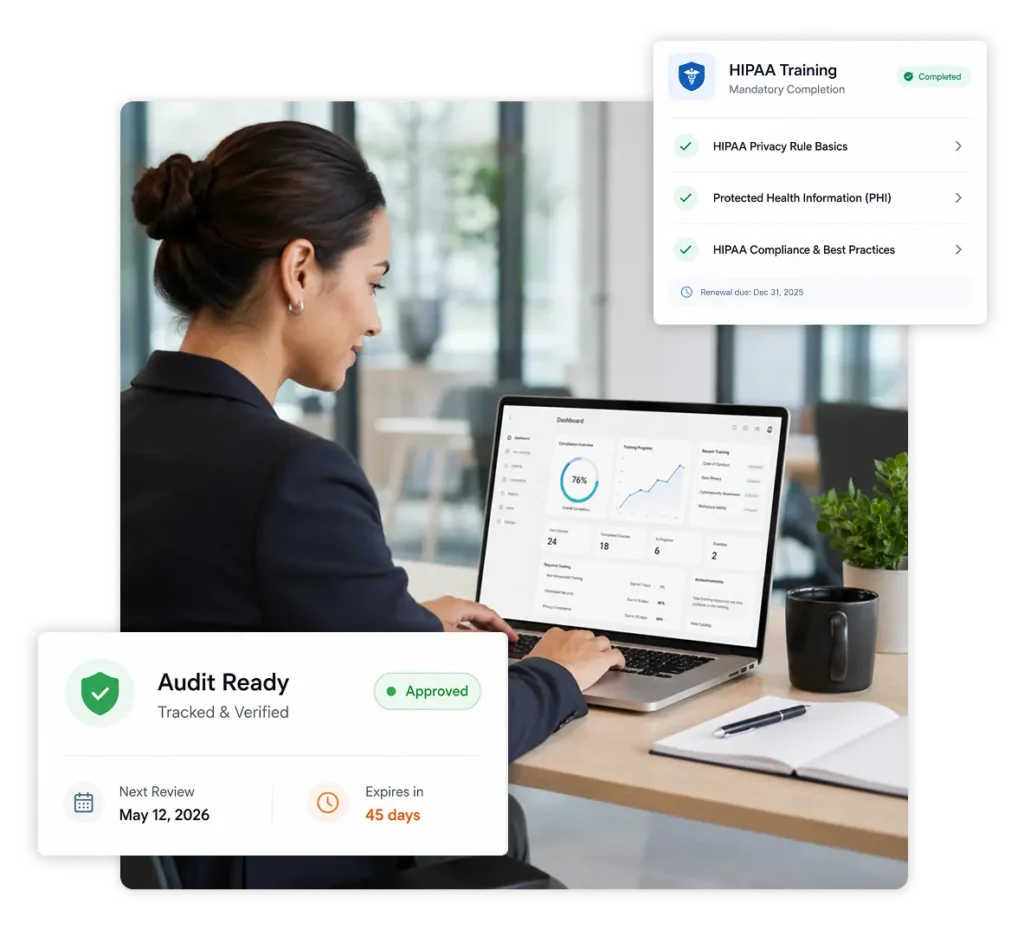
If you cannot prove training happened, it is as though it did not happen at all. A HIPAA compliant LMS one that handles data in line with the Privacy and Security Rules, enforces role-based access, and generates audit-ready completion records is not a luxury for organizations handling PHI at scale. It is a necessity. An LMS or compliance platform that assigns courses, tracks completions, sends automated reminders, and stores certificates gives your compliance program the infrastructure it needs to hold up under an OCR investigation.
- Step 4: Build in Refreshers and Triggers
Set up annual refresher training as a default, and build in triggers for additional training when policies change, new systems are introduced, or incidents occur. Automate these reminders wherever possible so compliance does not depend on someone remembering to act.
- Step 5: Document Everything
HIPAA Compliance Training Checklist
Most organizations know they need HIPAA training. Fewer know exactly what a complete, audit-ready training program looks like in practice. This checklist covers every element your program should have in place, whether you are building from scratch or reviewing an existing one.
Workforce Coverage
- All employees, volunteers, trainees, and workforce members who access PHI have been identified
- Business associates and contractors with PHI access are included in the training plan
- Role-based training tracks exist for clinical staff, administrative staff, IT personnel, and compliance leads
Training Content
- HIPAA Privacy Rule training covering patient rights, permitted uses and disclosures, and minimum necessary standards
- HIPAA Security Rule training covering administrative, physical, and technical safeguards for ePHI
- Breach Notification Rule training covering incident reporting procedures and timelines
- Organization-specific policies and workflows are referenced in the training content, not just generic regulatory definitions
Delivery and Scheduling
- New employees receive HIPAA training before or immediately upon accessing PHI
- Annual refresher training is scheduled for all applicable workforce members
- Training is accessible online and can be completed by remote, shift-based, and multi-location staff
Documentation and Audit Readiness
- Completion records are stored for a minimum of six years per the HIPAA document retention standard
- Each record shows the employee name, training date, course content covered, and the name of the training provider
- Certificates of completion are accessible for review during an OCR investigation or internal audit
- Business Associate Agreements include provisions confirming that the associate's staff have received HIPAA training
Content Currency
- Training materials reflect the current version of the HIPAA Privacy Rule (last updated May 2024 via the Reproductive Health Care rule) and Security Rule
- A review date is documented so training content does not become outdated without notice
- Regulatory updates trigger a content review within 30 days
If you are looking for HIPAA training courses that can be customized to your organization’s specific workflows and compliance requirements, Paradiso provides HIPAA-compliant course content built for healthcare settings, with role-based assignment and audit-ready tracking built in.
HIPAA Training for Specific Healthcare Settings
Paradiso LMS is crafted for partner training ecosystems, offering capabilities that surpass typical LMS features. These tailored solutions yield superior results in scaling diverse partner networks across various regions and roles, outperforming generic platforms that are merely adapted for this purpose.
Small and Independent Practices
Solo practitioners and small practices often struggle with HIPAA training because they lack a dedicated compliance team. The person responsible for training is frequently the same person running the front desk, handling billing, and seeing patients. For these settings, a streamlined, focused training program that covers the essentials without demanding hours of staff time is the right approach. Online self-paced courses are particularly effective here because they fit around patient care schedules.
Multi-Location and Enterprise Health Systems
Larger organizations face the opposite challenge. With hundreds or thousands of employees spread across multiple facilities, role-based training management becomes essential. A centralized LMS that assigns the right training to the right people, tracks completion at the individual and department level, and flags non-compliance before it becomes an audit risk is practically necessary for organizations at this scale.
Telehealth Providers
The expansion of telehealth has introduced new HIPAA training considerations. Providers conducting remote visits need training on the specific requirements for telehealth platforms, including what makes a video platform HIPAA-permissible, how to ensure patient privacy during remote consultations, and what to do when technical issues arise that may expose PHI.
Long-Term Care and Home Health
Get Started with HIPAA Compliance Training
HIPAA training is one of those areas where the cost of getting it right is far lower than the cost of getting it wrong. A properly built program protects your patients, protects your organization, and protects your people from being the unintentional source of a violation.
Whether you are building a training program from scratch, updating an existing one, or looking for a platform that makes compliance management simpler across your workforce, Paradiso LMS is built to handle the complexity. Role-based course assignment, automated reminders, completion tracking, certificate storage, and audit-ready reporting come built in.
Table of Contents
Got Questions?
Frequently Asked Questions
Any person who accesses, uses, or discloses PHI as part of their work must complete HIPAA training. This includes healthcare providers, administrative staff, medical couriers, IT professionals, billing companies, and any contractor classified as a business associate.
HIPAA does not specify a mandatory annual interval, but it requires training upon hire, when policies change, and when job functions change. Annual refresher training has become the industry-standard practice and is what most compliance frameworks and investigators expect to see.
No. HHS does not issue HIPAA certifications for individuals or organizations. What training providers issue are certificates of completion, which serve as documentation that training occurred. These are valuable for compliance purposes but are not government-recognized credentials.
Yes, and for most organizations, online training is the most practical option. It allows flexible scheduling, consistent delivery, automatic completion tracking, and digital storage of certificates, all of which support audit readiness.
Failure to train staff is one of the most commonly cited HIPAA violations during OCR investigations. Penalties can range from $100 to $50,000 per violation depending on the level of negligence, with annual caps reaching $1.9 million per violation category.
A foundational HIPAA training course typically takes between 30 minutes and two hours, depending on depth and format. Role-specific or advanced courses for compliance officers or security personnel can take longer. Most organizations offer shorter focused modules for annual recertification.
Yes. Business associates have independent obligations under HIPAA and are required to train their own staff on the handling of PHI. Covered entities must have signed Business Associate Agreements with these partners, which typically include provisions for training and compliance.