





Why Customer Training LMS Is Essential for Today’s Businesses
Delivering exceptional customer experience has become a key competitive differentiator, and a Customer Training LMS is central to achieving it. By offering tailored, interactive training through a single platform, businesses help customers gain maximum value from their products. This strengthens trust, boosts satisfaction, and increases loyalty. Research from leading analysts also shows that organizations that invest in structured customer education see higher retention rates and improved lifetime customer value.
A Customer Training LMS further enhances the customer journey by streamlining onboarding with clear, guided learning paths that reduce support needs and accelerate time-to-value. It also enables continuous learning through product updates, assessments, and troubleshooting resources—reducing support tickets and fostering product advocacy. With built-in analytics to identify knowledge gaps and refine future training, an LMS becomes a powerful engine for customer success and long-term business growth.

Key Factors to Consider When Choosing a Customer Training LMS
Selecting the right LMS requires careful evaluation of several critical factors. These elements ensure the platform aligns with your organizational goals and provides a seamless learning experience for your customers.
The primary considerations include customization capabilities, user experience, content management, integration options, and security features. Prioritizing these factors helps ensure your investment yields tangible benefits and supports long-term growth.
1. Customizability and Branding Capabilities
An LMS that allows branding customization helps reinforce your company’s identity. Features like logo placement, color schemes, and personalized interfaces create a consistent and professional learning environment. The ability to adapt learning paths, assessments, and content layout further enhances relevance and engagement.
2. User Experience and Accessibility
An intuitive interface streamlines navigation for diverse users. Responsive design ensures accessibility across desktops, tablets, and smartphones. Inclusive features such as multilingual support, WCAG compliance, and assistive technology compatibility broaden participation and improve satisfaction.
3. Content Management and Delivery Options
Robust content management facilitates easy uploading, organizing, and updating of learning materials. Support for various formats—videos, PDFs, SCORM, xAPI—allows flexibility. Features like version control and progress tracking enable continuous content improvement and learner monitoring.
4. Integration Capabilities and Compatibility
Seamless integration with existing enterprise systems such as CRM, ERP, and marketing tools optimizes workflows and data consistency. Support for APIs, LTI standards, and third-party plugins ensures the LMS adapts to evolving technical environments.
5. Support, Security, and Compliance
Reliable technical support minimizes downtime and user frustrations. Security protocols like encryption, secure authentication, and regular vulnerability assessments protect sensitive data. Compliance with regulations such as GDPR, HIPAA, or FERPA is critical for industries with strict data standards.
Comparing Popular Customer Training LMS Solutions
The market offers a variety of LMS options, each with unique features tailored to different organizational needs. Here is an overview of prominent solutions:
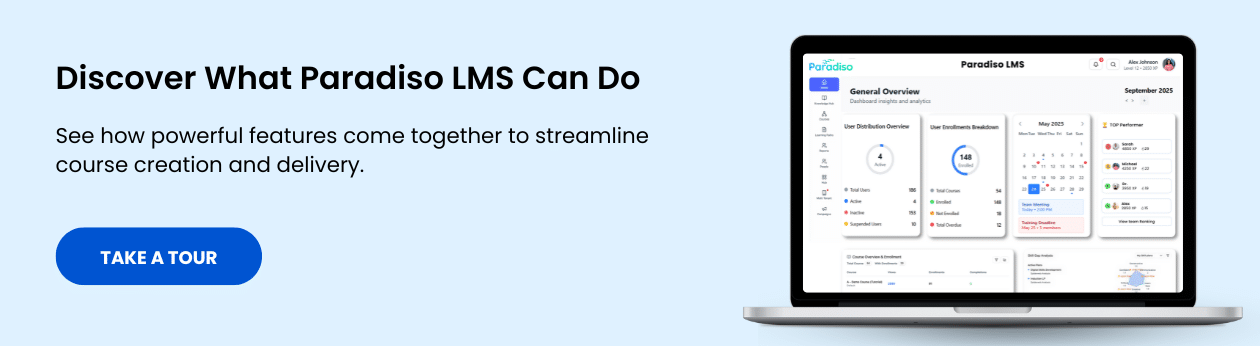
- Paradiso LMS: Paradiso LMS is a highly flexible and customizable platform designed to support diverse customer training needs. It offers robust content management, seamless integrations, and strong scalability, making it suitable for organizations of all sizes.
- Moodle: An open-source platform offering extensive customization; ideal for cost-conscious organizations willing to handle hosting.
- TalentLMS: User-friendly, affordable, suitable for small to medium businesses with straightforward training needs.
- Canvas: Known for its modern interface and collaborative tools, popular in higher education and professional development.
- Docebo: Advanced analytics, AI-powered recommendations, and extensive integrations, suitable for large enterprises.
Choosing among these depends on your organizational size, budget, industry requirements, and specific features desired. Small businesses benefit from simplicity and cost-effectiveness, while larger organizations look for scalability, advanced analytics, and extensive integrations.
Why Paradiso LMS Stands Out for Customer Training
Paradiso LMS stands out as a premium platform for delivering impactful customer training programs. Its versatile features and scalability make it suitable for organizations seeking tailored learning experiences that promote customer success and loyalty.
Why Paradiso LMS Stands Out
Paradiso LMS offers high customization, rich multimedia support, detailed analytics, and seamless integrations. Its flexible architecture allows for personalized learning paths, automations, and extensive branding options, making it ideal for delivering engaging training that aligns with your brand identity.
How Paradiso LMS Meets Your Business Needs
With features like role-based learning, certifications, and blended content delivery, Paradiso LMS adapts to diverse training contexts. Its analytics enable data-driven decisions, while automation reduces administrative overhead. Its ability to support multilingual and mobile learning enhances accessibility across global customer bases.
Seamless Integration with Existing Systems
The platform supports API connections and standards like LTI, facilitating smooth integration with CRMs, ERPs, and third-party content libraries. This connectivity ensures synchronized data, automated workflows, and a unified user experience.
Supporting Your Growth with Scalable Features
Paradiso LMS’s cloud infrastructure scales effortlessly, accommodating expanding user bases without performance issues. Modular features allow adding new functionalities or content, ensuring your platform grows with your organization’s evolving needs.
Best Practices for Choosing the Right Customer Training LMS
Choosing an LMS involves a strategic evaluation process:
- Define Your Goals: Clarify training objectives, target audience, and desired outcomes.
- Assess Features Against Needs: Prioritize essential functionalities such as customization, accessibility, content formats, and integrations.
- Engage Stakeholders: Collect feedback from administrators, trainers, and learners to ensure the platform meets diverse requirements.
- Request Demonstrations and Trials: Test software in real scenarios to evaluate usability and performance.
- Evaluate Support and Security Practices: Ensure the provider offers responsive assistance and adheres to industry-standard security protocols.
- Analyze Total Cost of Ownership: Consider licensing, implementation, maintenance, and scalability costs relative to your budget.
Following these best practices helps you select a platform that aligns with your organizational strategy, provides a positive user experience, and offers long-term value.
Conclusion: Enhance Customer Onboarding with the Right LMS
Choosing the right customer training LMS is a strategic investment that strengthens product adoption, improves customer satisfaction, and reduces support workload. A well-designed platform brings together customization, powerful integrations, and actionable analytics to create a seamless learning experience that supports every stage of the customer journey.
By exploring solutions that align with your goals—and evaluating how each platform can deliver personalized, scalable training—you position your organization to build stronger customer relationships and drive long-term success. The right LMS not only empowers customers to use your product effectively but also helps create a loyal, engaged user community.
Investing in a customer-focused LMS lays the foundation for sustainable growth, higher retention, and a differentiated customer experience. Now is the time to take the next step and adopt a platform that elevates your onboarding and ongoing training strategy.