CME Credits:
The Complete Guide for Healthcare Professionals (2026)
Your complete guide to earning, tracking, and managing CME credits across every role.
Overview:
This guide covers the complete picture of CME credits and continuing medical education for healthcare professionals across the United States. Use it to understand what CME credits are and how they differ from CEUs, find credit requirements by role including physicians, physician assistants, and nurse practitioners, navigate state-by-state licensing requirements and specialty board MOC obligations, understand how ACCME accreditation works and why it determines whether credits count, explore the full range of CME activity types from live conferences and online courses to simulation and journal-based learning, compare free CME options against accredited paid programs, and learn how to track and manage credits across a clinical workforce without gaps in documentation.
Whether you are an individual practitioner managing your own renewal cycle or a hospital administrator responsible for organisation-wide CME compliance, every section is written to give you a direct, actionable answer.
What Are CME Credits?
CME credits, short for Continuing Medical Education credits, are units of measurement that quantify completed educational activities designed to maintain, develop, and improve the knowledge, skills, and professional performance of physicians and other healthcare professionals.
CME is not informal professional development. The activities that generate credits must be provided by accredited organizations, follow structured educational standards, and serve genuine learning objectives grounded in identified gaps in professional practice. That distinction separates CME from general reading, peer conversations, or self-directed learning that happens outside an accredited framework.
In 2024, the accredited CME enterprise reached a record high of $3.7 billion in total reported income, with 95 percent of CME activities measuring learner competence and 46 percent measuring real-world performance change — reflecting how central accredited continuing education has become to improving patient care across the United States. Source: ACCME 2024 Annual Data Report.
AMA PRA Category 1 vs. Category 2 Credits
Not all CME credits carry the same weight. The American Medical Association divides credits into two categories, and understanding the difference matters for anyone managing their own CME portfolio or administering a training program.
AMA PRA Category 1 Credits are the higher standard. They are awarded for activities that meet specific educational design requirements and are provided by organizations accredited by ACCME, state medical societies, or other approved bodies. Category 1 Credits are what most licensing boards, hospital credentialing committees, and certification bodies ask for when they set CME requirements.
AMA PRA Category 2 Credits cover a broader range of self-directed learning activities, including journal reading, teaching, writing, and peer-reviewed educational experiences. They are self-reported rather than formally accredited. Many licensing requirements allow a portion of credits to come from Category 2 activities, but rarely all of them.
CME Credits vs. CEUs: What Is the Difference?
CME credits and CEUs (Continuing Education Units) are related but not the same, and the distinction becomes important when managing credentials across a multi-disciplinary healthcare team.
CME credits specifically apply to physicians and are governed by accreditation standards set by ACCME and its member organizations. CEUs are a broader term used across many professions including nursing, pharmacy, physical therapy, and allied health. One CEU typically equals ten hours of instruction. Nurse practitioners renew through CE hours, pharmacists through CPE (Continuing Pharmacy Education) units, and physical therapists through PDUs (Professional Development Units).
The practical implication for organizations is this: if you are managing a multi-disciplinary clinical team, your compliance tracking system needs to accommodate different credit types, different renewal cycles, and different accrediting bodies simultaneously. A single tracker built only for CME credits will not cover your entire workforce.
CME Credit Requirements by Role
CME requirements are not uniform. They vary by credential type, certifying board, and state licensing authority. Understanding the baseline requirements for each major role is the starting point for any organization building a CME compliance program.
CME Requirements for Physicians (MD/DO)
Physicians face CME requirements from two directions simultaneously: their state medical board, which governs license renewal, and their certifying specialty board, which governs Maintenance of Certification (MOC). Both must be met, and they often have different credit hour requirements, different acceptable activity types, and different cycle lengths.
At the state level, most boards require between 20 and 50 hours of CME per year. The Texas Medical Board requires 24 hours per year, including two hours specifically on medical ethics or professional responsibility. California requires 50 hours per two-year renewal cycle. New York requires 33 hours per three-year cycle, including mandatory coursework in pain management and end-of-life care.
CME Requirements for Physician Assistants (PA)
Physician Assistants are certified by the National Commission on Certification of Physician Assistants (NCCPA) and must meet specific CME requirements to maintain their PA-C credential.
The NCCPA requires 100 CME credits per two-year certification maintenance cycle. Of those 100 credits, at least 50 must be Category 1 from accredited educational activities. PAs must also pass a recertification exam (PANRE or PANRE-LA) every ten years. Source: NCCPA Certification Maintenance - CME Requirements.
CME Requirements for Nurse Practitioners (NP)
NPs also hold state licenses that carry their own CE requirements, separate from national certification renewal. Managing both simultaneously across a team requires a tracking system that distinguishes between the two.
The AANP requires 75 contact hours of continuing education over a five-year certification renewal cycle, with a minimum of 25 hours in pharmacotherapeutics. The ANCC requires 75 contact hours with specialty-specific variations. Source: AANP Certification Renewal Requirements, 2024.
CME Requirements by Specialty
Surgical specialties tend to have among the most structured MOC requirements. The American Board of Surgery requires surgeons to complete at least 90 Category 1 CME credits over each three-year MOC cycle, alongside case reviews and quality improvement participation. Source: American Board of Surgery MOC Requirements.
CME Requirements by State
State licensing requirements for CME vary considerably, and the gaps between states are significant enough to cause compliance failures for professionals licensed in multiple jurisdictions.
Source: Texas Medical Board, Medical Board of California, New York State Education Department Office of the Professions, Florida Board of Medicine, Illinois Department of Financial and Professional Regulation. Requirements subject to change - always verify directly with your state medical board.
CME Accreditation: How It Works
Accreditation is what separates a legitimate CME activity from general professional development. It is the quality assurance layer of the CME system, and understanding how it works matters both for professionals who consume CME and for organizations that provide it.
What Is ACCME and Why It Matters
The Accreditation Council for Continuing Medical Education (ACCME) is the primary accrediting body for CME providers in the United States. When a physician completes a CME activity and receives AMA PRA Category 1 credit, that credit is valid because the activity was provided by an ACCME-accredited organization, or by a state medical society operating under ACCME standards.
As of 2022, ACCME had approximately 760 accredited providers across the United States, including medical schools, hospital systems, specialty societies, and independent CME companies. Source: ACCME 2022 Annual Report.
ACCME operates a tiered accreditation system. Providers who meet the full ACCME Accreditation Criteria receive standard accreditation. Those demonstrating exceptional compliance can achieve Accreditation with Commendation, a distinction that reflects a higher level of organizational commitment to educational quality and independence.
The ACCME also oversees joint accreditation programs, where a single activity can simultaneously award credit for multiple professions, covering physicians, nurses, pharmacists, and other allied health professionals in one educational event.
MOC and Maintenance of Certification
Maintenance of Certification (MOC) is the ongoing process through which board-certified physicians demonstrate that they are maintaining competency in their specialty over time. MOC programs are administered by the 24 member boards of the ABMS, each setting its own requirements.
CME credits are a core component of most MOC programs, but not the only one. Most programs also require formal knowledge assessments, practice quality improvement activities, and in some cases patient safety training. Managing physician MOC compliance requires visibility into multiple activity types, not just credit hours.
Types of CME Activities
Not all CME looks the same. The educational landscape for healthcare professionals has expanded substantially over the past decade, and understanding the full range of activity types helps organizations build more effective and varied learning programs.
Live conferences and symposia
In-person events offer networking, hands-on workshops, and direct interaction with faculty and peers. According to ACCME data, live activities continued to account for a significant portion of total CME hours in 2022, even following the pandemic-driven shift toward online delivery.
Online and enduring material
Online CME has grown substantially and now represents the most accessible route to credits for many practitioners. Enduring materials, including web-based modules, recorded lectures, journal-based CME, and podcast-based learning, can be completed on flexible schedules that live conferences cannot offer. A 2020 analysis in JAMA noted a dramatic acceleration in online CME participation during the COVID-19 pandemic, and subsequent years have confirmed that much of that shift was permanent. Source: JAMA, 2020.
Simulation-based CME
Increasingly recognized for procedural specialties where hands-on practice is as important as cognitive knowledge. Surgical simulation, resuscitation training, and point-of-care ultrasound programs often carry CME credit through their accredited educational components.
Performance Improvement CME (PI CME)
Journal-based CME
Allows physicians to earn credits by reading peer-reviewed articles and completing associated assessments. Particularly well-suited to specialists who closely follow literature in their field. Publications including the New England Journal of Medicine and JAMA offer accredited journal CME activities, often included in subscription access.
How to Track and Manage CME Credits
Tracking CME credits is one of the most commonly mishandled aspects of professional compliance in healthcare. The requirement is clear. The documentation standards are specific. Yet under-tracking, lost records, and last-minute scrambles ahead of license renewal deadlines are remarkably common.
Manual vs. Digital CME Tracking
Manual tracking through paper logs, spreadsheets, or personal folders of PDF certificates is the default for many individual practitioners. It works until it does not. A license renewal application requiring documentation of 50 hours over two years, produced under deadline pressure, is not the moment to discover that three completion certificates went to an old email address.
Digital tracking tools range from basic credit portfolio platforms like the AMA CME Passport and the NCCPA tracking portal, to integrated learning management systems that combine course delivery, credit tracking, completion documentation, and compliance reporting in a single platform.
The ACCME’s Program and Activity Reporting System (PARS) is the official mechanism through which accredited providers report CME activities. For physicians using ABMS-member board MOC portals, credits earned through accredited activities can be transferred automatically from some provider systems, eliminating manual re-entry and the data integrity risks that come with it.
What a CME Management System Should Include
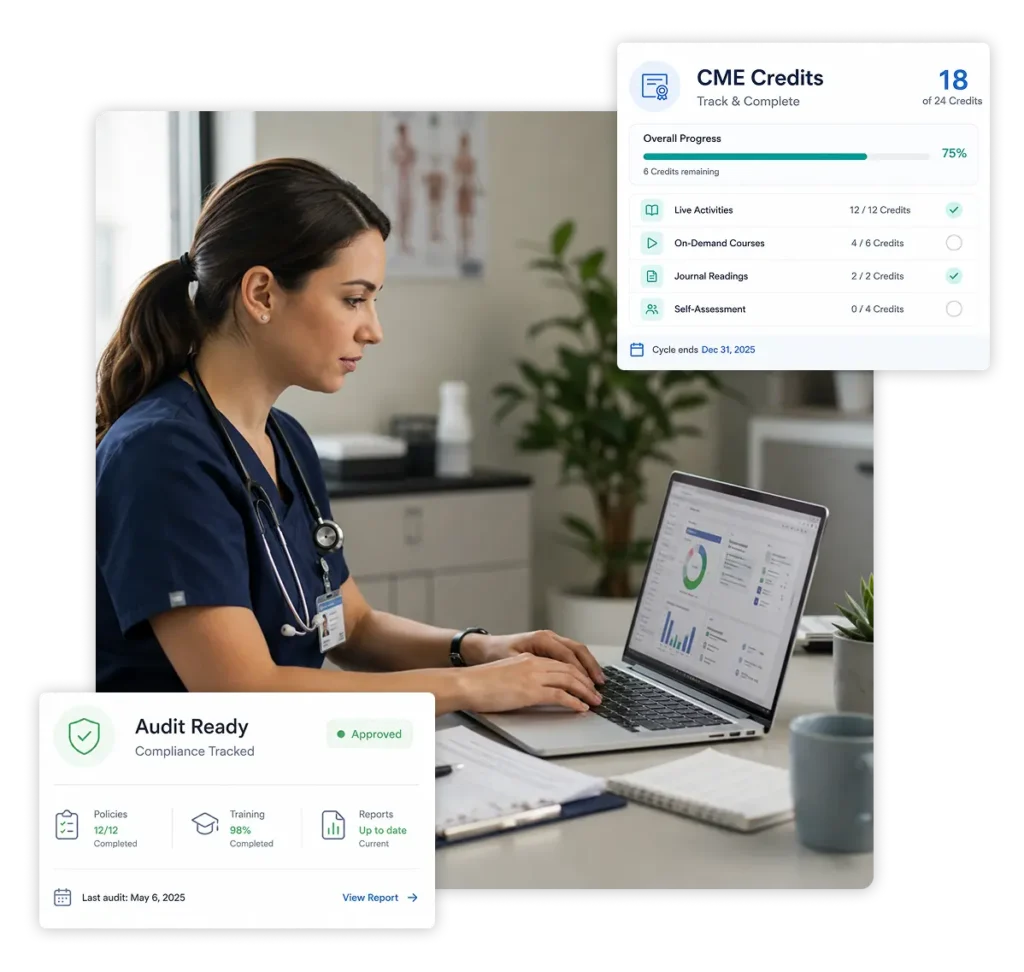
For hospitals, health systems, medical societies, and independent CME providers managing credits at scale, a dedicated CME tracker platform does considerably more than a spreadsheet ever could. The right system centralises credit logging, automates compliance reporting, and gives administrators real-time visibility into their entire workforce’s CME status.The core capabilities an effective system requires include:
- Credit tracking and portfolio management for individual learners, including multi-source activity logging, certificate storage, and on-demand summary reporting
- Role-based compliance dashboards with real-time visibility into workforce completion status, upcoming deadlines, and compliance gaps
- Automated reminders and deadline alerts for both learners and administrators
- Accreditation reporting support for organizations that are themselves CME providers and need to report to ACCME through PARS
- Content delivery capabilities for organizations offering CME courses internally rather than directing staff entirely to third-party providers
- Integration with HR, credentialing, and EHR systems to connect training data with broader workforce management
How an LMS Simplifies CME Credit Management
The growth of online CME has made the question of delivery infrastructure unavoidable. When an organization wants to offer accredited CME internally, track completion across a clinical workforce, issue certificates, and report to accrediting bodies, those functions require a system capable of handling them reliably and at scale.
This is where a CME LMS a learning management system built specifically for continuing medical education environments becomes the operational core of a CME program, serving two distinct groups with overlapping needs.
For CME providers and medical education organizations
A medical education platform serves as the infrastructure through which courses are built, hosted, and delivered to learners. It handles enrollment, progress tracking, post-test administration, certificate generation, and in integrated environments, activity reporting to PARS or similar systems. Managing these functions across separate tools for content hosting, assessment, learner management, and reporting introduces friction, data integrity risks, and administrative overhead that grows with every course added to the catalog.
For hospitals, health systems, and multi-specialty practices
An LMS functions as the compliance and tracking infrastructure. It enables administrators to assign mandatory CME requirements to specific roles, track completion in real time, send automated reminders ahead of renewal deadlines, and generate audit-ready reports that demonstrate organizational compliance. When credentialing committees or accrediting bodies ask for evidence that clinical staff have met their CME obligations, the answer is a report, not a file cabinet.
The two functions are not mutually exclusive. An organization that is both a CME provider and a healthcare employer, such as an academic health center, needs an LMS that handles content delivery and compliance tracking simultaneously.
Key capabilities that distinguish a CME learning management system from a generic corporate learning platform include HIPAA-compliant data handling, SCORM and xAPI content compatibility for third-party CME content, integration with HR and credentialing systems, support for CE credit tracking across multiple credential types, and certificate generation that meets accrediting body documentation standards.
Platforms like Paradiso LMS for CME are designed specifically for this environment, supporting both CME course delivery for education providers and organizational compliance tracking for healthcare employers within a single system. For organizations evaluating options, the questions worth asking are: Can it handle the credit types your workforce earns across different roles? Can it integrate with your HR and credentialing systems? And can it produce the documentation your accrediting bodies actually require?
CME in the Digital Age: Trends Shaping How Credits Are Earned
One of the most common questions healthcare organizations ask is: how often is HIPAA training required? The direct answer is that HIPAA does not specify a fixed annual requirement. What it requires is training when workforce members are hired, when functions change, and whenever policies or procedures are updated. It also requires that training be appropriate to each person’s role.
Online CME adoption has not reversed
A 2020 analysis in JAMA noted that online CME participation increased dramatically during the pandemic, and subsequent years have confirmed that a significant portion of that shift was permanent. Learners who discovered the flexibility of online CME during travel restrictions did not abandon it when restrictions lifted. Source: JAMA, 2020.
Microlearning formats are gaining ground
Traditional CME assumed blocks of uninterrupted learning time. Clinical reality rarely provides those. Short focused modules of fifteen to thirty minutes that address a specific clinical question fit more naturally into the gaps between patient encounters. ACCME has provided guidance supporting shorter format activities that meet accreditation standards.
AI-assisted learning personalization is emerging
Some CME platform now use learner data to recommend activities based on identified knowledge gaps, practice patterns, or specialty-specific literature. While still early in adoption, this personalization layer has the potential to make CME genuinely more relevant to individual practice.
Integration with EHR and clinical data is increasing
Building a CME Compliance Program for Your Organization
Individual CME management and organizational CME management are fundamentally different problems. A physician managing their own portfolio needs a reliable tracking tool and a calendar reminder. A hospital managing CME compliance across 300 physicians, 150 nurse practitioners, and 200 physician assistants needs a system, a process, and accountability structures.
Centralize tracking without controlling activity selection
They centralize tracking without controlling activity selection. Healthcare professionals have legitimate autonomy in choosing CME activities relevant to their practice. The compliance program does not need to dictate which conferences to attend or which online modules to complete. It does need to capture what was completed, document it properly, and flag gaps before they become license renewal problems. An LMS for continuing education that accepts externally earned credits alongside internally delivered ones achieves this balance, giving administrators a complete picture of compliance without restricting how learners earn their hours.
Differentiate requirements by role from day one
A generalized all-staff CME policy breaks down immediately when applied across a workforce with physicians, PAs, NPs, pharmacists, and allied health professionals who each have different requirements from different credentialing bodies. Role-based tracking, where each track reflects actual requirements for that credential type, is far more accurate and easier to manage.
Build renewal cycles into your operating calendar
License and certification renewal deadlines are knowable in advance. Automated reminders set at 120 days, 60 days, and 30 days before individual renewal deadlines keep both learners and administrators ahead of the curve.
Keep documentation audit-ready at all times
Credentialing committees, hospital privileging processes, and state licensing boards can all request CME documentation with short notice. Organizations whose records exist in individual email inboxes rather than a centralized, searchable system are one credentialing audit away from a significant administrative problem.
Account for externally earned credits
A significant portion of the CME credits a clinical workforce earns will come from outside the organization’s own learning platform: specialty conferences, journal-based activities, webinars from professional associations, and self-directed online modules. A compliance program that only tracks internally delivered training will consistently undercount total credit hours.
The Business of CME: Understanding the Provider Ecosystem
A HIPAA training program that actually protects your organization is not a single course delivered once. It is a structured, documented, and maintained system that evolves with your organization and the regulatory environment.
The global continuing medical education market was valued at approximately $9.8 billion in 2021, with consistent growth projected through the decade driven by increasing regulatory requirements and the expansion of online CME delivery. Source: Grand View Research, CME Market Analysis, 2022.
Joint accreditation allows a single educational activity to simultaneously award credit for physicians, nurses, and pharmacists, administered through the Joint Accreditation for Interprofessional Continuing Education, a partnership between ACCME, ANCC, and ACPE. For organizations delivering education to multi-disciplinary clinical teams, joint accreditation significantly simplifies administrative overhead.
Commercial support plays a meaningful role in funding CME, particularly in specialties where pharmaceutical and device innovation drives significant educational need. ACCME standards require absolute independence between educational content decisions and funding sources. Providers who accept commercial support must follow the ACCME Standards for Integrity and Independence in Accredited Continuing Education.
Get Started with CME Credit Management
Whether you are an individual practitioner managing your own portfolio or an organization responsible for CME compliance across a clinical team, having the right infrastructure in place makes the difference between a compliance program that works and one that creates risk.
Accreditation requirements, credit types, role-specific thresholds, and state-specific rules are complex. Managing them across a workforce of any size through manual processes introduces gaps that tend to surface at the worst possible moment: at renewal time, during a credentialing review, or in the context of a compliance audit.
An LMS built for CME management changes that equation. It centralizes course delivery and tracking, automates compliance reporting, and gives both learners and administrators a single source of truth for credit status and documentation.
Table of Contents
Got Questions?
Frequently Asked Questions
CME stands for Continuing Medical Education. It refers to the structured, accredited educational activities that healthcare professionals are required to complete on an ongoing basis to maintain their licenses and certifications. The abbreviation CME is sometimes confused with the Chicago Mercantile Exchange in non-medical contexts.
A CME credit is a unit representing one hour of completed, accredited educational activity. Credits quantify the amount of continuing medical education a healthcare professional has completed within a given period and are the primary currency for demonstrating compliance with licensing and certification renewal requirements.
CME credits apply specifically to physician-facing education governed by ACCME standards. CEUs are a broader term used across many healthcare professions including nursing, pharmacy, and allied health. One CEU equals ten contact hours of instruction. The terms are not interchangeable across different professional credential systems.
Options range from manual tracking with personal spreadsheets to digital portfolio tools like the AMA CME Passport and NCCPA tracking portal, to integrated learning management systems that combine credit tracking with course delivery, automated reminders, and audit-ready reporting for administrators managing team compliance.
Individual practitioners are ultimately responsible for their own CME completion and documentation. However, hospitals, health systems, and medical groups increasingly take an organizational role in supporting and tracking CME compliance across their workforce, both to protect credentialing processes and to ensure clinical staff training requirements are met consistently.
A continuing education LMS for medical professionals should support multiple credit types (AMA PRA Category 1, AOA, ANCC, ACPE) to cover multi-disciplinary teams, integrate with HR and credentialing systems to keep compliance records aligned with workforce data, generate certificates that meet ACCME and state board documentation standards, send automated deadline reminders, and produce audit-ready compliance reports at both the individual and organisational level. HIPAA-compliant data handling is also essential given the sensitive nature of healthcare workforce records.