Healthcare Learning Management System (LMS): The Complete Guide
Overview
Whether you are a compliance officer preparing for the next audit, an L&D leader evaluating platforms for the first time, or a director trying to unify internal and external training onto one system, every section here is written to give you a direct, actionable answer.
Why Healthcare Organizations Need a Dedicated LMS (Not a Generic One)
Ask anyone who has run compliance training on a generic corporate LMS, and they’ll tell you the same thing: it works, until an auditor asks for proof. Healthcare training ties back to a rule someone can be tested against, HIPAA, OSHA, CMS, or a state licensing board, so it demands individual-level tracking, audit-ready reporting, and healthcare-grade data handling from day one. That’s the gap a healthcare LMS is built to close.
Most organizations discover this mid-audit, when a spreadsheet stops being “good enough.” Many run two separate systems, internal compliance in one tool and external training for partners or patients in another, doubling cost and fragmenting reporting. Consolidating both under one platform with a single BAA is usually the biggest efficiency win available.
Comparing vendors? See our best healthcare LMS guide. Need the broader picture? Check our learning and development guide. Ready to see one in action? Book a demo.
What is a Healthcare Learning Management System?
A healthcare learning management system is software that lets healthcare organizations create, assign, deliver, and track training for both clinical and non-clinical staff, while producing the audit-ready records that regulators and accreditors expect. Unlike a general-purpose LMS, it’s built around compliance from the ground up, with HIPAA-aligned data handling, certification tracking, and role-based learning paths built into the core product rather than added as an afterthought.
In practice, that means a hospital can assign HIPAA refreshers to every employee, track exactly who completed them and when, and pull a complete compliance report the moment a surveyor asks for one, instead of scrambling to reconstruct it from memory and email threads. It means a pharmaceutical company can run GxP training with full version control and audit trails that hold up under FDA scrutiny. And it means a healthcare association can deliver continuing education credits to thousands of members without a spreadsheet anywhere in sight.
The platform typically covers three connected jobs at once: internal staff compliance (the mandatory training every employee has to complete on a schedule), external training (onboarding partners, customers, patients, or research participants), and the accreditation layer that ties both back to a regulatory body. Most legacy setups handle these three jobs across two or three separate tools. A modern healthcare LMS is built to run all of them from one place.
Buyers are typically L&D leaders, compliance officers, quality directors, and education leads, while the people actually logging in day to day are clinicians, nurses, allied-health staff, administrative teams, and often external partners or learners too. That range of users is exactly why role-based learning paths matter so much here: a nurse’s required training list looks nothing like a billing coordinator’s, and the platform needs to route each of them to the right content automatically, without an administrator manually assigning courses one person at a time.
According to a 2026 market analysis from Vantage Market Research, the global healthcare LMS market was valued at roughly $3.8 billion in 2025 and is projected to reach $11.6 billion by 2035, growing at close to 12% a year. The report ties that growth directly to regulatory training mandates, workforce digitization, and clinical risk mitigation, not just general demand for e-learning software. In other words, this isn’t a “nice to have” software category anymore. It’s becoming core healthcare infrastructure, in the same category as the EHR itself.
Healthcare LMS vs Generic LMS: Key Differences
| Requirement | Generic LMS | Healthcare LMS |
|---|---|---|
| Business Associate Agreement (BAA) | Usually not offered | Signed before contract execution |
| PHI-grade data handling | Not designed for it | Built in from the core architecture |
| Role/licensure-based learning paths | Manual workarounds required | Native, mapped to clinical roles |
| Audit-ready reporting | Needs manual cleanup and formatting | Generated on demand, ready for surveyors |
| Pre-built compliance content | Rare or generic | HIPAA, OSHA, and clinical libraries included |
| EHR/EMR and CE/CME tracking | Requires custom development | Native integration paths |
What Training is Actually Required in Healthcare?
- HIPAA privacy and security training, for anyone who could reasonably encounter protected health information
- OSHA bloodborne pathogens and exposure control training, for clinical and support staff with occupational exposure risk
- Infection control and hand hygiene training is refreshed on a recurring cycle rather than a one-time onboarding event
- Fire safety, emergency preparedness, and life-safety drills, tied to facility accreditation requirements
- Workplace violence prevention training, increasingly mandated at the state level for healthcare settings
- Advance directives, resuscitation policy, and patient-rights education, particularly for clinical and case-management staff
On top of the content itself, the timing matters just as much. Per CMS Conditions of Participation guidance, many of these requirements need to be completed within 90 days of hire and then repeated annually, and the Joint Commission requires documented competency assessment on a defined cycle, not just a one-time completion checkbox. A healthcare LMS should be able to enforce both the content list and the timing automatically, flagging anyone who falls out of cycle before it becomes an audit finding.
Why Healthcare Organizations Need an LMS
Healthcare training isn’t just about capability. It’s about evidence. Regulators including CMS, the Joint Commission, OSHA, and the agencies enforcing HIPAA all expect organizations to prove, on demand, that specific people completed specific training by a specific date. A general LMS can deliver the course. It usually can’t produce that proof without someone stitching spreadsheets together the night before an audit, which is exactly the position no compliance officer wants to be in.
The cost of getting this wrong is not theoretical. Per the HIPAA Journal’s 2026 penalty update, civil monetary penalties for HIPAA violations now range from $145 up to roughly $2.19 million per violation, depending on the level of culpability the Office for Civil Rights finds during its investigation. Enforcement activity has stayed active too: OCR-related fines topped $15 million across 2024 and 2025 combined, according to compliance-tracking firm Censinet, with risk analysis failures behind the majority of 2025’s enforcement actions. Training gaps are frequently named directly in the corrective action plans that follow a settlement, which makes training infrastructure a genuine line item in an organization’s regulatory risk profile, not just an HR nicety.
Regulatory Compliance & Audit-Ready Reporting
Reducing Training Costs & Admin Time
Supporting Clinical & Non-Clinical Staff at Scale
Key Features of a Healthcare LMS

| Feature | Why It Matters in Healthcare |
|---|---|
| HIPAA-aligned data security | Protects PHI and satisfies the security posture regulators and hospital CISOs require before approving a vendor |
| SCORM / xAPI / AICC support | Ensures courses run and report correctly across systems, including years of legacy content |
| EHR/EMR integration | Connects training and credentialing to the clinical systems staff already use every day |
| Built-in authoring tools | Lets teams build or update compliance content without licensing a separate authoring product |
| CE/CME credit tracking | Automates credit delivery, renewal reminders, and accreditation reporting to the bodies that require it |
| Mobile access & offline learning | Reaches shift-based, non-desk staff wherever and whenever they're working |
| Automated compliance reports & dashboards | Produces audit-ready evidence in seconds instead of days of manual assembly |
| Competency management & skills validation | Ties completion to demonstrated skill, not just a checked box, satisfying Joint Commission competency rules |
HIPAA-Aligned Data Security and the Certifications That Matter
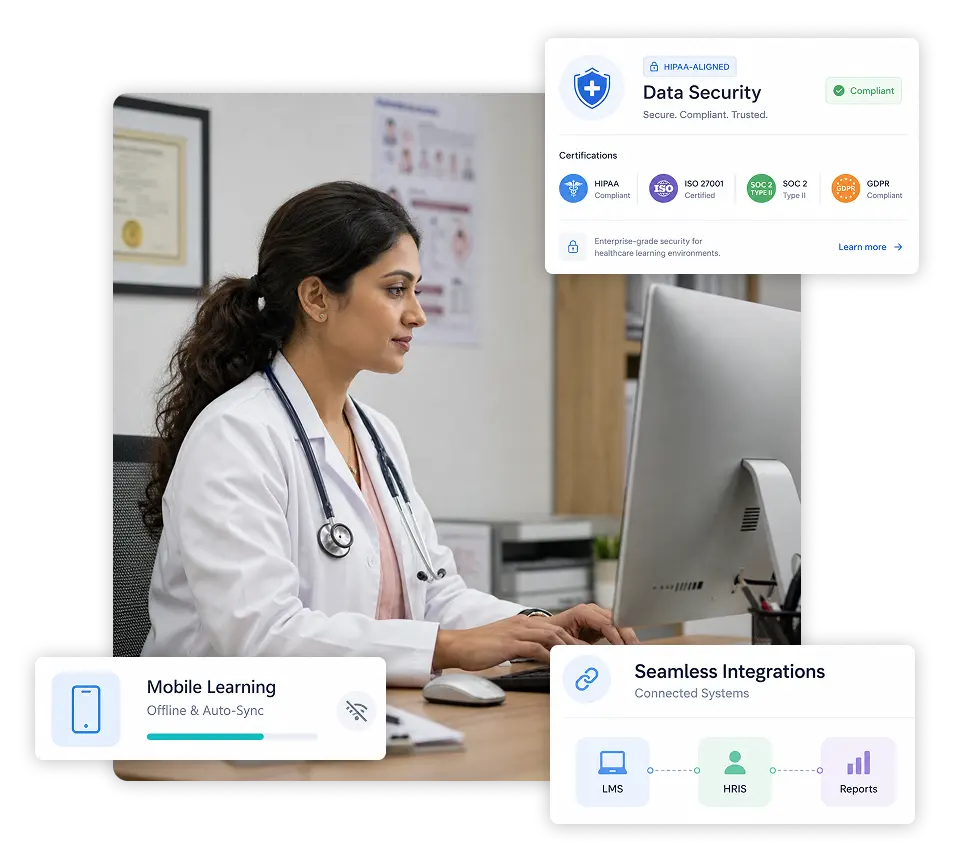
It’s worth being precise about terminology here: there is no official government “HIPAA certification” body, so any vendor claiming to be “HIPAA-certified” should be able to name the specific independent audit or attestation behind that claim. Paradiso is HIPAA-compliant and independently audited, and separately holds SOC 2 and ISO 27001 certifications, with GDPR support for organizations operating in the EU.
Beyond these, HITRUST CSF is increasingly treated as the healthcare-specific gold standard for security assurance, and it’s a reasonable, specific question to ask any vendor during evaluation, alongside SOC 2 and ISO 27001. Our HIPAA-compliant LMS guide goes into exactly what to check for here.
SCORM / xAPI / AICC Support
Healthcare organizations rarely start from zero when they adopt a new LMS. Most have years of existing SCORM or AICC content built up across multiple previous platforms, and a modern LMS needs to run that content without forcing a costly rebuild from scratch. xAPI support adds the ability to capture richer learning data, including activity that happens outside the LMS itself, like simulation exercises or mobile microlearning sessions.
EHR/EMR Integration (Epic, Cerner)
Built-in Authoring Tools
Compliance content changes constantly. Policies get updated, procedures shift after an incident review, and generic off-the-shelf courses often need customization to reflect an organization’s specific workflows and terminology. Built-in authoring means that customization happens inside the LMS itself, instead of requiring a separate piece of software and a separate export-and-upload process every time something changes.
CE / CME Credit Tracking
For associations, academic medical centers, and any organization delivering continuing education, credit tracking isn’t optional, it’s the entire product. It needs to log completed credits accurately, flag renewal deadlines before they lapse, and report to accrediting bodies without manual reconciliation at the end of every cycle. Our CME learning management guide covers exactly how this workflow should function.
Mobile Access & Offline Learning
Nurses, home health aides, and site coordinators rarely sit at a desk during a shift. A healthcare LMS needs to work cleanly on a phone and ideally needs to keep functioning when connectivity drops mid-shift in a basement unit or a rural home visit, syncing progress automatically once the connection returns rather than forcing someone to redo a module they already completed.
Automated Compliance Reports & Dashboards
The difference between an audit that takes days and one that takes seconds usually comes down to whether reporting is automated in the first place. Dashboards that surface completion rates, overdue training, and expiring certifications in real time turn compliance from a periodic scramble into a routine, almost boring check, which is exactly the outcome a compliance officer should want, and it’s usually the single feature that pays for the platform on its own.
Competency Management & Skills Validation
VR & Simulation-Based Training
Healthcare LMS Integrations
Training data is most useful when it connects to the systems an organization already runs, rather than sitting in its own silo. Beyond EHR/EMR integration, a healthcare LMS should reasonably be expected to connect to:
- HRIS/HCM platforms such as Workday, syncing new hires, role changes, and terminations automatically
- SSO and SAML providers, so staff log in with the same credentials they use everywhere else
- Video conferencing tools like Microsoft Teams, for instructor-led and virtual classroom sessions
- External content libraries, so licensed course catalogs can sit alongside internally built content
- Calendar and scheduling systems, to keep training deadlines visible where staff already plan their day
Beyond system integrations, accessibility is worth a direct mention too: WCAG, Section 508, and ADA compliance are increasingly a procurement checkbox for both staff-facing and patient-facing content, and it’s a fair question to raise with any vendor during evaluation rather than assuming it’s covered.
AI in Healthcare Training: What's Actually Changing

Adaptive learning paths
Instead of assigning the same fixed curriculum to everyone in a role, AI can route staff to the specific modules tied to their actual competency gaps, skipping content they’ve already demonstrated proficiency in and spending more time on the areas an assessment flagged as weak.
AI-assisted course authoring
Building and updating compliance content is one of the biggest bottlenecks healthcare L&D teams face. AI authoring tools can convert existing policy documents, slide decks, or meeting recordings into structured, trackable courses in a fraction of the time a manual build would take, which matters most for teams without a dedicated instructional design function.
AI Roleplay for high-stakes conversations
Perhaps the most healthcare-specific application, AI Roleplay lets staff practice difficult, high-stakes conversations, patient communication, de-escalation, consent discussions, through realistic, adaptive simulations with personalized feedback after every session. It’s covered in more depth in the skills section below, since it’s less a platform feature and more a training method.
Core Healthcare Skills Delivered Through an LMS
Clinical Competency & Patient Safety Skills
This covers the core clinical training every role requires: procedural competencies, infection control, medication safety, and specialty-specific skills tied to licensure. It’s usually the largest content category by volume, and the one most closely tracked against accreditation standards.
Regulatory & Compliance Skills
AI Roleplay for High-Stakes Conversations
Some of the hardest skills to teach are the ones slides and quizzes can’t really simulate: difficult diagnoses, de-escalation, consent conversations, and handling an upset family member. AI Roleplay gives staff realistic, adaptive practice for these exact conversations, with personalized feedback after every session, so they walk into the real thing already having rehearsed it rather than winging it for the first time with an actual patient.
Onboarding & Role Transition Skills
Leadership & Non-Clinical Staff Skills
Healthcare LMS for Every Care Setting

LMS for Hospitals & Health Systems
LMS for Healthcare Compliance Training
LMS for Healthcare eLearning & Online Delivery
Microlearning for Healthcare Staff
Long courses are hard to fit into a 12-hour shift, and traditional hour-long modules often get abandoned halfway through when a patient call comes in. Short, focused microlearning modules let staff complete training in the gaps between patients or tasks, a few minutes at a time, which measurably improves completion rates for a workforce that rarely has an uninterrupted hour to spare for anything, let alone training. It also tends to improve retention, since shorter, more frequent sessions are generally easier to remember than one long annual session crammed in during onboarding week.
LMS for Pharma & Life Sciences
Pharma and biotech companies operate under GxP regimes, which means SOP training, quality documentation, and validated version control all need to be airtight enough to survive an FDA inspection. On top of regulatory training, commercial teams and medical science liaisons need enablement content that keeps pace with product updates and evolving clinical data, often across global teams working in different regulatory environments simultaneously. Our LMS for pharmaceutical industry page covers this use case in full, including how validation and audit trails fit into the platform itself.
LMS for Medical Device Sales Training
That’s extended-enterprise training to an external audience that still touches regulated clinical environments, and it requires multi-tenant delivery with certification tracking and product-update distribution built directly into the platform, rather than emailed PDFs and a hope that people read them.
Patient & Member Education
This is a growing extension of the “external training” half of the two-systems problem, and it’s worth confirming that a vendor can deliver a distinct, branded experience for patients or members separate from the internal staff environment.
How to Choose the Best Healthcare LMS
Picking the right platform comes down to matching your actual requirements to what a vendor can prove, not just what they claim on a landing page. Here’s a practical sequence to work through before signing anything:
- Map your training audiences first: List every group that needs training, internal staff, external partners, patients, or research participants, before you look at a single vendor demo.
- Confirm HIPAA compliance and BAA availability in writing: A vendor that won't commit to a signed BAA before contract execution isn't usable for regulated training, no matter what else they offer on paper.
- Check integration compatibility with your EHR/EMR and HRIS: Training data that can't connect to the systems you already run creates a second silo instead of solving the first one.
- Evaluate reporting speed, not just reporting existence: Ask how long it takes to generate a full compliance report across departments and insist on a live demonstration rather than a slide showing a mockup.
- Test the mobile and offline experience yourself: If your workforce is shift-based, this isn't a nice-to-have feature; it's the difference between real adoption and a platform nobody uses.
- Ask about content, not just the platform: Find out whether pre-built compliance courses are included, editable, and kept current as regulations change year over year.
- Get a transparent view of total cost, including customization: Enterprise suites often bundle customization into an inflated base price. Ask for it quoted separately so you can actually compare vendors apples to apples.
Questions to Ask Healthcare LMS Vendors
- Will you sign a Business Associate Agreement before we sign the contract, not after?
- What certifications do you hold beyond a general HIPAA claim, such as SOC 2, ISO 27001, or HITRUST?
- Can one platform genuinely handle both our internal staff compliance and our external training audience?
- How long does it actually take to generate a compliance report across every department, demonstrated live?
- Do you integrate with our specific EHR/HRIS systems, and has that exact integration been done successfully before?
- Is customer data ever used to train your AI features, and can those AI features be switched off entirely if needed?
- What does data migration from our current platform actually look like, timeline, effort, and who does the work?
Healthcare LMS Pricing: What Drives the Cost
5 Best Healthcare Learning Management Systems
| Vendor | Best For | HIPAA / BAA | Internal + External Unified | Notable Strength |
|---|---|---|---|---|
| HealthStream | Large hospitals needing deep internal compliance content | HIPAA-focused positioning | Primarily internal | Long-standing compliance content library |
| Paradiso LMS | One platform for staff compliance + external training | HIPAA-compliant, audited; BAA before contract; SOC 2, ISO 27001 | Yes, natively | Clinical research fit; lower total cost than enterprise incumbents |
| Relias | Clinical content with strong analytics | HIPAA-focused positioning | Primarily internal | Established clinical content and reporting tools |
| MedTrainer | Smaller clinics and ambulatory practices | HIPAA-focused positioning | Primarily internal | Simple OSHA/HIPAA suite for low-IT-footprint teams |
| Docebo | Large enterprises needing a general, configurable LMS | Verify directly; not healthcare-specific by default | Configurable, not native | Scale and configurability across use cases |
Healthcare LMS Implementation: What to Expect
Epic / EHR Go-Live Training for Clinical Staff
EHR/HRMS Integration
Data Migration & Onboarding Timeline
Driving Completion: Adoption & Change Management
ROI of a Healthcare Learning Management System
There’s a time-value calculation worth running for your own organization too. If a compliance team currently spends, say, two full working days pulling together records ahead of every audit or survey, and an LMS turns that into an on-demand report generated in seconds, the hours saved compound across every department and every audit cycle in a year. For an organization that faces four to six survey or audit events annually across multiple departments, that alone can recover dozens of staff-days a year that would otherwise go into manual record assembly instead of patient care or compliance improvement work.
Layer in reduced instructor-led training costs, lower turnover-related retraining expenses, and faster onboarding for a shift-based workforce, and the platform typically pays for itself well before the first contract renewal comes around. The roughly 12% projected annual growth in the healthcare LMS market itself, per Vantage Market Research’s 2026 report, suggests more organizations are reaching that same conclusion every year, and are choosing to make the switch rather than continue absorbing the hidden cost of manual compliance work.
Conclusion
A healthcare LMS earns its place for one reason: healthcare training gets judged on proof, not effort. Every section above points back to the same throughline — HIPAA-aligned security, audit-ready reporting, and role-based paths for clinical and non-clinical staff are what let an organization walk into a survey with evidence already assembled instead of a scramble to reconstruct it after the fact. Getting there comes down to matching your actual audiences, integrations, and reporting needs against what a vendor can demonstrate live, not what they promise on a sales call.
Request a demo and see how a HIPAA-certified LMS with a signed BAA, audit-ready reporting, and role-based learning paths can replace the two-system problem with one platform your compliance team can actually trust.
Table Of Contents
Got Questions?
Frequently Asked Questions
Can’t find what you’re looking for? Talk to our team.
A healthcare LMS is a learning management system built specifically for regulated healthcare training, with individual-level tracking, audit-ready reporting, and HIPAA-aligned data security built into the core platform rather than added on afterward as a workaround.
Not quite. Compliance training is one major use case, but a full healthcare LMS also supports clinical education, onboarding, CE/CME credit tracking, and external training for partners or patients, all delivered from one platform instead of several.
Yes, if any training data touches protected health information or the platform is used by a covered entity or business associate. Look for HIPAA-compliant, independently audited status paired with a signed Business Associate Agreement, not just a general compliance claim on a website.