What Is Corporate Training? A Complete Guide to Modern Workplace Learning
Understand how corporate training works, the programs organisations use and the steps required to improve employee skills and business performance.

Written & Reviewed By
Pradnya Maske

Product Marketing Manager · Paradiso eLearning · 10+ Years in L&D
Quick Answer
Corporate training can be delivered through classroom instruction, online courses, virtual sessions, mentoring, simulations and on-the-job learning. HR and L&D teams typically manage these programs and measure their impact through completion, skill improvement and workplace performance.
Key Takeaways
- Corporate training develops capabilities employees need for current and future roles.
- Common programs include onboarding, compliance, technical, sales and leadership training.
- Training may be delivered in person, online or through blended learning.
- Effective programs connect learning outcomes to measurable business goals.
Introduction
Corporate training is the structured process organizations use to develop employee knowledge, skills, and behaviors needed to perform their jobs effectively and support business objectives.
Modern Workforce Training includes much more than traditional classroom sessions. It covers onboarding, compliance education, leadership development, technical skills, sales enablement, customer education, partner training, and continuous professional development.
For L&D leaders, the real question is not simply, “How many people completed the course?”
The more important question is:
Did the training change what people can do?
That distinction separates effective corporate training programs from completion reports.
What Is Corporate Training?

Corporate training refers to the planned learning activities organizations create to improve employee training capabilities, support business goals, and maintain consistent performance standards.
At its simplest level, corporate training answers a practical business question:
“What do our people need to know or be able to do better?”
The answer may involve many different areas.
A new employee may need onboarding training to understand company processes, tools, and culture. A salesperson may need negotiation training to improve customer conversations. A healthcare employee may need compliance training software to meet regulatory requirements. A manager may need leadership development to coach teams effectively.
The common thread is that corporate training exists to close a gap between current capability and required capability.
That gap could involve:
- Knowledge gaps, where employees do not understand a process or concept.
- Skill gaps, where employees understand something but cannot apply it effectively.
- Performance gaps, where employees have the ability but are not achieving expected results.
A strong corporate training strategy begins by identifying those gaps instead of immediately creating courses.
Why Is Corporate Training Important?
Corporate training matters because organizations depend on people being able to adapt, perform, and make good decisions.
Technology is changing. Regulations change. Customer expectations change. Business strategies change.
Training is one of the mechanisms organizations use to help employees keep pace with those changes.
According to the Association for Talent Development (ATD), organizations continue to invest significantly in employee learning and development because workforce capability directly affects business performance. ATD’s State of the Industry reports examine training investment, delivery methods, and learning trends across organizations.
However, investment alone does not guarantee results.
A company can spend heavily on training and still fail to improve performance if learning is disconnected from actual work.
A compliance course completed once a year may satisfy a requirement, but it may not create lasting behavioral change. A leadership workshop may inspire managers for a week but fail if managers do not receive ongoing coaching and practical reinforcement.
This is why experienced L&D teams increasingly focus on learning ecosystems rather than isolated training events.
Corporate training matters because it helps organizations close the gap between current employee capability and required capability. Training supports business performance by developing workforce capability, maintaining consistent standards, reducing operational risks, and preparing employees for changing business requirements. However, training is only valuable when it improves something beyond course completion rates.
Corporate Training Supports Business Goals
The strongest corporate training programs begin with business outcomes.
For example:
A retail organization experiencing inconsistent customer service across locations may not need “customer service training” as the first solution. The real need may be identifying where employees struggle, whether managers reinforce expectations, and whether performance standards are clear.
A software company introducing a new product may need more than product knowledge courses. Sales teams may need to practice handling objections, customer success teams may need troubleshooting scenarios, and support teams may need updated technical documentation.
Training becomes valuable when it solves business problems.
Corporate Training Helps Build a Skilled Workforce
Skill development has become a major focus for organizations because job requirements continue to change.
The LinkedIn Workplace Learning Report has consistently highlighted skill development, career growth, and employee learning opportunities as important priorities for L&D teams.
Develop new skills
Improve confidence
Prepare for expanded responsibilities
Understand changing tools and processes
For organizations, it helps create internal capability instead of relying only on external hiring.
This is especially important in industries where expertise is difficult to replace quickly, such as healthcare, manufacturing, financial services, and technology.
Workforce Training Reduces Operational and Compliance Risks
In regulated industries, training is often connected directly to business risk.
Healthcare organizations may need employees to understand privacy requirements and patient safety procedures.
Financial organizations may require training around regulations, security practices, and ethical standards.
Manufacturing organizations may need safety training related to equipment operation and workplace procedures.
In these cases, training is not simply an employee benefit. It becomes part of operational governance.
The challenge is ensuring that compliance training creates understanding rather than becoming a yearly checkbox exercise.
A completed compliance course does not automatically mean a compliant workforce. The real measure is whether employees understand expectations and apply them when situations occur.
What Are the Different Types of Corporate Training Programs?
Corporate training takes many forms because organizations have different capability needs at different stages of the employee lifecycle. A new employee joining a company, a manager preparing for leadership responsibilities, and a customer learning how to use a product all require different learning experiences.
A common mistake is treating corporate training as a single category. In practice, effective training programs are designed around specific audiences, business goals, and performance outcomes.
Here are the major types of corporate training programs organizations typically use.
| Type of Corporate Training | Purpose | Common Examples |
|---|---|---|
| Onboarding training | Help new employees become productive faster | Company policies, tools, culture, processes |
| Compliance training | Reduce operational and regulatory risk | Safety, ethics, privacy, security training |
| Technical skills training | Build role-specific capabilities | Software skills, systems, technical processes |
| Leadership training | Develop managers and future leaders | Coaching, communication, decision-making |
| Sales training | Improve customer-facing performance | Product knowledge, negotiation, objection handling |
| Customer training | Help external users succeed | Product education, certifications, user onboarding |
| Partner training | Enable external business partners | Channel education, product certification |
The right mix depends on the organization’s goals. A highly regulated healthcare organization may prioritize compliance and process training, while a technology company may focus more heavily on product knowledge, technical skills, and continuous upskilling.
The important point is that Workforce Training should not begin with the question:
“What course should we create?”
It should begin with:
“What capability does the business need to improve?”
Corporate training includes seven major types: onboarding training, compliance training, technical skills training, leadership training, sales training, customer training, and partner training. The right mix depends on organizational goals and industry requirements. Effective training programs begin by identifying capability gaps rather than simply creating more courses.
How Does Corporate Training Work?

Corporate training works through a continuous cycle of identifying skill needs, designing learning experiences, delivering training, and measuring whether employees can apply what they learned.
The most effective L&D teams do not start by building content. They start by understanding the performance problem.
A sales team missing revenue targets may not necessarily need a generic sales course. The issue could be ineffective discovery conversations, weak product positioning, unclear processes, or insufficient coaching from managers.
Training is only one possible solution.
This is where instructional design and performance consulting become important.
A typical corporate training process includes the following stages.
Corporate training works through a continuous cycle: identify skill gaps and business needs, define clear learning objectives, design the appropriate learning experience, deliver through the right channels and methods, and measure whether employees can apply what they learned. The most effective approach starts by understanding the performance problem before creating training content.
1. Identify Business and Skill Gaps
The first step is understanding what employees need to do different.
For example, if customer complaints increase after a new product launch, the solution may involve customer service training, updated product resources, or improved internal communication.
The goal is to identify the root cause before creating learning content.
2. Define Clear Learning Objectives
Once a need is identified, the next step is defining what employees should know or be able to do after training.
Weak objective:
“Employees will understand cybersecurity.”
Strong objective:
“Employees will identify common phishing attempts and follow the correct reporting process.”
Clear objectives make training easier to design and measure.
They also help prevent one of the most common L&D mistakes: creating large amounts of content without knowing what success looks like.
3. Design the Learning Experience
Corporate training design involves choosing the right format, content approach, and practice opportunities.
Technology does not replace coaching. It creates more opportunities for practice.
A compliance topic may require short modules, assessments, and certification tracking.
A leadership topic may require discussion, coaching, scenarios, and peer learning.
A sales topic may benefit from simulations where employees practice customer conversations.
AI roleplay can help sales representatives practice objections, negotiation, and discovery calls before meeting real prospects.
4. Deliver Training Through the Right Channels
Training delivery depends on the audience, topic, and business environment.
A global organization with employees across multiple countries may need scalable digital learning. A manufacturing company may combine online safety modules with hands-on equipment training.
Common delivery methods include:
| Training Method | Best Used For |
|---|---|
| Instructor-led training | Complex topics requiring discussion and expert guidance |
| Virtual instructor-led training | Distributed teams needing live interaction |
| eLearning | Scalable knowledge delivery |
| Microlearning | Quick skill reinforcement |
| Simulations | Practice-based learning |
| Blended learning | Combining digital and human interaction |
There is no single “best” delivery method.
The right approach depends on the skill being developed.
A five-minute microlearning module may work well to remind employees about security practices. It is unlikely to replace hands-on training for operating complex machinery.
What Are the Benefits of Corporate Training?

Corporate training creates value when it improves employee capability and supports business outcomes.
The benefits extend beyond employees completing courses.
Improved Employee Performance
Well-designed training helps employees perform their roles with greater confidence and consistency.
For example, when a company introduces a new enterprise software system, effective training can reduce confusion, shorten adoption time, and help employees use the system correctly.
However, training alone is not always enough.
Performance improvement often requires reinforcement, manager support, job aids, and opportunities to practice.
Faster Employee Onboarding
New employees often need to learn:
Better Compliance and Risk Management
Compliance training helps organizations establish consistent standards around important areas such as:
For compliance-focused organizations, tracking completion, assessment results, certifications, and renewal dates becomes an important operational requirement.
This is where learning technology becomes valuable.
Stronger Employee Development and Retention
Employees increasingly expect opportunities to develop their skills.
Corporate training supports:
However, there is a difference between offering training and creating a learning culture.
A library of thousands of courses does not automatically create development opportunities.
“Many organizations still confuse having more training content with having better learning. More courses rarely solve a capability problem unless the learning experience is connected to real work.”
What Role Does an LMS Play in Corporate Training?
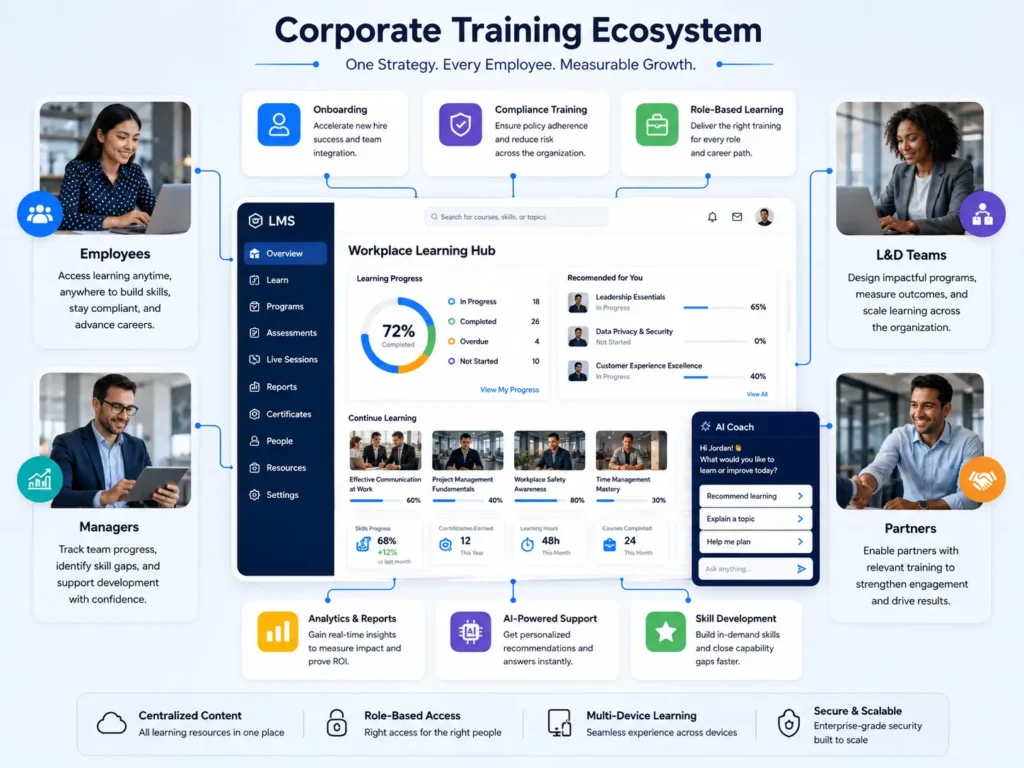
A Learning Management System (LMS) provides the technology foundation for delivering, managing, tracking, and improving corporate training programs.
For many organizations, the LMS becomes the central system connecting learners, content, administrators, managers, and business data.
A modern corporate training LMS typically supports:
For example, a new employee may be added to an HR system. Through an HRIS integration, that employee record can automatically create a learner profile in the LMS. The LMS can then assign onboarding courses based on department, location, or role.
Once training is completed, managers and administrators can access reports showing progress and completion status.
How LMS Integrations Support Corporate Training
A Learning Management System (LMS) provides the technology foundation for delivering, managing, tracking, and improving corporate training programs.
For many organizations, the LMS becomes the central system connecting learners, content, administrators, managers, and business data.
HRIS Integration
Connects employee information between HR systems and the LMS.
Common uses:
- Automatic user provisioning
- Department-based learning assignments
- Employee status updates
Single Sign-On (SSO)
- Easier learner access
- Reduced password management
- Better security controls
CRM Integration
Useful for customer-facing teams.
Examples:
- Assigning sales training
- Tracking certifications
- Connecting learning activity with customer-facing roles
ERP and Business System Integration
Helps organizations connect learning with operational workflows.
API and Webhook Connectivity
APIs allow systems to exchange information.
Common use cases:
- User synchronization
- Training completion updates
- Reporting automation
- Custom workflows
Learning Standards: SCORM, xAPI, cmi5, and LTI
Corporate training technology often depends on interoperability standards.
SCORM
SCORM (Sharable Content Object Reference Model) is one of the most widely adopted eLearning standards. It allows training content and LMS platforms to communicate information such as completion status, scores, and learner progress.
xAPI
Experience API (xAPI) expands learning tracking beyond traditional LMS courses. It can capture learning activities happening across different environments, including simulations, mobile apps, and offline experiences.
cmi5
cmi5 combines the flexibility of xAPI with LMS-based course management rules, helping organizations manage modern learning experiences while maintaining LMS control.
LTI
Learning Tools Interoperability (LTI) enables connections between learning platforms and external learning applications.
These standards matter because enterprise training ecosystems often include multiple tools, content providers, and learning experiences.
How Do You Measure Corporate Training Effectiveness?
Corporate training is only valuable when it improves something beyond course completion.
A learner finishing a module tells you that someone accessed content. It does not tell you whether they understood the concept, changed their behavior, or improved their performance.
This is one of the biggest shifts happening in modern L&D: moving from measuring training activity to measuring training impact.
A useful measurement approach connects learning data with workplace outcomes.
For example, a compliance team may track whether employees completed required training before a deadline. That is necessary, but it is only one layer of measurement.
A stronger approach also asks:
The right metrics depend on the purpose of the training.
Common Corporate Training Metrics –
Completion and Participation Metrics
These are the most basic measurements.
They answer questions such as:
Completion tracking is especially important for mandatory training, certifications, and regulatory requirements.
However, completion should be viewed as a starting point, not the final measure of success.
Knowledge and Skill Assessments
Assessments help determine whether learners understood the material.
Examples include:
- Knowledge quizzes
- Practical assessments
- Scenario-based evaluations
- Simulations
For example, a cybersecurity course should not only ask employees to remember definitions. It should test whether they can identify suspicious emails or respond correctly to security situations.
Workplace Performance Metrics
This is where L&D teams can demonstrate greater business value.
Depending on the training objective, organizations may measure:
- Faster onboarding time
- Reduced operational errors
- Improved sales performance
- Higher customer satisfaction
- Increased productivity
- Better manager effectiveness
The challenge is that training is rarely the only factor influencing business results.
A sales training program may support revenue growth, but pricing strategy, product quality, market conditions, and sales processes also influence outcomes.
Good L&D teams acknowledge this complexity instead of claiming every business improvement came from training alone.
What Are the Common Challenges of Corporate Training?
Building corporate training programs sounds straightforward until you manage them at scale.
A training manager supporting a few hundred employees may be able to manage learning manually. But once training expands across departments, locations, languages, compliance requirements, and external audiences, complexity increases quickly.
Here are some challenges many organizations face.
Challenge 1: Training Becomes a Completion Exercise
One of the most common problems is focusing too heavily on completion rates.
Completion reports are easy to generate, which makes them attractive.
But they do not answer the bigger question:
“Did employees become better at their jobs?”
A healthcare employee clicking through a privacy training module is different from that employee correctly applying privacy practices during real patient interactions.
A sales representative completing a product course is different from that representative confidently handling customer objections.
“L&D teams should be careful not to confuse tracking activity with measuring capability. A completed course is evidence of participation, not proof of performance improvement.”
Challenge 2: Content Becomes Outdated
- Reviewing content regularly
- Updating outdated information
- Retiring irrelevant courses
- Maintaining compliance accuracy
Modern authoring tools and centralized LMS platforms help training teams manage content updates more efficiently.
Challenge 3: Learning Is Disconnected From Daily Work
Many employees do not struggle because they lack information.
They struggle because training is separated from the moment they need to apply it.
Consider a manager who completes a leadership course about giving feedback. If that manager receives no coaching, examples, reminders, or opportunities to practice, the learning may never translate into behavior.
This is why reinforcement matters.
Effective corporate training often includes:
- Practice opportunities
- Manager support
- Job resources
- Follow-up learning
- Performance feedback
Challenge 4: Scaling Training Across Different Audiences
Best Practices for Creating Effective Corporate Training Programs
Effective corporate training is not built by simply uploading more courses.
It requires thoughtful design, strong alignment with business goals, and continuous improvement.
Start With Business Outcomes
Instead of:
“We need leadership training.”
Ask:
“Which product-related conversations, decisions or customer outcomes need to improve?”
Instead of:
“We need product training.”
Ask:
“What customer conversations or business outcomes should improve?”
This approach connects training to workplace performance instead of treating it as an isolated content-delivery activity.
Design Training Around the Learner’s Reality
Employees balance training with daily responsibilities, deadlines and customer requirements. Programs that ignore these realities often struggle with participation, completion and workplace application.
Good corporate training considers:
- Job responsibilities
- Available learning time
- Existing knowledge and skills
- Preferred learning formats
- Performance feedback
- Manager and peer support
A field technician using a mobile device between service calls has different needs from an office-based employee attending scheduled learning sessions.
Combine Different Learning Methods
Most workplace capabilities cannot be developed through one format alone. Knowledge may be introduced through self-paced learning, demonstrated during instructor-led sessions, practised through simulations and reinforced through coaching.
A strong corporate training strategy often combines:
- Instructor-led workshops
- Virtual instructor-led sessions
- Simulations and practical exercises
- Self-paced digital courses
- Coaching and mentoring
- Assessments and knowledge checks
The goal is not to use every possible method.
The goal is to choose a method that matches the skill being developed.
Use Data to Improve Training
Learning data helps L&D teams understand participation, knowledge improvement, skill development and workplace application. These insights can be used to improve content, adjust delivery methods and provide additional support.
Learning analytics can reveal:
- Enrolment and completion rates
- Assessment improvement
- Difficult or repeated content
- Learner engagement
- Skill proficiency
- Manager and employee feedback
- Performance differences across teams
How Is AI Changing Corporate Training?
AI is helping organizations create content faster, personalize learning and provide scalable practice opportunities. However, it should support instructional design and human decision-making – not replace subject-matter expertise, coaching or performance evaluation.
AI-Powered Learning Recommendations
AI-supported learning platforms can recommend content based on assessment results, existing skills, learning history, job responsibilities and required competencies. Employees in the same role may therefore receive different recommendations based on their individual development needs.
Recommendations should remain transparent and reviewable by learners, managers and L&D teams.
AI Authoring and Content Development
AI-assisted authoring can help learning teams create and update training materials more efficiently.
Potential applications include:
- Creating initial course outlines
- Drafting learning objectives
- Generating assessment questions
- Summarizing source documents
- Translating and localizing content
- Updating existing materials
Human review remains essential.
A poorly designed course can be created faster with AI, but it is still a poorly designed course.
AI Roleplay and Simulation-Based Training
Skills such as sales, customer service, leadership and negotiation require practice – not only information. AI roleplay provides realistic scenarios in which employees can rehearse conversations and receive structured feedback in a controlled environment.
AI-based practice should supplement manager coaching and real-world experience rather than replace them.
How Paradiso LMS Supports Corporate Training
A modern corporate training strategy requires more than a repository for courses. Organizations need a platform that centralizes learning, automates administration, supports different audiences and provides measurable performance insights.
For organizations managing complex learning environments, integration is especially important.
A corporate LMS often needs to connect with systems already used by the business, including:
These integrations make learning part of existing business workflows while reducing manual administration.
Choosing the Right Corporate Training Approach
The right corporate training approach depends on the organization’s goals, workforce structure, learner needs, industry requirements and existing technology.
The right approach depends on:
A strong corporate training strategy balances three things:
The right learning experience, delivery technology, and the measurement framework.
Conclusion:
Corporate Training Builds Capability - not Just Course Completions
Corporate training is the structured process of developing the knowledge, skills and behaviours people need to perform effectively and support business goals.
Successful programs begin with measurable outcomes, reflect how employees work and combine learning with practice, feedback and continuous improvement. Technology provides the infrastructure to create, deliver and measure learning, but its value depends on how effectively training improves workplace performance.
Share This:
Written & Reviewed By
Pradnya Maske
Product Marketing Manager · Paradiso eLearning · 10+ Years in L&D
Pradnya Maske is a Product Marketing Manager with over 10 years of experience in the eLearning industry. Based in Florida, she is a senior expert at Paradiso eLearning — passionate about corporate learning strategy, virtual training, and helping organisations find the right LMS for their workforce.
View all articles ->Got Questions?
Frequently Asked Questions
Can’t find what you’re looking for? Talk to our team.
Corporate training is a structured learning process designed to improve employees’ knowledge, skills and workplace performance. It includes onboarding, compliance, technical training, sales enablement, leadership development and professional skills training.
Corporate training helps organizations close skill gaps, improve performance, support compliance and prepare employees for changing roles and technologies.
Examples of corporate training programs include:
- Employee onboarding programs
- Compliance and regulatory training
- Leadership development programs
- Sales enablement training
- Product training
- Technical skills training
- Customer education programs
- Partner certification programs
- Workplace safety training
How does an LMS support corporate training? Employee training focuses specifically on helping employees improve job-related skills and knowledge.
Corporate training is broader. It includes employee training but may also include customer training, partner education, compliance programs, and other learning initiatives that support organizational goals.
In other words, employee training is one part of a larger corporate training strategy.
A Learning Management System (LMS) helps organizations deliver, manage, track, and measure corporate training programs.
An LMS can support:
- Course delivery
- Learner management
- Training assignments
- Assessments
- Certifications
- Compliance tracking
- Reporting dashboards
- Integration with HRIS, CRM, ERP, and other business systems
For enterprise organizations, an LMS becomes the central system connecting learning activities with business operations.
AI is being used in corporate training to improve personalization, automate content creation, and create more realistic practice environments.
Common applications include:
- Personalized learning recommendations
- AI-powered course authoring
- Automated assessments
- Learning analytics
- AI coaching assistants
- Roleplay simulations
AI can make training more scalable, but human instructional design remains essential for creating meaningful learning experiences.