5 Best Self Hosted LMS Platforms of 2026: Features & Comparison
What is Self Hosted LMS?
A self-hosted LMS (Learning Management System) is a computer programme that is set up and used on a server that belongs to the company or individual using it. With this kind of LMS, businesses may completely control how their e-learning resources and content are managed, customised, and used. When using a self-hosted LMS in 2026, the company is in charge of providing the system’s hardware, software, and technical support. This can involve activities like server upkeep, database administration, and software upgrades. In exchange, the company gains total control over the information, security, and functionality of their LMS, which they may tailor to suit their own requirements.
The following are some Benefits of adopting a self-hosted LMS in 2026:
Organizations that desire to manage their e-learning resources and material have various advantages when using a self-hosted LMS (Learning Management System).
Total command over the security and privacy of data.
Access to the source code for additional development and modification Options for branding, functionality, and content customization.
Ability to interface with other organizational systems and tools.
No ongoing subscription costs or dependency on outside providers.
However, a self-hosted LMS also has obligations and obstacles, including the requirement for technical know-how, server and network infrastructure, and continuing maintenance and support. Before making a choice, organizations should consider the advantages and drawbacks of a self-hosted LMS in light of their unique requirements and available resources.
3 Tips For Choosing The Best Self-Hosted LMS in 2026 For Your Business
In addition to platform features, the domain name and extension chosen for an educational site can influence how learners and institutions recognize its purpose. Using education-themed TLDs can help clearly signal an academic focus and make URLs more intuitive for audiences. If you have chosen to convert to a self-hosted LMS solution, there are still a few things to consider. Here are some suggestions to assist you in making a wiser (and safer) decision.
1. Try Before you Buy
An investment would be an LMS that allows self-hosting. You must conduct research and test drive your top options because of this. Check to see if the features and user interface are both worthwhile investments. Additionally, you can check to determine if the customer assistance is up to par. Does the LMS, for instance, have a vibrant user forum? Can you immediately reach the tech support staff to seek assistance with a problem? Many LMS providers offer no restrictions on the free trials and demos. Prior to making your purchase, make sure to establish a list of questions during the trial period and discuss them with the LMS seller. After you’ve signed on the dotted line, you don’t want to have a severe case of buyer’s remorse.
2. Make The Selection Process A Team Effort
The decision-making process for the self hosted LMS should involve every member of your team. especially those who plan to regularly create and set up online training resources using the technology. Invite them to evaluate the system and offer suggestions. Find out how they felt about the features in general and whether they thought they were beneficial. They may already have a few excellent picks of their own, so you may also ask for recommendations.
3. Set A Realistic Budget
A self-hosted LMS indeed makes budgeting simpler. But you must make sure you include all costs, not simply the deposit. Consider the future upgrades, continuing maintenance, and content creation expenses you’ll incur. This will enable you to determine the cost of ownership as accurately as possible and prevent you from incurring long-term debt. To be able to sum everything up and select the best LMS for the money, ask the LMS vendor for a full estimate.
5 Best Self-Hosted Learning Management Systems in 2026
The finest open-source self-hosted LMS, as of my knowledge limit in 2026, is debatable and depends on the particular demands and specifications of each firm. However, the following are a few well-liked and highly rated open-source self-hosted LMS options:
Paradiso LMS
Moodle
Chamilo
Totara Learn
Dokeos
LMS Platform
Current Status (2026)
Open Source
Enterprise Ready
Best For
Notes
Paradiso LMS
Active & Enterprise-focused
Yes (with commercial support)
Yes
Corporate & global enterprises
Strong integrations, AI features, scalable deployment
Moodle
Highly active & widely used
Yes
Yes (with Moodle Workplace)
Education & corporate training
Large global community & plugin ecosystem
Chamilo
Active
Yes
Moderate
Educational institutions & NGOs
Lightweight and easy to use
Totara Learn (by Totara)
Active & Enterprise-level
Open-core model
Yes
Compliance-heavy organizations
Strong performance & compliance features
Dokeos
Niche but operational
Yes
Industry-specific
Pharma & regulated industries
Focused on high-compliance sectors
1. Paradiso LMS
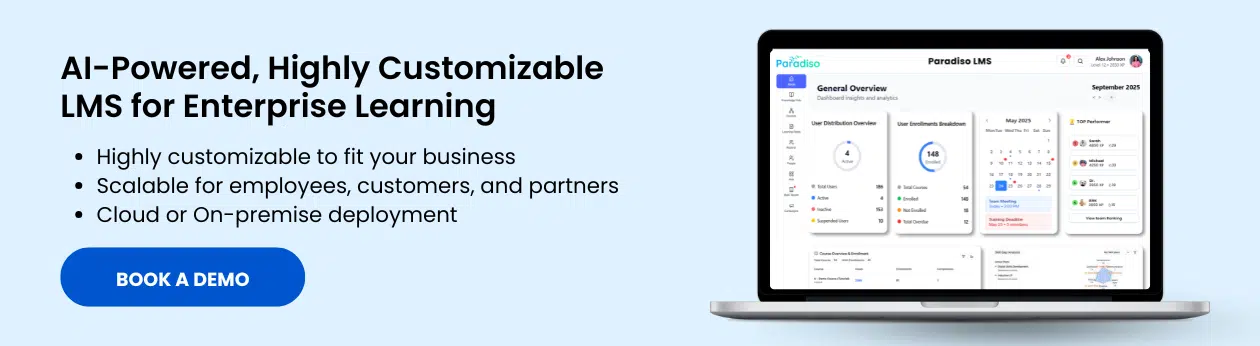
The reason Paradiso LMS is among the best self hosted LMS, at the top of the list of online learning platforms is that it provides a wide range of unique e-learning services to businesses all over the world. Our clients include well-known universities and major corporations. We develop cutting-edge, custom e-learning systems with your end users, or learners, in mind. Our solutions are built on a solid foundation of science and technology.
Being the best Self-hosted LMS, our platform is highly strong and has many features and connectors, creating a comprehensive eLearning solution that meets the needs of institutions and enterprises.
Our user-based fees are here to simplify pricing for businesses and associations of all sizes.
2. Moodle
Moodle is an self hosted LMS that has been in use by schools, universities, and companies all around the world since 2002. It has many features, including tools for managing and creating courses, gamification, assessments, and collaboration. The open-source self hosted LMS, Moodle, which is utilized by hundreds of millions of students worldwide, is at the centre of our ecosystem. Moodle LMS, which was created in collaboration with the community, is enhanced by Moodle Workplace, Moodle Apps, and a network of Certified Service Providers who offer expertise in hosting, customization, support, and training.
Headquarters:
West Perth, Western Australia
3. Chamilo
Chamilo is a free, self hosted and open-source LMS that offers robust features, including course management, assessment tools, and reporting. It has a clean and intuitive interface that makes it easy to create and manage online courses. The Chamilo Association is an international non-profit association which aims at promoting, improving and protecting the freedom (free software character) of the e-learning software Chamilo. Managed by a intercontinental voluntary board of directors, it coordinates the efforts of the different actors around the Chamilo software projects in order to maximize efficiency and the benefits to the public community.
Headquarters:
Lugo, Galicia
4. Totara Learn
Totara is rapidly transforming the learning technology software market. Totara’s products are highly flexible and bring powerful freedoms to all organizations with formal and informal learning needs, both within the workplace and the extended enterprise. Totara Learn is an enterprise-level LMS that can be heavily customised and is based on the Moodle framework. Performance management, compliance reporting, and a flexible foundation for custom development are among its advantages.
Headquarters:
Brighton, England, United Kingdom
5. Dokeos
Dokeos LMS provides Self-hosted Learning Management Systems for high-consequence industries such as pharmaceutical, healthcare, manufacturing, financial services and training centers. Our ability to customize our services to our clients needs made our successful. Dokeos is a free and Self-hosted LMS that provides a variety of capabilities for creating and managing courses, conducting assessments, and producing reports. With a variety of plugins and themes available to increase its capabilities, it is made to be flexible and adaptable.
Headquarters:
Paris, France
Maximizing User Experience: Integrating Paradiso AI into Your Self-Hosted LMS in 2026.
In order to improve the user experience, Paradiso AI, a platform that offers conversational AI services, can be integrated into a self-hosted learning management system (LMS). The integration would enable the LMS to provide automatic content generation and interactions with users in natural language. This could include functions like responding to frequently asked questions, directing users throughout the platform, making tailored course recommendations, and more. Setting up the required infrastructure and APIs to link the LMS with the Paradiso AI platform would be part of the integration process.
Conclusion
The best self-hosted LMS in 2026 depends on each organization’s specific goals, technical capabilities, and training requirements. Platforms such as Paradiso LMS, Moodle, Chamilo, Totara Learn, and Dokeos offer a variety of features for course creation, customization, assessments, and reporting.
While self-hosted LMS solutions provide greater control over data, security, and system configuration, they also require proper infrastructure and ongoing technical support. Organizations should carefully assess their budget, scalability needs, integration requirements, and internal expertise before making a decision.
With thoughtful planning and the right resources, a self-hosted LMS can become a flexible and dependable solution for delivering effective online learning experiences.
FAQs About Self-Hosted LMS
1. What is the difference between self-hosted LMS and cloud LMS?
A self-hosted LMS is installed on your own servers or private cloud infrastructure, giving you full control over data and customization, whereas a cloud LMS is vendor-hosted and managed externally.
2. Is a self-hosted LMS more secure?
A self-hosted LMS is installed on your own servers or private cloud infrastructure, giving you full control over data and customization, whereas a cloud LMS is vendor-hosted and managed externally.
3. Who should choose a self-hosted LMS?
Organizations with strict compliance requirements, data sovereignty concerns, internal IT capabilities, or advanced customization needs are ideal candidates for self-hosted LMS solutions.
4. What are the hidden costs of a self-hosted LMS?
While there are no subscription fees in many cases, costs may include hosting infrastructure, server maintenance, upgrades, technical staff, security management, and customization.
5. Can a self-hosted LMS integrate with enterprise systems?
Yes. Most self-hosted LMS platforms support integration with HRMS, ERP, CRM, Single Sign-On (SSO), and third-party tools through APIs.
Our website uses cookies to ensure it functions properly and provides a safer experience. Some cookies are necessary for the website to operate. By clicking 'Accept,' you agree to the use of cookies as outlined in our Privacy Policy. If you click 'Decline,' only essential cookies will be used.