



Italian companies face unique training challenges. Your workforce is distributed across regions; you’re navigating GDPR compliance, managing Fondimpresa-funded training initiatives, and balancing limited L&D budgets with mandatory regulatory training. Most LMS platforms aren’t built for how Italian businesses operate—they come with one-size-fits-all features and pricing that doesn’t account for SME realities.
Choosing the wrong LMS costs you 4-8 months, €50K+, and migration when it doesn’t fit your culture or regulations. The right platform for LMS integrates with your Italian HR systems, supports Fondimpresa tracking, and scales with your growth without hidden costs.
This guide cuts through noise. We’ll show you exactly what Italian companies need, walk through five proven platforms popular in Italy, and give you a clear decision framework—whether you’re a growing tech startup in Milan, a manufacturing network in Emilia-Romagna, or a financial services firm in Rome.
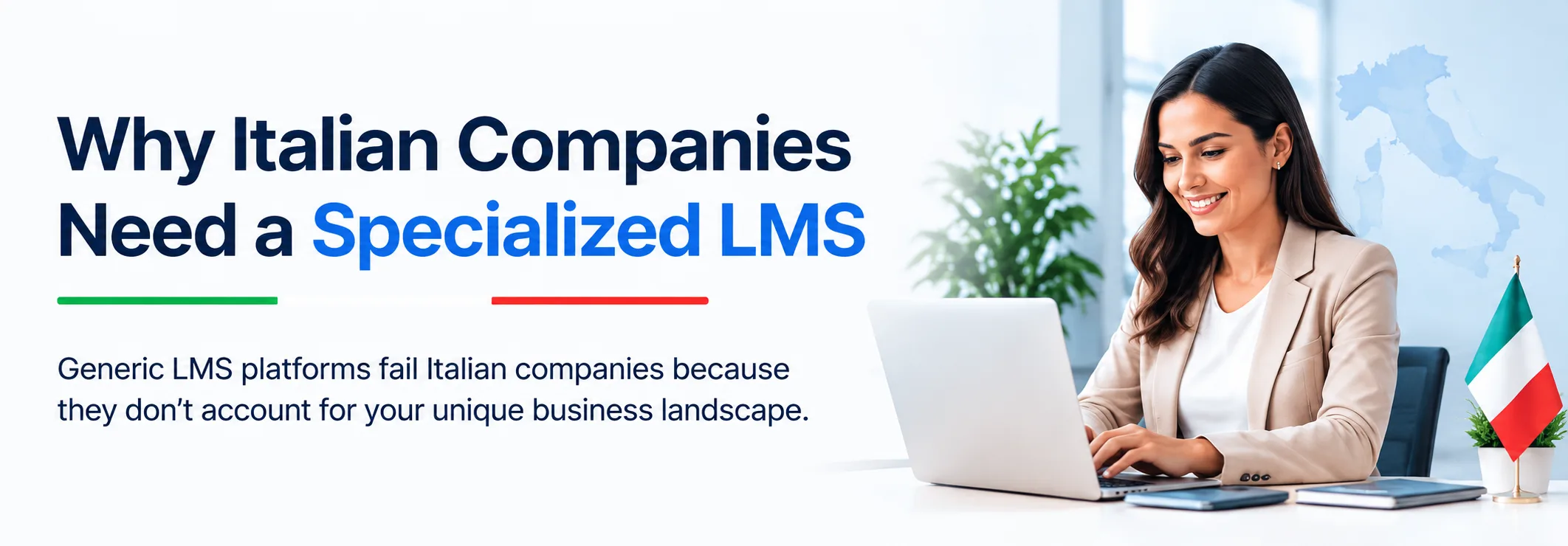
Why Italian Companies Need a Specialized LMS?
Generic LMS platforms fail Italian companies because they don’t account for your unique business landscape.
What Is a Corporate LMS for Italian Companies?
A corporate LMS for Italian companies helps organizations deliver, manage and measure employee training lms across locations, departments and learner groups. Unlike a basic training portal, an enterprise LMS connects learning activities with business systems such as HR platforms, identity providers and reporting tools. For Italian businesses, the right LMS should also support multilingual learning, GDPR requirements, content standards and the operational needs of distributed teams.
Five Key Criteria for Selecting an LMS in Italy
Before evaluating any platform, use this framework. It’s built specifically for how Italian companies operate
1
GDPR & EU Compliance
Mandatory under Italian data protection law. Your LMS must prove EU compliance, not just claim it.
Does it store data in EU data centers?
Can you prove compliance to auditors?
Does it generate GDPR audit trails?
2
Fondimpresa Integration
If you use Fondimpresa funding, the LMS must track hours, document completion, and export reports for fund submissions.
Does it generate Fondimpresa-compliant reports?
Can you export completion certificates?
3
Italian HR System Integration
Your people live in Perseo, Nominasoft, or Zucchetti. The LMS must sync automatically, not require manual entry.
HRIS LMS integration reduces manual employee administration by allowing user data, roles and organizational structures to move between systems.
Through APIs, connectors or automated data synchronization, L&D teams can keep learner records updated while improving reporting accuracy and reducing duplicate work.
Is data sync automatic?
Can roles and permissions be updated from your HRIS?
4
Cost Transparency
Hidden costs kill SME budgets. You need all-in pricing with no surprises.
Are implementation and support included?
Is pricing per user or fixed?
Are there hidden fees for custom integrations?
5
Mobile & Offline Learning
Your workers are mobile. Training must work on-the-go.
Does offline content sync when reconnected?
Is it usable without strong internet?
6
SCORM & Content Compliance
Many training programs use SCORM formats. Your LMS must support existing content.
Can you import existing courses without rebuilding?
Is content tracking accurate?
7
Italian Language & Support
You need documentation and support in Italian. Generic English-only platforms create friction.
Is support available in Italian?
Are documentation and training materials in Italian?
8
Data Residency & Sovereignty
GDPR and Italian regulations require data to stay in Europe. Cloud solutions must offer EU server options.
Can you choose data residency?
Is data encrypted both in transit and at rest?
What Makes an Enterprise LMS Different?
An enterprise LMS is designed for organizations managing complex training environments, multiple locations and different learner audiences. Italian enterprises often need more than course delivery—they need integrations, analytics, multilingual support, automation and governance features that help L&D teams manage learning at scale.
Five Best LMS Platforms for Italian Companies
Quick Comparison Table
LMS Platforms for Italian Training Requirements
*Typical fit should be validated against your organization’s compliance, reporting, data-residency, and integration requirements.
Which LMS Fits Your Italian Company? Four Common Scenarios
Scenario 1: Growing Tech Company in Milan
The best LMS for an Italian company depends less on company size alone and more on how training is delivered, what systems need to connect, and what records your L&D team must maintain. These four scenarios show how different requirements can change the shortlist.
Primary needs: Employee onboarding, straightforward administration, GDPR-conscious data handling and mobile learning.
Secondary needs: HR or payroll integration, Italian-language learning and room to expand the training program.
Platforms to evaluate: TalentLMS or Paradiso LMS
TalentLMS is worth considering when simplicity is the priority. It officially supports Italian, supports SCORM 1.2, xAPI and cmi5, and provides an iOS and Android mobile app with offline access for supported content.
Paradiso LMS becomes more relevant when the company expects its learning environment to grow in complexity. It supports mobile and offline learning, SCORM and xAPI content, SSO and enterprise integrations, alongside AI-assisted personalization and skills-focused learning.
If your employee records are stored in Perseo, Nominasoft or another Italian HR/payroll platform, don’t assume a pre-built connector exists. Ask each vendor to demonstrate whether the integration can be handled through an existing connector, API, webhook or custom integration.
Best decision factor: Choose TalentLMS when ease of administration is the main requirement. Evaluate Paradiso when integrations, skills development, automation and future scalability matter more.
Scenario 2: Manufacturing Network in Emilia-Romagna With 200–400 Employees
Primary needs: Training across multiple sites, SCORM content, mobile or offline learning and reliable training records.
Secondary needs: HRIS integration, role-based assignments and records that can support Fondimpresa-funded training processes.
Platforms to evaluate: Paradiso LMS or Moodle Workplace
Paradiso LMS is relevant to distributed manufacturing training because it supports mobile and offline access, SCORM/xAPI content, role-based learning and enterprise integrations. This can help an L&D team assign training according to job role, department or location while maintaining centralized reporting.
Moodle Workplace is another strong option when your organization wants greater configuration flexibility and has internal technical expertise or access to a Moodle service provider. Moodle Workplace supports organizational hierarchies, automation, multilingual learning and mobile access, including offline learning through the Moodle App.
For Fondimpresa-funded training, evaluate the reporting workflow, not simply whether a vendor claims “Fondimpresa support.” Fondimpresa’s own process requires monitoring information to be entered through its FPF platform, including details about training activity and participants.
Ask each LMS vendor to demonstrate how it records:
Learner participation and attendance
Course dates and scheduled sessions
Training hours
Learner identity and organizational information
Completion and assessment records
Exports your team can use when preparing Fondimpresa monitoring and reporting data
If you use Zucchetti or another HRIS, include an actual user-provisioning and role-change workflow in the demo rather than accepting a general statement that the platform “supports HR integrations.”
Best decision factor: Evaluate Paradiso when enterprise integration and centralized learning operations matter most. Evaluate Moodle Workplace when customization and platform control are stronger priorities.
Scenario 3: Financial Services Firm in Rome With 150–200 Employees
Primary needs: GDPR-conscious processing, access controls, employee training, security and reliable reporting.
Secondary needs: SCORM compatibility, HR-system integration, role-based learning and controlled access to training data.
Platforms to evaluate: Paradiso LMS or ILIAS
ILIAS is particularly relevant when the organization wants an open-source environment with strong control over deployment and configuration. ILIAS states that it can be configured in conformity with European GDPR requirements and provides detailed roles and rights for controlling access to learning content and user information. It also natively supports SCORM 1.2 and SCORM 2004.
Paradiso LMS is another option when your team needs managed enterprise learning with SSO, role-based access, HR-system connectivity and mobile delivery. Paradiso documents GDPR support, encryption controls and SAML 2.0 SSO alongside its corporate learning capabilities.
Security evaluation should go beyond asking whether a vendor is “GDPR-compliant.” Ask for its data processing agreement, security documentation, subprocessors, authentication controls, data-transfer arrangements, retention options and relevant certifications.
Best decision factor: Consider ILIAS when open-source control is central to your IT strategy. Consider Paradiso when you want broader managed LMS capabilities and enterprise connectivity without maintaining as much of the learning infrastructure yourself.
Scenario 4: Italian Subsidiary of a Global Consulting Firm With 500+ Employees
Primary needs: Multilingual learning, international scalability, enterprise integrations, centralized reporting and AI-assisted learning.
Secondary needs: Italian learner experience, mobile access, global HR-system integration and consistent learning governance across countries.
Platforms to evaluate: Paradiso LMS or Docebo
Docebo is designed for enterprise learning and officially supports Italian as a platform language. Its current platform also includes AI capabilities, while the Go.Learn mobile app supports mobile learning and offline access for certain training materials.
Paradiso LMS is also relevant for multinational training because it supports multilingual learning, mobile access, employee and extended-enterprise training, AI-assisted learning and integrations with enterprise business systems. Its multilingual platform is designed to manage localized learning and centralized reporting across regions.
For either platform, an Italian subsidiary should separately validate local requirements such as the Italian learner and administrator experience, HR-system connectivity, data-transfer requirements and any Fondimpresa reporting processes.
Best decision factor: Compare the two platforms using your actual global architecture. Test HR provisioning, SSO, localization, learning-data reporting and administration across countries before making the final decision.
How Should You Evaluate and Implement an LMS in Italy?
A successful LMS implementation starts with requirements rather than vendor demonstrations. Define how people, content and learning data need to move through your organization before comparing platform features.
Before Vendor Selection
Start by documenting your current learning environment:
Define employee, customer, partner or compliance training requirements
Identify your HRIS, payroll, identity and other systems that may exchange data with the LMS
Confirm whether Fondimpresa-funded training is part of your learning program
Inventory existing SCORM, xAPI, video, PDF and other course content
Define Italian and other language requirements
Document security, privacy, data-residency and data-transfer requirements
Decide which learning and business outcomes you need to report
This prevents a common LMS-selection problem: comparing impressive demonstrations without knowing whether the platform can support the workflows your team actually uses.
During LMS Evaluation
Request demonstrations from a focused shortlist and give every vendor the same scenarios to complete.
Ask vendors to demonstrate user provisioning, SSO, role-based enrollment, content migration, mobile learning and the reports your L&D team expects to use. If Fondimpresa applies, show vendors the records your team needs and ask how those records would be captured and exported.
For Italian-language requirements, test the product rather than relying only on a language-support checkbox. Review learner navigation, administrator screens, notifications, certificates and any AI-generated or translated content that your workforce will see.
During Technical Due Diligence
Review the vendor’s:
GDPR and data-processing documentation
Hosting and data-transfer arrangements
Security certifications and independent assurance reports where available
Authentication and role-based access controls
API, webhook and integration capabilities
Backup, retention and deletion policies
Support and implementation responsibilities
EU hosting can be useful for organizations with specific data-residency requirements, but GDPR does not automatically require all personal data to remain inside the European Union. Your legal or privacy team should evaluate the vendor’s actual processing and international-transfer arrangements.
Before Go-Live
Create a documented migration and testing process.
Test user records, organizational structures, learning histories, course packages, enrollment rules and reporting before moving the full workforce onto the LMS. Your team should also define who owns integrations, course administration, learner support and data-quality issues after launch.
Why LMS Reporting Matters for Italian L&D Teams?
LMS reporting helps L&D teams move beyond completion tracking and understand whether training improves workforce capability. Modern learning analytics can connect participation data, assessments, skills development and business outcomes to create a clearer picture of training effectiveness.
How Should Italian Companies Measure LMS ROI?
LMS ROI should be calculated from your own baseline rather than from generic percentages such as “30% less administration” or “20% faster onboarding.” Those figures vary significantly by organization and should not be presented as expected outcomes without evidence.
Start with four measurement areas.
1. Training Operations
Measure how much administrative work the LMS removes or simplifies.
Track metrics such as:
GDPR and data-processing documentation
Hosting and data-transfer arrangements
Security certifications and independent assurance reports where available
Authentication and role-based access controls
API, webhook and integration capabilities
Backup, retention and deletion policies
Support and implementation responsibilities
A simple calculation is:
Annual administrative value = monthly hours saved × loaded hourly employee cost × 12
2. Onboarding and Time to Competency
Measure whether employees reach required job capability sooner after implementation.
Instead of reporting only whether an onboarding course was completed, compare time to independently performing required tasks, manager sign-off, assessment results and role-specific competency milestones.
3. Skills and Performance
Completion rates tell you whether training was consumed. They don’t tell you whether capability improved.
Where possible, connect learning data with skills assessments, performance measures, quality indicators or other business metrics relevant to the training program.
Paradiso’s skills-focused approach can be useful here because learning can be connected with identified skill gaps and targeted development rather than treating completion as the final outcome.
4. Fondimpresa Training Administration
If Fondimpresa is relevant, measure the administrative effort required to collect and reconcile training data before and after LMS implementation.
Useful measures include missing records, reconciliation work, time spent preparing monitoring information and the consistency of participant and training-hour data. Fondimpresa requires monitoring before final reporting, so reliable source data can make the process easier even when the LMS does not connect directly to the FPF platform.
Which LMS Should an Italian Company Choose?
The best LMS for Italian companies is the platform that fits your training workflows, technology stack, learner population and reporting requirements—not necessarily the platform with the most features.
For smaller companies prioritizing straightforward administration, TalentLMS may deserve a place on the shortlist. Organizations wanting extensive open-source control should evaluate Moodle Workplace or ILIAS. AmpleLogic is more naturally aligned with pharmaceutical, biotech, medical-device and other GxP-focused training environments based on its current product positioning.
For mid-market and enterprise Italian companies, Paradiso LMS is worth evaluating when integrations, multilingual learning, AI-supported training, mobile delivery and multiple learning audiences are important. Global enterprises should also compare Paradiso with Docebo using the same technical and operational requirements.
The final decision should come from a structured proof-of-concept. Give shortlisted vendors your actual HR integration, Italian learner experience, SCORM migration, reporting and Fondimpresa-related requirements and ask them to demonstrate the workflow.
CTA: Explore how Paradiso LMS can support your employee, customer, partner and compliance training requirements. Book a demo and evaluate the platform using your actual integration, localization and reporting workflows.
FAQs About Choosing an LMS in Italy