



Quick Answer: What Is Informal Learning?
- Informal learning is learning that happens outside structured training programs through experience, conversations, collaboration, and self-directed activities.
- It helps employees develop skills by learning from colleagues, workplace situations, and resources available when they need them.
- An LMS can help organizations support informal learning by creating spaces for knowledge sharing, collaboration, and continuous employee development.
Most employees do not learn everything they need to know by completing a course. A large part of workplace learning happens when someone asks a colleague for advice, watches a quick demonstration, searches for a solution, or learns from experience.
This everyday process is called informal learning. It happens naturally during work and helps employees build knowledge, improve skills, and solve problems in real situations. This approach is becoming an important part of employee training because it helps employees continue learning beyond scheduled courses.
Traditional training still plays an important role in building structured knowledge. But informal learning adds another layer by helping employees apply what they learn, share expertise, and continue developing skills beyond scheduled training sessions.
In this guide, you’ll learn what informal learning is, why it matters for workplace learning, and how your L&D team can support it with the right learning strategy and technology.
What Is Informal Learning?
Informal learning is the process of gaining knowledge and skills through everyday experiences rather than through planned courses or formal instruction.
Unlike formal learning, which usually follows a defined curriculum, informal learning happens naturally as employees perform their jobs, interact with others, and solve challenges.
Think about a new employee joining a sales team. They may complete product training and employee onboarding courses during their first weeks. But they often learn the practical side of selling by listening to experienced colleagues, joining customer calls, asking questions, and observing how others handle conversations.
That is informal learning in action.
Informal learning can happen through:
For L&D teams, the opportunity is not to control every informal learning moment. It is to create an environment where valuable knowledge can be shared, discovered, and reused.
How is Informal Learning different from Formal Learning?
Formal and informal learning support employee development in different ways. The most effective learning strategies combine both approaches.
Formal Learning vs Informal Learning
Formal learning provides employees with foundational knowledge. Informal learning helps them understand how to apply that knowledge in real workplace situations.
For example, a healthcare organization may provide a structured course on a new patient management system. However, employees often learn the most practical shortcuts by discussing workflows with experienced team members.
The strongest learning cultures do not choose between formal and informal learning. They connect both.
Why Does Informal Learning Matter for Workplace Learning?
Informal learning matters because employees need more than information. They need opportunities to apply knowledge, solve problems, and develop confidence in their roles.
A course can explain how to complete a task. Informal learning helps employees understand how that task works in real situations.
How Does Informal Learning Improve Employee Skill Development?
Informal learning helps employees build skills continuously by connecting learning with daily work. This supports continuous employee development by helping people learn from everyday experiences.
When employees can ask questions, exchange ideas, and learn from experienced colleagues, they gain practical knowledge faster.
For example, a new manager may complete a leadership course about giving feedback. However, their confidence improves when they discuss difficult conversations with other managers and learn how experienced leaders handle similar situations.
The result is stronger skill application, not just course completion.
How Does Informal Learning Support Knowledge Sharing?
Every organization has valuable knowledge that exists within its employees. Informal learning helps capture and spread that knowledge.
A senior employee may know how to solve a recurring customer issue, improve a process, or handle a challenging situation. When that experience is shared with others, the entire team benefits.
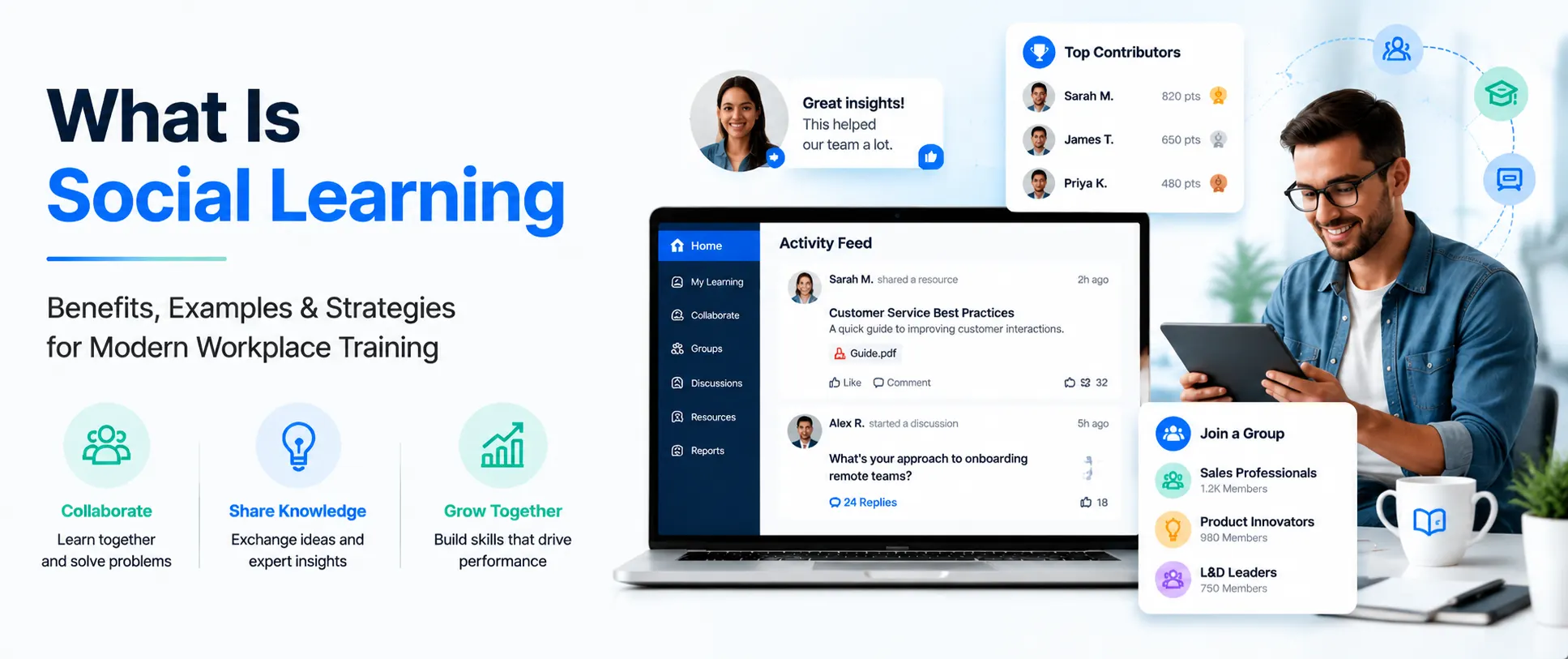
Your L&D team can encourage knowledge sharing through discussion groups, communities, employee-generated resources, and collaborative learning spaces. These activities are closely connected with social learning, where employees learn through collaboration and shared experiences.
How Does Informal Learning Build a Learning Culture?
A strong learning culture develops when employees see learning as part of their everyday work.
Informal learning supports this by making development continuous instead of limited to scheduled training events.
Employees begin to think differently:
Over time, learning becomes part of how work gets done.
A common mistake in L&D is measuring learning only through course completion. Completion tells you someone clicked through content. It does not always tell you whether they can apply the skill when it matters.
What Are Examples of Informal Learning in the Workplace?
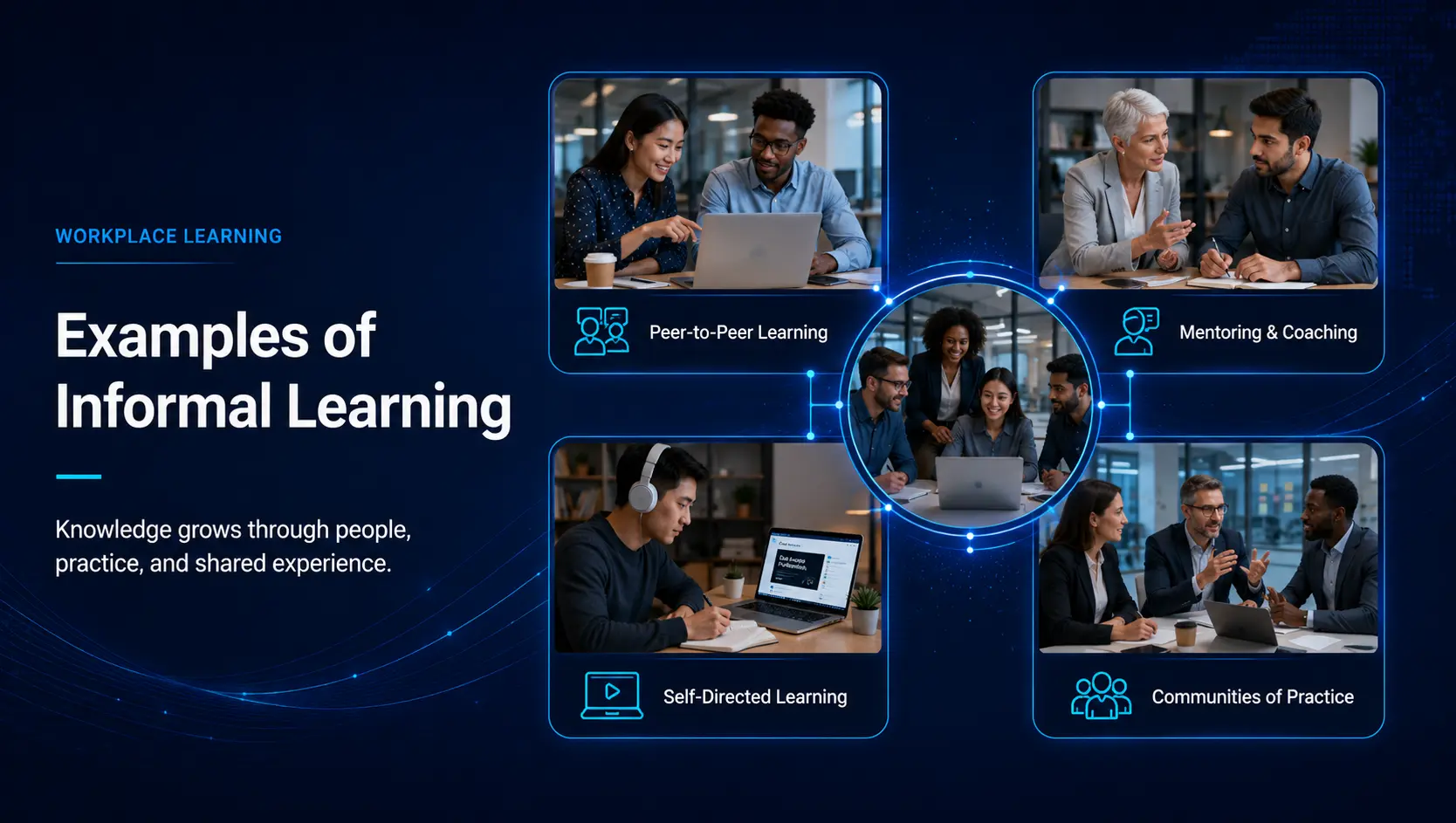
Informal learning appears in many everyday workplace activities.
Some common examples include:
Peer-to-Peer Learning
Employees learn from coworkers by sharing experiences, tips, and solutions.
Example: A customer support team creates a space where representatives share approaches for handling difficult customer conversations. New employees learn from real situations instead of only reading procedures.
Mentoring and Coaching
Experienced employees help others develop skills through guidance and feedback.
Example: A senior sales professional mentors new team members by sharing negotiation techniques learned from years of customer interactions.
Self-Directed Learning
Employees search for information when they need it.
Example: A marketing employee learns a new analytics tool by watching tutorials, exploring resources, and experimenting with real campaigns. A mobile learning experience can make these resources available when employees need them.
Communities of Practice
Employees with similar roles or interests collaborate and exchange knowledge.
Example: Managers across different departments discuss leadership challenges and share solutions that worked in their teams.
How Can an LMS Support Informal Learning?
A learning management system (LMS) can support informal learning by creating a central environment where employees can access knowledge, share experiences, collaborate with peers, and continue developing skills beyond formal courses.
An AI-powered LMS can help organizations personalize learning experiences and connect employees with relevant resources.
Many organizations already have informal learning happening every day. Employees ask questions in team chats, share documents, recommend resources, and help colleagues solve problems.
The challenge is that these learning moments are often scattered and difficult to measure. Valuable knowledge may stay with one employee or disappear when people move roles.
An LMS helps bring these learning activities into a more connected learning ecosystem.
For example, a manufacturing company may have experienced technicians who know how to troubleshoot equipment issues quickly. When that knowledge is shared through learning communities, videos, discussions, or internal resources, newer employees can learn from real workplace experience.
What Role Does an LMS Play in Knowledge Sharing?
An LMS helps organizations capture and distribute employee knowledge so learning does not depend only on individual conversations.
Your L&D team can use an LMS to create spaces where employees share insights, discuss challenges, and access resources created by internal experts.
This supports a culture where employees do not only consume training content. They also contribute to the learning experience.
Common examples include:
- Employees sharing best practices after completing a project
- Subject matter experts creating short learning resources
- Teams discussing challenges related to their roles
- Managers sharing leadership experiences with peers
The goal is not to replace structured training. It is to make learning available when employees need it most.
How Does Informal Learning Improve Employee Engagement?
Informal learning improves engagement because employees become active participants in their own development.
Traditional training often follows a one-direction approach: an organization provides information, and employees consume it.
Informal learning creates interaction. Employees can ask questions, share opinions, and connect learning with their daily responsibilities.
For example, a sales team completing negotiation training may continue learning through peer discussions about real customer objections. One employee may share how they handled a difficult conversation, helping others understand how to apply the training in practice.
This creates a stronger connection between learning and performance.
How Can You Create an Informal Learning Strategy?
A successful informal learning strategy starts by understanding how your employees already learn and then creating opportunities to support those behaviors.
You do not need to redesign your entire learning program. Start by identifying existing knowledge-sharing habits and building systems around them.
Identify Existing Learning Behaviors
Begin by observing where learning already happens.
Ask questions such as:
- Where do employees go when they need help?
- Which employees are considered experts in specific areas?
- What knowledge is currently difficult to access?
- Which skills require more peer support?
These answers help your L&D team understand where informal learning can create the most value.
Create Spaces for Collaboration
Employees need accessible spaces where they can share knowledge.
This could include discussion communities, expert groups, mentoring networks, or shared learning resources.
For example, a customer service organization may create a community where employees discuss common customer challenges and share successful responses. Over time, these conversations become a valuable knowledge resource for the entire team.
Encourage Employee-Generated Learning Content
Some of the most useful learning resources come from people doing the work every day.
Encourage employees and subject matter experts to share:
- Short videos
- Process tips
- Role-specific guides
- Case discussions
- Problem-solving examples
This helps transform employee experience into organizational knowledge. Your team can also use an eLearning authoring tool to turn employee knowledge into reusable learning resources.
Connect Informal Learning With Formal Training
Informal learning works best when it supports structured learning programs.
For example, after completing a leadership course, managers can join peer discussions where they talk about applying those concepts in real situations.
The course provides the foundation. The conversation creates deeper understanding.
How Do You Measure the Impact of Informal Learning?
Measuring informal learning requires looking beyond completion rates and focusing on engagement, knowledge sharing, skill development, and workplace application.
Because informal learning is less structured than formal training, traditional metrics alone are not enough.
Your L&D team can evaluate success by tracking:
- Participation in learning communities
- Employee contributions and knowledge sharing
- Engagement with learning resources
- Skill development over time
- Feedback from managers and employees
- Application of new knowledge at work
For example, if employees regularly share solutions in a technical learning community, that activity shows knowledge exchange is happening. The next step is connecting those learning behaviors to improvements in performance.
This is where learning analytics become valuable. Using LMS reporting and analytics helps L&D teams understand engagement, participation, and learning trends. The right LMS can help you understand not only what employees complete, but how they interact with learning across the organization.
How Does Paradiso LMS Support Informal Learning?
Paradiso LMS helps organizations create continuous learning environments where employees can combine structured training with everyday knowledge sharing and skill development.
A strong learning strategy requires more than delivering courses. It requires helping employees discover relevant knowledge, connect with others, and continue improving their skills.
With Paradiso LMS, your L&D team can support informal learning by creating a more connected learning experience that includes:
Personalized Learning Experiences
Employees learn differently based on their roles, goals, and existing skills.
Paradiso LMS helps organizations support personalized learning paths so employees can discover relevant resources while continuing their professional development.
Knowledge Sharing and Collaboration
Informal learning depends on interaction.
By creating opportunities for employees to share insights, discuss challenges, and learn from peers, organizations can make internal knowledge easier to access.
Learning Analytics and Insights
Understanding how employees engage with learning helps L&D teams improve their strategy.
Instead of only looking at course completion, teams can focus on broader indicators such as participation, skill growth, and learning engagement.
Integration With Existing Business Systems
Informal learning often happens across different tools and platforms.
An LMS that connects with existing systems helps create a more unified learning experience by bringing learning resources, employee information, and development activities together.
What Are the Best Practices for Supporting Informal Learning?
To make informal learning successful, focus on creating the right environment rather than forcing participation.
The most effective approaches include:
- Making knowledge easy to find
- Encouraging employees to share expertise
- Recognizing contributors
- Supporting managers as learning champions
- Connecting informal learning with business skills and goals
A learning culture grows when employees understand that sharing knowledge benefits everyone.
What Is the Future of Informal Learning in Corporate Training?
Informal learning will continue to become an important part of corporate training because employees need faster, more relevant ways to develop skills. A corporate LMS helps organizations bring formal and informal learning together at scale.
The future of workplace learning is not about choosing between courses and conversations. It is about combining structured learning, employee experiences, technology, and collaboration.
For L&D leaders, the opportunity is clear: build learning environments where employees can learn when they need it, from the people and resources that help them succeed.
How Can Paradiso LMS Help You Build a Continuous Learning Culture?
Informal learning becomes more valuable when your organization has the right strategy, technology, and learning environment to support it.
Paradiso LMS helps L&D teams bring formal training and everyday learning together by supporting personalized learning, knowledge sharing, analytics, and scalable employee development.
Explore how Paradiso LMS can help your organization create a continuous learning culture where employees build skills through both structured training and real workplace experiences.
Frequently Asked Questions About Informal Learning