


Employee training is more than just a checkbox on HR’s to-do list-it’s the heartbeat of a company’s growth, productivity, and overall workplace satisfaction. When done right, training empowers employees, builds confidence, and fuels performance. In fact, organizations with strong training programs see up to 218% higher income per employee and 17% greater productivity, proving just how powerful effective learning can be.
But here’s the catch: even the most well-intentioned programs can fall flat if certain employee training mistakes creep in. Many companies invest heavily in training, yet still struggle with disengaged employees and poor results. Why? Because the execution often misses the mark.
Imagine spending hours designing a training program, only to see employees disengage, forget key lessons, or struggle to apply what they’ve learned. Frustrating, right? You’re not alone-studies show that a majority of employees feel training doesn’t fully prepare them for real job challenges.
That’s why it’s crucial to recognize the pitfalls before they sabotage your efforts. Avoiding these common mistakes not only saves time and money but also ensures your workforce truly gains the skills and knowledge they need to succeed.
Think of effective training like planting a garden. You can’t just scatter seeds randomly and hope for the best. You need the right soil, proper care, and consistent attention to grow strong, healthy plants. Similarly, employee training requires clear goals, relevant content, and engaging methods that actually stick—especially when 80% of employees say they would stay longer at a company that invests in their learning and development.
In this article, we’ll walk you through the most common employee training mistakes, why they happen, and practical ways to fix them-so your next training program doesn’t just look good on paper but actually transforms the way your team works.
Why Avoiding Employee Training Mistakes Matters
Training is more than just checking a box. Poorly executed programs lead to:
- Low engagement and morale
- Reduced knowledge retention
- Wasted resources and time
- Slower business growth
Recognizing and correcting employee training mistakes early can save costs and improve team performance.
Top 10 Employee Training Mistakes to Avoid
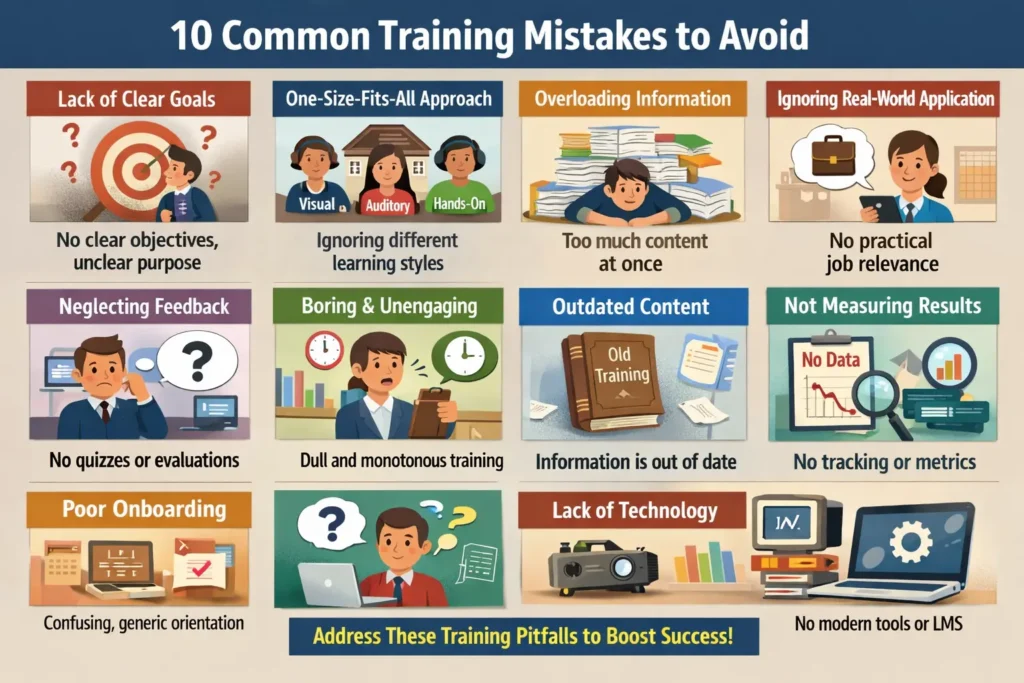
1. Lack of Clear Goals and Objectives
One of the most common employee training mistakes is starting a program without clear goals. Imagine attending a session and not knowing what you’re supposed to achieve—frustrating, right? Employees should always know:
- Why the training matters – how it contributes to their role and company success
- What skills or knowledge they will gain – so they feel confident and prepared
- How it impacts their work – ensuring relevance and practical application
Without these clear objectives, even the best-designed courses can feel pointless. Clear goals guide learners, provide focus, and increase retention, which ultimately prevents wasted time and resources.
Pro Tip: Begin each training with a short overview of goals and expected outcomes. Use visual aids or a simple roadmap to make objectives crystal clear.
2. One-Size-Fits-All Approach
Not all employees absorb information the same way. A one-size-fits-all training is a recipe for disengagement and low retention. Some employees learn best through visuals, others through listening or hands-on practice. Ignoring these differences is a huge training pitfall.
Tip: Personalize training with:
- Blended learning: combine videos, readings, and interactive tasks
- Microlearning: deliver small, digestible modules
- Interactive exercises: quizzes, polls, or gamified challenges
Personalization ensures that every learner can engage meaningfully, boosting both satisfaction and knowledge retention.
3. Overloading Information
Ever sat through a training session and felt overwhelmed by the sheer amount of content? This is another frequent employee training mistake. Cramming too much information at once leads to confusion, reduced retention, and sometimes, outright frustration.
Tip: Break down content into smaller, manageable chunks. Use microlearning and spaced repetition techniques to help employees absorb and retain critical knowledge. Remember, less is often more when it comes to effective workplace learning.
4. Ignoring Real-World Application
Training that exists only in theory rarely sticks. Employees often forget what they’ve learned if they can’t immediately apply it to their jobs. Ignoring real-world relevance is one of the costliest employee training mistakes.
Tip: Incorporate practical exercises such as:
- Simulations that mimic actual tasks
- Role-playing to practice customer interactions or internal processes
- Scenario-based challenges that test problem-solving skills
Connecting training to real-life tasks helps employees retain information and see its immediate value in their work.
5. Neglecting Feedback
Without feedback, employees are left guessing whether they’re on the right track. Skipping feedback is a subtle but serious training mistake-it can make learners feel undervalued and disengaged.
Tip: Provide regular feedback through:
- Short quizzes after modules
- Interactive polls during sessions
- One-on-one check-ins or mentoring
Feedback not only guides improvement but also signals that the company values continuous learning and employee growth.
6. Skipping Engagement Strategies
Training that’s boring or repetitive leads to yawns, scrolling phones, or even skipping sessions altogether. Lack of engagement is a major employee training mistake that undermines the entire program.
Tip: Boost engagement by including:
- Gamified challenges or point systems
- Leaderboards to foster friendly competition
- Interactive discussions and team exercises
- Recognition or rewards for participation
Active engagement ensures learners stay focused, retain information, and even enjoy the process.
7. Failing to Update Content
Nothing kills credibility faster than outdated training. Policies, technology, and best practices change constantly. Failing to refresh materials is a classic employee training mistake.
Tip: Schedule regular content audits to:
- Remove obsolete practices
- Update technology tutorials or process guides
- Include new industry regulations or standards
Fresh, up-to-date content shows employees that the company is invested in relevant and effective learning.
8. Not Measuring Training Effectiveness
If you don’t track training results, how do you know it’s working? Many organizations skip this step, making it one of the most overlooked training pitfalls. Without metrics, you can’t improve or justify the investment.
Tip: Measure success using:
- Engagement metrics (attendance, participation, completion rates)
- Knowledge retention assessments (quizzes, scenario tasks)
- Performance improvement on the job
- ROI analysis to ensure training investments are paying off
Tracking effectiveness helps identify weaknesses, improve content, and prove the value of training initiatives.
9. Overlooking Onboarding Programs
Generic onboarding programs are one of the biggest employee training mistakes, especially for new hires. A poor start can lead to confusion, errors, and high turnover—before employees even get fully onboarded.
Tip: Tailor onboarding programs by:
- Role-specific training modules
- Providing mentors or buddy systems
- Including hands-on exercises and check-ins
A strong, personalized onboarding experience ensures new employees feel supported, confident, and ready to contribute quickly.
10. Not Integrating Technology Effectively
Manual or outdated training methods slow progress, reduce engagement, and make it harder to measure results. Overlooking modern tools is one of the most common employee training mistakes in today’s fast-paced workplace.
Tip: Leverage technology thoughtfully to make training more effective, such as:
- AI-powered LMS platforms that personalize learning paths based on employee performance and preferences
- Interactive tools like virtual simulations, AR/VR modules, and mobile learning apps for real-world practice
By integrating these tools, you not only streamline training delivery but also create a more engaging, measurable, and impactful learning experience for your employees.
How to Fix Employee Training Mistakes
- Define clear, measurable objectives for every program.
- Personalize learning to suit employee needs.
- Focus on microlearning for better retention.
- Connect training to real-world tasks.
- Provide regular feedback and assessment.
- Keep content updated and engaging.
- Track metrics to measure effectiveness.
- Use technology wisely for accessibility and tracking.
Avoiding these mistakes will lead to higher engagement, improved productivity, and a better ROI on your training programs.
Conclusion
Avoiding common employee training mistakes isn’t just about running a smoother training program-it’s about empowering your workforce, boosting engagement, and driving real results for your organization. From setting clear goals and personalizing learning to incorporating feedback and leveraging technology, each step plays a crucial role in creating training that sticks.
Remember, effective training isn’t a one-time event-it’s a continuous process of learning, adapting, and improving. By recognizing and addressing these pitfalls, you not only save time and resources but also create a culture where employees feel supported, motivated, and confident to perform at their best.
Invest in smarter, more engaging training today, and watch your team-and your business-thrive tomorrow.