




India’s workforce is moving beyond simply experimenting with artificial intelligence. Employees are beginning to redesign work around AI tools and agents, which means the future of learning and development in India will increasingly depend on how quickly L&D teams can build both technical capability and human judgment.
Microsoft’s September 2026 India Work Trend Index found that 32% of Indian AI users surveyed qualified as “Frontier Professionals,” employees already redesigning workflows around AI agents. The same research found that 63% prioritized quality control of AI output and 59% considered critical thinking a key skill.
For 2027, that creates a different mandate for L&D. Delivering more courses will not be enough. Your team will need to identify emerging skills, personalize development, create opportunities for practice, support internal mobility, and connect training with measurable workforce outcomes.
Quick Answer
- The major L&D trends for India in 2027 will include agentic AI, skills-based learning, personalized development, AI-supported practice, distributed workforce training, career mobility, and stronger learning measurement.
- Technical AI skills will matter, but critical thinking, collaboration, leadership, judgment, and adaptability will become equally important as employees work alongside AI systems.
- L&D teams should shift from measuring course activity toward measuring capability: what employees can actually do differently after training.
1. How will agentic AI change L&D in India in 2027?
AI training will move beyond prompt writing toward learning how to work effectively with AI agents.
India is already showing signs of this shift. Microsoft’s 2026 research found that advanced Indian AI users are using agents for multi-step workflows rather than treating AI only as an assistant for isolated tasks.
That changes what AI literacy means.
A finance analyst may need to validate an AI-generated forecast. A recruiter may need to check an AI recommendation for bias or missing context. A sales manager may use an agent to research an account but still needs judgment to decide how to approach the customer.
For your L&D team, AI development should therefore include tool fluency, role-specific application, verification, governance, and human decision-making.
An AI-powered LMS can support this approach by connecting AI-assisted content creation with personalized development, skills analysis, coaching, and practical learning experiences.
Build AI-Ready Skills Across Your Workforce
India’s L&D challenge for 2027 is not simply adopting AI. It is helping employees build the skills to use AI responsibly and effectively in their roles.
2. Why will skills-based learning become more important?
Skills-based learning starts with what employees need to be able to do, rather than which courses they need to complete.
That distinction will matter more in 2027 because the skills required for many roles are changing quickly.
LinkedIn’s February 2026 Skills on the Rise data for India highlighted areas including prompt engineering, LLMOps and data storytelling alongside stakeholder management, collaboration and leadership.
The World Economic Forum also expects almost 40% of workers’ core skills globally to change by 2030. AI and big data, cybersecurity and technological literacy are among the fastest-growing technical skills, while creative thinking, resilience, leadership and lifelong learning are also rising.
That means your learning strategy cannot separate “digital skills” and “human skills” too neatly.
A project manager working with AI needs AI literacy, but they also need stakeholder management, critical thinking and communication. A manufacturing supervisor working with predictive systems needs technical understanding as well as judgment and team leadership.
Move From Generic Training to Role-Based Development
If your L&D team is moving from generic course catalogs to role-based development, personalized learning paths can help connect skills gaps with the right training, assessments, and practice.
If your 2027 L&D dashboard still treats completion rate as the main definition of success, it is measuring training activity rather than workforce capability.
3. How will personalized learning develop in 2027?
Personalized learning will move from recommending content toward creating development paths around roles, existing skills and career ambitions.
Imagine assigning the same generative AI course to 3,000 employees. The finance team, sales team, developers and HR team might all complete it, but their actual AI use cases are completely different.
A better approach starts by identifying what each role needs to do differently.
Your sales team may need AI-assisted account research and conversational practice. HR may need AI governance and workforce analytics. Developers may need agentic development workflows and LLMOps.
Structured learning paths can help your team connect these skill requirements with courses, assessments and practical activities instead of leaving employees to search an unlimited content library.
4. Why will practice-based learning grow?
Creating content is becoming easier. Applying learning remains difficult.
That makes practice one of the most important L&D opportunities for 2027.
Consider a newly promoted manager who completes a course on difficult conversations. A quiz may show that they understand the framework, but it does not tell you whether they can respond effectively when an employee becomes defensive during a performance discussion.
Sales training has the same problem. Watching an objection-handling video is not the same as responding to a difficult buyer.
Simulation-based learning, AI coaching and roleplay can close some of that gap by letting employees practise decisions before the consequences become real.
This does not replace trainers or managers. It gives learners more opportunities to apply skills between the classroom and the workplace.
5. How will India’s distributed workforce influence corporate training?
Learning delivery will need to work across more locations, roles and employment models.
India’s GCC ecosystem illustrates this shift. IBEF reported in November 2025 that India’s GCC workforce could reach 3.46 million by 2030, with nearly 39% of employees potentially operating from non-metro locations as Tier II and III cities gain more roles.
By 2026, skills shortages were already visible across AI and data, platform engineering, cloud infrastructure and cybersecurity roles.
For L&D teams, distributed talent means training cannot assume everyone works from Bengaluru, Hyderabad, Mumbai, Delhi NCR, Chennai or Pune.
Mobile learning, asynchronous delivery, virtual training, localized content and flexible learning schedules will become increasingly important.
Employee training software can help manage learning paths, learner assignments, training records and reporting across geographically distributed teams.
6. Why will career mobility become an L&D priority?
The question employees ask about learning is changing from “What course should I complete?” to “Where can this skill take me?”
That matters because AI is changing roles as well as tasks.
India’s expanding GCC market is creating demand for areas including AI, data, cloud, cybersecurity, engineering and other specialist capabilities. At the same time, some repetitive or legacy technology roles are becoming less prominent.
L&D can help connect those changes to internal mobility.
For example, a software professional might build a pathway toward AI engineering. A customer-support employee may develop into customer-success or automation operations. A manufacturing technician might progress toward a role involving connected equipment or advanced automation.
When employees can see the connection between learning and future opportunity, development becomes more meaningful than simply assigning another course.
7. Why will learning measurement change in 2027?
Leadership will expect L&D to show what changed because of training.
Completion rates still have a purpose. They tell you whether assigned training was completed.
They do not tell you whether a salesperson improved discovery conversations, whether a manager gives better feedback, or whether an employee became capable of using AI responsibly.
A stronger 2027 measurement model should connect learning at four levels:
- Participation: Did employees engage with the learning?
- Learning: Did knowledge or proficiency improve?
- Application: Can employees perform the skill at work?
- Business impact: Did performance, quality, productivity, sales, mobility or another relevant outcome change?
That final connection matters.
Go Beyond Completion Rates
Completion rates alone will not be enough in 2027. Your learning platform should help you connect training data with skills, performance, and the systems your business already uses.
What should Indian L&D teams do to prepare for 2027?
Do not begin your 2027 planning cycle by asking department heads which courses they want.
Start with business change.
What roles are being affected by AI? Which capabilities will become harder to hire? Where is the business expanding? Which workflows are being automated? What does an employee need to do differently twelve months from now?
Once those questions are clear, identify the current skills gap.
Then build targeted learning rather than assigning the same training to everyone. Combine content with practice, manager support, assessments and real workplace application.
Your technology architecture matters too. Learning information should not remain isolated inside the LMS if HR, CRM, collaboration or performance systems contain the context needed to understand workforce development.
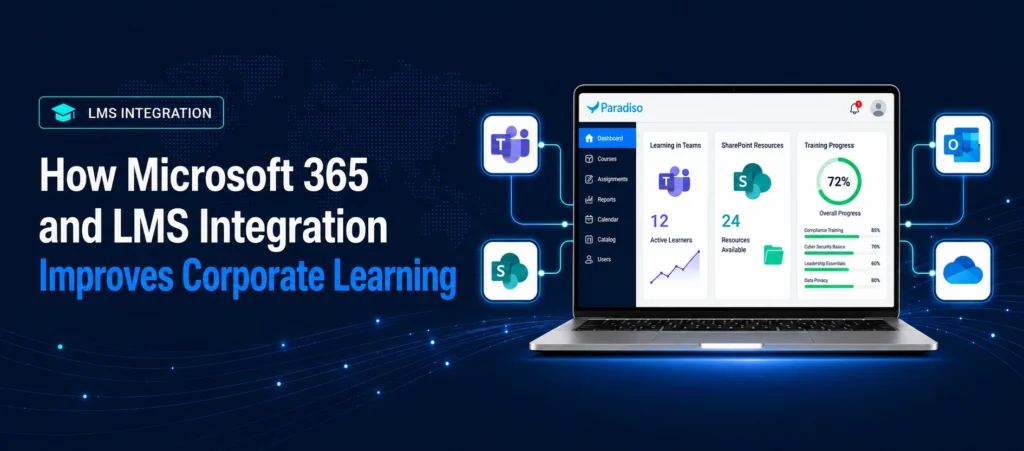
LMS integrations can help connect learning with the systems your employees and managers already use.
What is the business case for changing your L&D strategy?
The value of modern L&D comes from improving capability while reducing unnecessary training operations.
Consider an illustrative eight-person L&D team where each person spends six hours per week manually assigning learning, consolidating reports and reconciling employee data.
At a loaded labor cost of ₹800 per hour, that work represents approximately ₹19.97 lakh annually. If automation and integrations cut the administrative effort in half, roughly ₹10 lakh of annual team capacity could be redirected toward skills analysis, learning design, coaching and performance support.
That is an illustrative calculation, not an industry benchmark or promised software saving.
The bigger opportunity may come from faster onboarding, shorter time to proficiency, improved sales capability, better internal mobility or fewer errors.
The metric should depend on the problem your business is actually trying to solve.
What role will L&D professionals play in 2027?
L&D professionals will increasingly work as capability strategists rather than course administrators.
You will need to translate business priorities into skill requirements, decide where AI can support learning, build practical development experiences, partner with managers, and measure whether capability changes.
The AI-skilling ecosystem around India is expanding at the same time. Microsoft reported in September 2026 that it had already equipped more than 10 million people in India with AI skills toward a target of 20 million by 2030.
For corporate L&D, the question is therefore becoming less about whether employees should learn AI and more about which AI capabilities they need for their particular work.
How can Paradiso LMS support an L&D strategy for 2027?
Paradiso LMS can support organizations moving from course-focused learning toward skills and capability development.
Its role becomes most relevant when your team needs to connect employee training, personalized learning, AI-supported development, reporting, integrations and scalable delivery across multiple audiences.
The goal should not be to use AI simply because the LMS offers it. Use AI where it reduces administrative work, personalizes development, improves practice or gives your team better information about skills.
For broader enterprise learning requirements, explore Paradiso’s corporate LMS.
What does the future of learning and development in India look like in 2027?
The future of learning and development in India will increasingly be defined by the transition from digital learning to intelligent, skills-based workforce development.
AI will accelerate course creation and personalization, but technology will not remove the need for human judgment, leadership, communication or critical thinking. Microsoft’s latest India findings reinforce that point: even among advanced AI users, quality control and critical thinking remain central capabilities.
The strongest L&D strategies for 2027 will therefore connect four things: the skills the business needs, personalized development, opportunities to practise, and evidence that performance improved.
If your 2027 roadmap includes AI skills, employee upskilling and more measurable learning, explore how Paradiso’s AI-powered LMS can support that learning model.
Is Your LMS Ready for Your 2027 L&D Strategy?
If your 2027 L&D strategy includes AI skills, personalized learning, employee upskilling, and measurable business outcomes, it may be time to evaluate whether your current learning platform can support that shift.
Frequently Asked Questions
What are the biggest L&D trends in India for 2027?
How will AI change learning and development in India in 2027?
Which skills will employees in India need for 2027?
Why will upskilling remain important in India?
How should L&D teams measure success in 2027?
What role can an AI-powered LMS play in 2027?