
Unlocking the Power of White Label Online Course Platforms for Enterprises
In today’s competitive business landscape, enterprises recognize the critical importance of innovative training solutions to foster employee development, enhance corporate branding, and drive overall growth. White label online course platforms have emerged as transformative tools, offering fully customizable and branded eLearning environments tailored specifically to organizational needs.
Unlike generic off-the-shelf solutions, white label platforms empower companies to craft cohesive learning experiences that reinforce brand identity and culture while delivering engaging, scalable training content. These platforms seamlessly integrate with existing corporate systems, boost learner engagement, and provide detailed analytics to measure learning outcomes.
Leveraging white label online course solutions allows enterprises to maintain control over training programs, ensuring consistency in messaging, appearance, and user experience. This consistency strengthens brand recognition across all learning touchpoints.
What is a White Label Online Course Platform?
A white label online course platform is a learning management system that allows organizations to fully customize branding, including logos, domains, user interfaces, and communication elements. Instead of displaying the LMS provider’s identity, the platform reflects the organization’s brand.
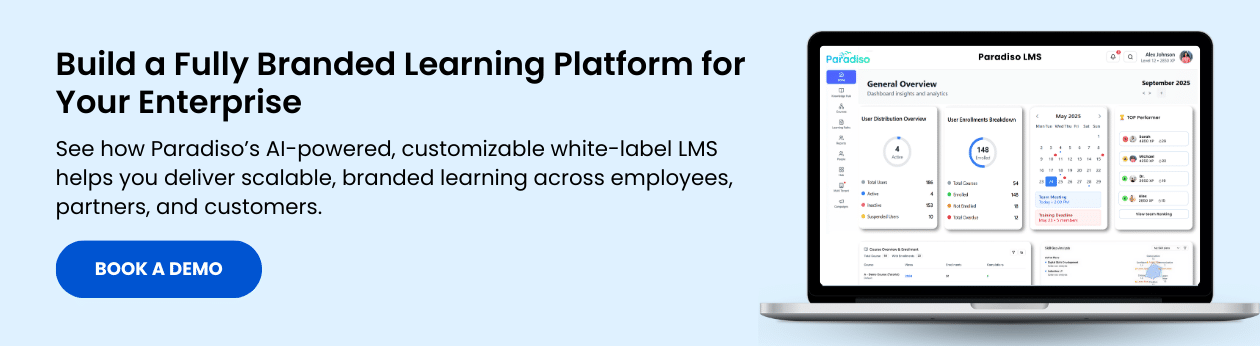
This ensures learners experience training under your brand not a third party tool, making it especially valuable for enterprises delivering training to employees, partners, and customers through a fully branded LMS environment.

Why Enterprises Are Rapidly Adopting White Label LMS Platforms
Enterprises today are not just delivering training—they are building learning ecosystems.
White label LMS platforms help organizations:
- Maintain complete brand control
- Deliver consistent learning experiences across audiences
- Scale training globally
- Integrate with business systems like CRM and HRMS
This shift is driven by the need to align learning with business growth, revenue, and customer experience. By white labeling your LMS, enterprises ensure consistency in branding, user experience, and communication across all training touchpoints.
What to Look for in a White Label Online Course Platform
Choosing the right white label online course platform is essential for organizations aiming to establish a branded, scalable, and engaging eLearning environment. Evaluating essential white label LMS features such as customization, integrations, analytics, and scalability is critical for long-term success.
1. Security and Data Privacy
Protecting sensitive learner information and proprietary content is paramount. A robust platform should comply with standards like ISO 27001 and GDPR, ensuring data privacy and security. Essential features include SSL encryption, secure login protocols, and regular security updates, all of which safeguard your organization’s reputation and foster user trust.
2. Customization and Branding Capabilities
The core advantage of white label solutions is the ability to fully customize the platform’s look and feel. Look for options enabling logo integration, color scheme adjustments, personalized login pages, and tailored user interfaces. Such flexibility enhances brand recognition, builds learner confidence, and positions your organization as a credible authority.
3. Seamless Integrations
An effective platform should integrate effortlessly with existing systems such as CRM, HRMS, payment gateways, and third-party content providers. Compatibility with standards like SCORM and xAPI (Tin Can API) is crucial for smooth content integration. APIs facilitate automation and streamline administrative workflows, making the LMS a seamless part of your enterprise ecosystem.
4. Learner Engagement Features
Engagement boosts retention and course completion. Features such as gamification (badges, leaderboards), discussion forums, live chat, mobile accessibility, and personalized learning paths encourage active participation. Analytics dashboards also provide insights into learner progress, informing targeted interventions and continuous improvement.
5. Cost Effectiveness and Return on Investment (ROI)
Assess the total cost of ownership, including licensing, customization, maintenance, and support. An ideal platform offers scalable plans suited to your current and future learner base. Additionally, evaluate potential ROI through improved learning outcomes, increased enrollments, and reduced reliance on external training providers.
Prioritize platforms that meet your current needs and support future growth. For comprehensive features and smooth LMS management, solutions like Paradiso LMS offer customizable, secure, and integration-ready platforms tailored for enterprise training.
Top 9 White Label Online Course Platforms for Enterprises in 2026
Enterprises aiming to deliver branded, scalable, and flexible online training solutions are increasingly turning to white label platforms. These solutions allow organizations to customize user experiences, reinforce branding, and integrate e-learning seamlessly within existing infrastructure. As 2026 approaches, knowing the top players helps in making informed choices aligned with corporate goals. Here are the nine leading platforms, along with their key features and ideal use cases:
1. Paradiso LMS
Overview: Paradiso LMS is a highly flexible, enterprise-grade white label platform designed to support complex training ecosystems. It enables organizations to deliver fully branded learning experiences across employees, partners, and customers from a single system.
Strengths and Features: Paradiso LMS offers deep customization, allowing businesses to control every aspect of branding—from domains to UI/UX. Its multi-tenant architecture enables multiple portals for different audiences, making it ideal for extended enterprise training. The platform also includes advanced analytics, automation, and a built-in authoring tool, along with over 100 integrations including Salesforce, SAP, and HRMS systems.
Ideal Use Cases: Large enterprises, training providers, and organizations managing multi-audience training environments such as partner onboarding, compliance, and customer education.
2. Docebo
Overview: Docebo is an AI-powered LMS known for delivering personalized and engaging learning experiences at scale. It is widely used by enterprises that prioritize automation and learner-centric training.
Strengths and Features: Focused on engaging learners, Docebo provides personalization, gamification, social learning, AI-driven content recommendations, and extensive integrations—supporting complex enterprise ecosystems.
Ideal Use Cases: Global organizations aiming to enhance engagement and leverage data-driven training programs.
3. TalentLMS
Overview: TalentLMS is a user-friendly and cost-effective platform designed for quick deployment and ease of use. It offers essential white labeling features suitable for growing organizations.
Strengths and Features: Offers straightforward white labeling, with options for logos, colors, and domain customization. Its user-friendly interface allows quick setup, with integrations for HRIS and webinar tools.
Ideal Use Cases: Mid-sized enterprises needing an easy-to-manage, branded platform for onboarding, partner training, or customer education.
4. LearnUpon
Overview: LearnUpon is a well-structured LMS designed to manage training across multiple audiences through separate portals. It focuses on ease of use and strong administrative control.
Strengths and Features: Specializes in enterprise-grade branding, multi-domain support, and flexible course delivery. Strong support and ease of use facilitate rapid deployment.
Ideal Use Cases: Internal training, partner certification, and client education requiring a reliable, branded LMS.
5. Totara Learn
Overview:Totara Learn is an open-source LMS that provides high flexibility and customization for enterprises with specific technical requirements.
Strengths and Features: An open-source LMS with high customization potential, branding, features, and integrations. Modular architecture allows tailored solutions.
Ideal Use Cases: Technically skilled enterprises seeking a flexible, bespoke learning ecosystem.
6. SAP Litmos
Overview: SAP Litmos is a corporate-focused LMS known for its strong compliance capabilities and enterprise-level security.
Strengths and Features: Combines branding options with enterprise security and compliance. Offers a vast content library, automation, and integrations supporting scalability.
Ideal Use Cases: Large enterprises needing seamless SAP integration, with a focus on compliance and security.
7. Absorb LMS
Overview: Absorb LMS combines a modern user interface with powerful administrative tools and analytics, making it suitable for enterprises focused on performance tracking.
Strengths and Features: Fully customizable interface with mobile responsiveness, social learning, and rich reporting—aimed at high user adoption and fast deployment.
Ideal Use Cases: Organizations wanting a sleek, branded environment supporting various content types and mobile learners.
8. iSpring Learn
Overview: iSpring Learn is a practical LMS solution that combines learning management with built-in course authoring capabilities.
Strengths and Features: Branded with domain customization and strong integration with iSpring Suite. Easy to deploy, suitable for enterprises with limited technical resources.
Ideal Use Cases: Fast, branded LMS deployment with seamless content creation integration.
9. D2L Brightspace
Overview: D2L Brightspace is a powerful LMS focused on adaptive learning and personalized education experiences.
Strengths and Features: Focuses on personalized, adaptive learning with branding flexibility, analytics, and engagement tools—ideal for data-driven training.
Ideal Use Cases: Enterprises emphasizing advanced analytics, personalized learning, and compliance programs.
Evaluating these platforms thoroughly enables enterprises to select solutions that enhance branding, scalability, learner engagement, and operational efficiency in 2026.
Common Mistakes to Avoid
Choosing the wrong white label LMS can lead to long-term scalability and usability issues. Here are some common mistakes enterprises should avoid:
Choosing Based Only on Price
Many organizations focus only on upfront costs, ignoring long-term value. A cheaper LMS may lack scalability, integrations, or advanced features, leading to higher costs later.
Ignoring Scalability
Selecting a platform that works for current needs but cannot support future growth can limit expansion. Enterprises should choose an LMS that can handle increasing users, content, and multiple audiences.
Overlooking Integrations
An LMS that doesn’t integrate with existing systems like CRM, HRMS, or ERP can create operational inefficiencies and data silos.
Neglecting User Experience
A complex or outdated interface reduces learner engagement and adoption. Ease of use is critical for both administrators and learners.
Focusing Only on Features, Not Use Case
Many platforms offer extensive features, but not all align with your business goals. The LMS should match your specific training needs, whether it’s compliance, onboarding, or partner training.
Paradiso LMS: A Leading White Label Solution for Enterprise Training
Paradiso LMS is a premier white label LMS designed to meet the complex needs of enterprises seeking tailored training solutions. Its robust feature set, scalability, and seamless integration capabilities empower organizations to create a unified, branded learning environment that boosts engagement, knowledge retention, and growth.
Customization and Branding Flexibility
Paradiso LMS allows full personalization, including logo placement, color schemes, and layout adjustments, aligning the platform with corporate branding standards. Role-specific dashboards and customizable interfaces ensure content relevance and an engaging user experience across departments.
Scalability to Support Growing Enterprise Needs
The architecture supports expanding organizations, capable of handling thousands of concurrent users without performance issues. New courses, users, and features can be added over time, making Paradiso LMS adaptable to future training demands.
Advanced Security Features Ensuring Data Protection
Security measures include SSL encryption, role-based access control, and audit trails. GDPR and ISO compliance ensure data privacy and protection, reinforcing trust and risk mitigation.
Comprehensive Integration Capabilities
Open APIs facilitate integration with enterprise systems such as Salesforce, SAP, and HRMS, streamlining administration and enabling single sign-on (SSO). This integration supports operational efficiency and data consistency across platforms.
Success Stories Demonstrating Effectiveness
A multinational retail chain customized Paradiso LMS as a white label LMS for retail, increasing learner engagement by 40% and boosting compliance completion rates. Likewise, a Fortune 500 manufacturer integrated the platform with their ERP system, reducing onboarding time by 30%. These examples highlight its capacity to deliver tailored, secure, and scalable training solutions aligned with business objectives.
Conclusion & Actionable Takeaways
Choosing the right white label platform significantly impacts your training effectiveness and engagement. Focus on scalability, customization, user experience, integration, and support to find the optimal solution. This strategic approach enables branded, personalized training that boosts learner engagement and strengthens organizational ties.
Embedding analytics and reporting tools allows for data-driven decision-making, helping refine strategies and demonstrate ROI. Prioritize platforms offering flexible deployment, strong support, and compatibility with existing systems.
Solutions like Paradiso LMS provide extensive capabilities, including branding, advanced analytics, and seamless integrations—empowering your organization to achieve training excellence and sustained growth. Investing in the right white label platform positions your enterprise for long-term success in talent development and organizational excellence.