






THANK YOU
FOR YOUR INFORMATION
One of our expert will be in touch with you…


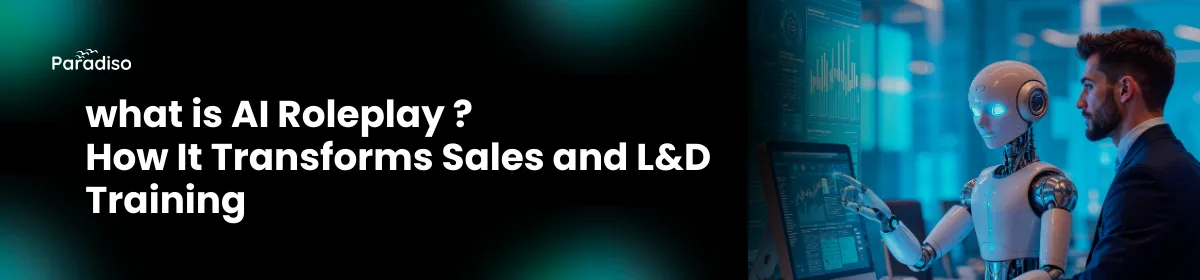
In recent years, artificial intelligence (AI) roleplay has become a transformative tool within corporate training. This innovative approach uses AI-driven avatars and virtual scenarios to simulate real-world interactions, providing learners with immersive, personalized, and risk-free environments to develop critical skills. As organizations recognize the limitations of traditional methods—such as static lectures and passive e-learning—AI roleplay offers a dynamic alternative aligned with contemporary workforce development needs.
The increasing complexity of sales processes and the fast pace of today’s business environment highlight the need for engaging and effective training solutions. AI roleplay enables sales teams to rehearse important conversations, handle objections, and negotiate in realistic yet controlled settings. Similarly, in Learning & Development (L&D), AI-powered roleplay facilitates experiential learning, allowing employees to apply concepts in adaptable scenarios with immediate feedback.
Furthermore, integrating AI roleplay into corporate training enhances engagement, boosts retention, and accelerates skill mastery. It allows organizations to supplement traditional approaches with scalable, cost-effective solutions, fostering a more agile and competent workforce. As AI continues to evolve, its role in transforming corporate learning environments will only expand, making AI roleplay essential to modern talent development strategies.
AI roleplay involves sophisticated artificial intelligence systems that generate immersive, dynamic scenarios mimicking real-world interactions. Unlike static or scripted simulations, AI roleplay offers adaptive, personalized experiences tailored to individual learning needs and situational complexities.
These systems leverage natural language processing (NLP) to understand and respond in human-like ways, along with machine learning algorithms that adapt scenarios based on user input. This creates an engaging, flexible environment where learners can practice skills, make decisions, and experience realistic consequences with safety and control.
Its functionalities span various domains such as customer service training, language learning, crisis management simulations, and behavioral assessments. By creating highly realistic and interactive scenarios, AI roleplay enhances skill acquisition, increases engagement, and speeds up learning outcomes. Its capacity to generate endless variations keeps learners challenged and motivated, making it a valuable educational and professional development tool.
AI roleplay has emerged as a key tool in corporate training by enabling learners to practice skills within a safe, controlled environment. This approach improves confidence and competence through realistic simulations that adapt to individual progress and provide immediate, personalized feedback.
One major benefit is its ability to mimic complex workplace challenges. For example, customer service reps can engage with AI avatars that respond with genuine queries and emotions, helping trainees develop effective communication, emotional intelligence, and problem-solving skills under pressure.
Advanced AI platforms analyze interactions to track progress and identify improvement areas. They offer targeted feedback and tailor scenarios to optimize learning outcomes, making training more relevant and efficient. Several industries demonstrate these benefits: in healthcare, AI simulations help medical students practice patient interactions, while in finance, roleplay scenarios involve navigating compliance and ethical dilemmas, reducing risks.
Overall, integrating AI roleplay results in engaging, measurable, and effective training. It supports realistic simulation, ongoing performance tracking, and personalized development, creating better-prepared and adaptable professionals ready for real-world challenges.
In today’s fast-changing business landscape, organizations need effective, engaging, and adaptable training programs. Traditional methods—like classroom sessions and static e-learning—often lack interactivity and scalability. Consequently, there’s a critical need to adopt advanced technological solutions that enhance learning experiences and produce measurable results.
Many organizations face high costs, inconsistent content quality, and low engagement in their training efforts. In-person training is resource-intensive, involving venue costs, trainers, and time away from work. E-learning, while more scalable, sometimes fails to prepare learners for real-life scenarios. Maintaining motivation and ensuring information retention remain ongoing concerns.
AI roleplay offers a solution by simulating realistic scenarios in which employees can hone skills safely. These intelligent systems adapt responses to individual learners, offering personalized feedback and fostering higher engagement. This reduces reliance on expensive, resource-heavy training sessions.
The future points toward immersive learning powered by AI and augmented reality (AR). AI systems are increasingly sophisticated, using NLP and machine learning to produce natural and nuanced interactions. They can simulate complex interpersonal situations—like customer interactions or crisis responses—more accurately than ever before.
Integrating virtual reality (VR) with AI roleplay enhances learning by immersing users in high-stakes scenarios without real-world risks. Such environments improve retention and transfer of skills, boosting confidence and competency across various fields.
One of AI roleplay’s key advantages is its cost efficiency. By minimizing physical resources and trainer requirements, organizations can significantly lower training costs. AI platforms are scalable, enabling simultaneous onboarding and development for large groups across multiple locations without additional expenses.
Additionally, AI solutions are accessible 24/7, allowing learners to train at their own pace, which accelerates onboarding and ongoing professional growth. These advantages make AI roleplay an urgent and strategic choice for future-ready organizations.
Paradiso LMS’s innovative AI roleplay features redefine corporate training by providing dynamic, engaging, and tailored experiences. These tools utilize state-of-the-art AI to simulate realistic scenarios, enabling learners to practice in safe, controlled environments that mirror real challenges.
One of Paradiso LMS’s strengths is its high level of customization. Organizations can tailor roleplay scenarios to suit specific industries, company policies, or individual skill levels. Personalization keeps training relevant, practical, and immediately applicable, increasing engagement and retention.
The platform seamlessly integrates with existing enterprise systems such as HR and leave management software, Learning Record Stores (LRS), and other e-learning modules. This interoperability ensures smooth data flow and allows organizations to monitor progress comprehensively. It also enables adapting training based on real-time analytics, aligning AI roleplay with broader learning strategies.
Paradiso LMS’s AI roleplay features facilitate the delivery of smarter, more effective training. By simulating complex interactions—from customer service to safety protocols—learners develop critical thinking and decision-making skills in a risk-free setting. This approach boosts confidence and results in more competent employees.
Overall, these features combine customization, seamless system integration, and innovative methodologies to foster continuous professional growth and better workforce readiness.
AI roleplay is transforming corporate training, communication, and skill development by creating realistic, interactive scenarios. It enhances engagement, speeds up skill acquisition, and promotes deeper understanding across areas like customer service, leadership, and compliance. Its ability to simulate diverse situations with consistent, unbiased feedback makes AI roleplay an invaluable tool in modern education.
Adopting this approach allows organizations to develop scalable, cost-effective, and adaptable training programs tailored to individual needs. To capitalize on these benefits, companies should consider pilot projects, invest in AI-enabled platforms, and train HR teams on new methodologies.
Solutions like Paradiso LMS offer comprehensive AI capabilities—supporting sophisticated roleplay modules, personalized learning paths, and real-time analytics. Integrating AI roleplay into your training framework can lead to measurable improvements in employee performance, engagement, and future-readiness in an increasingly digital landscape.
Let AI create your training courses
