Healthcare organizations run on the competency of their people. Every clinical decision, every patient interaction, every compliance requirement comes back to one foundational question: are your staff prepared?
Healthcare training programs are the structured systems through which that preparation happens. They are not optional for professional development. They are operational requirements, regulatory obligations, and the primary tool available to healthcare leaders who want to reduce errors, close skill gaps, and build a workforce capable of delivering consistent, high-quality care.
This guide covers all of it, whether you are building a training program from the ground up, reviewing one that has grown without a clear structure, or looking for ways to deliver training more efficiently across a distributed workforce.
Healthcare training programs are structured educational initiatives designed to develop, maintain, and improve the knowledge, skills, and behaviours of healthcare workers across all roles and settings. They can be mandatory or elective, clinical or administrative, delivered in person or online, and managed at the individual, department, or organisational level.
What distinguishes healthcare training from general professional development is the regulatory and patient safety context that surrounds it. A training gap in most industries creates inefficiency. In healthcare, it can contribute to medical errors, compliance violations, patient harm, and organisational liability. That context shapes how training programs need to be designed, documented, and tracked.
The scope of a well-designed healthcare training program is also temporal. It does not begin onboarding and end six months later. It runs continuously, updating when regulations change, when new equipment is introduced, when incidents identify gaps, and when staff move into new roles. Organisations that treat training as a recurring operational function rather than a periodic compliance exercise are consistently better positioned when audits, incidents, or accreditation surveys occur.
Clinical training focuses on the direct delivery of patient care. It covers medical procedures, clinical protocols, diagnostic skills, infection control, medication administration, and patient assessment. This type of training often requires hands-on practice, supervised performance, and competency verification before a staff member is cleared to work independently in a clinical role.
Non-clinical training addresses the operational, administrative, and behavioural dimensions of working in healthcare. It covers compliance and regulatory requirements, communication skills, leadership development, data privacy, billing and coding, and a range of soft skills that directly affect both the patient experience and the internal functioning of the organization.
Both matter equally. An organisation that invests heavily in clinical skills training, but neglects compliance, leadership, or cultural competency will still carry significant risk. The strongest healthcare training programs treat clinical and non-clinical development as two sides of the same workforce strategy, not as separate priorities.
Mandatory training covers everything that staff are legally or institutionally required to complete. This includes compliance programs mandated by CMS, OSHA standards, Joint Commission accreditation requirements, and state licensing obligations. Mandatory training applies across the board regardless of whether an individual feels they need it. It exists because regulators and accrediting bodies have determined that consistent exposure to specific content protects both patients and the healthcare workforce.
Elective training, by contrast, is driven by individual development goals, departmental priorities, or organisational capability-building initiatives. Leadership courses, advanced clinical skills, specialty certifications, and communication workshops typically fall in this category. Elective training is where healthcare organisations differentiate themselves, investing in the capabilities that go beyond compliance and toward genuine competitive advantage.
The most effective healthcare training programs manage both tracks, ensuring mandatory requirements are met consistently and on time while creating space for the elective development that retains good people and builds stronger teams.
Healthcare organisations need to train their workforce across a wide range of topics, skills, and compliance obligations. The breadth of healthcare training courses available today reflects just how varied that need is, covering everything from one-hour mandatory compliance modules to multi-week leadership development programs.
Understanding the full landscape of training types helps healthcare leaders build programs that are comprehensive rather than reactive, and reactive training programs are always more expensive than planned ones.
Healthcare compliance training is the structured delivery of regulatory and policy-specific education that ensures every workforce member understands their legal obligations and knows how to fulfil them in their specific role. It is the foundation of every healthcare training program, covering the regulatory requirements that govern how healthcare organisations operate, how patient data is handled, how workplace safety is maintained, and how clinical care is documented and delivered.
De-escalation training for healthcare workers is a structured program that teaches clinical and non-clinical staff how to recognise early warning signs of agitation or distress, use verbal and non-verbal communication techniques to reduce tension, and respond safely when patient or visitor behaviour escalates. It is not optional soft skills development. It is a direct response to one of the most serious and under-addressed safety challenges in the healthcare workplace.
De-escalation training directly addresses this reality by giving staff practical tools before incidents occur rather than crisis response procedures after they do. Training covers documentation requirements and reporting obligations when incidents occur and addresses both physical and psychological safety considerations for staff. The Joint Commission has issued Sentinel Event Alerts on workplace violence in healthcare, and CMS has signalled expectations around healthcare worker safety programs.
Patient safety training equips clinical and support staff with the knowledge and behaviours that prevent harm to patients during care. It covers communication frameworks like SBAR (Situation, Background, Assessment, Recommendation), fall prevention protocols, medication safety practices, infection control procedures, and the reporting of near-misses and adverse events.
The Joint Commission’s National Patient Safety Goals provide specific, evidence-based targets that accredited organisations must address through training. CMS ties patient safety performance to reimbursement through the Hospital Value-Based Purchasing initiative, making patient safety training a financial as well as a clinical and ethical priority.
For professionals who want to formalise their patient safety expertise, patient safety certification programs like the Certified Professional in Patient Safety (CPPS) and the Certified Healthcare Safety Professional (CHSP) provide structured pathways. Both are increasingly recognised as markers of credibility in quality improvement and risk management roles.
Clinical skills training develops and maintains the technical competencies that clinical staff need to perform their roles safely and effectively. It covers hands-on procedural training, diagnostic techniques, clinical assessment, equipment operation, and the practical application of clinical protocols in patient care scenarios.
Unlike theoretical knowledge covered in compliance training, clinical skills training requires demonstration and verification of competency. A clinician may understand the procedural steps in isolation but still perform them incorrectly under time pressure or in complex patient scenarios. Clinical skills training addresses this gap through simulation, supervised practice, and structured competency assessment.
Clinical skills training encompasses bedside assessment techniques, wound care procedures, medication administration, catheter placement, wound management, electronic health record (EHR) navigation in clinical context, emergency response protocols, and specialty-specific skills that vary by clinical setting. The Joint Commission requires documented evidence of competency assessment before staff are cleared to perform clinical procedures independently.
Healthcare organisations increasingly use high-fidelity simulation to deliver clinical skills training in a controlled environment before staff perform procedures on actual patients. Simulation-based training allows staff to practice complex scenarios, build confidence, and demonstrate competency without patient risk. For complex clinical skills, blended delivery combining simulation training with hands-on supervised practice produces the best learning outcomes.
Strong clinical outcomes depend on strong leadership at every level of a healthcare organisation. Charge nurses, department heads, clinical directors, and executive leaders all shape the environment in which care is delivered, and the quality of that environment is directly tied to the quality of the training they have received.
Healthcare leadership training covers strategic thinking and resource allocation, change management in clinical environments, team communication and conflict resolution, regulatory and financial literacy, and the interpersonal skills that build psychological safety and reduce staff turnover. Organisations with strong leadership development programs consistently show better staff retention numbers, lower rates of burnout, and measurably better patient satisfaction scores.
Leadership development also serves as a practical succession planning function. Healthcare organisations face well-documented shortages of qualified clinical and administrative leaders. Building the next generation of leaders within the existing workforce is both more cost-effective and more culturally aligned than hiring externally. See our healthcare leadership training guide.
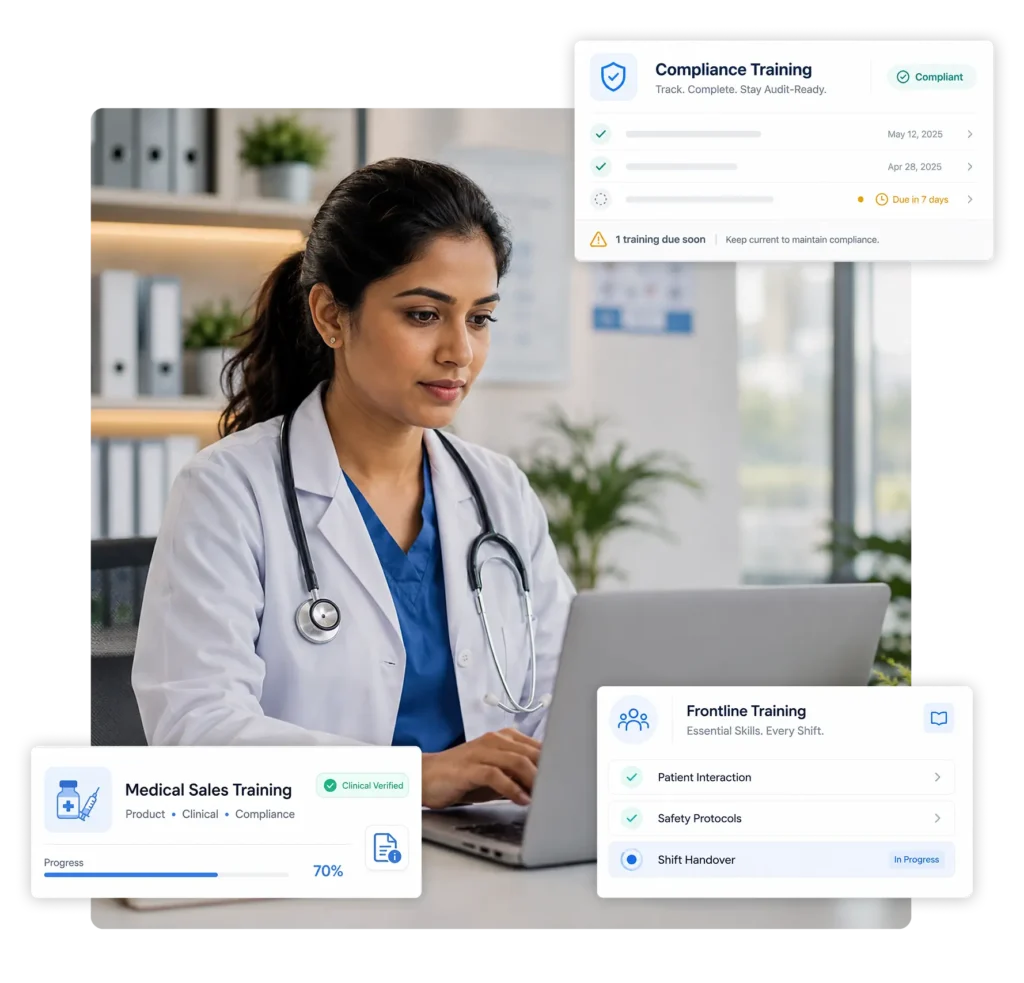
Frontline healthcare workers – patient care technicians, nursing assistants, medical assistants, phlebotomists, housekeeping and environmental services staff – are often the first point of contact for patients and deliver essential patient care, yet they frequently receive less structured training than clinical or administrative teams.
Frontline staff training addresses the unique responsibilities and challenges of these roles: patient communication and empathy, infection control in real-world practice, patient safety protocols from a non-clinical perspective, HIPAA compliance and patient confidentiality, manual handling and ergonomics, customer service and de-escalation, and the reporting of patient concerns or safety hazards to clinical supervisors.
These staff also provide essential context to clinical teams. A patient care technician who notices a patient’s behaviour changes, anxiety levels, or physical discomfort often identifies problems before clinical staff do. Training frontline teams to communicate effectively with clinical staff, to document observations accurately, and to feel empowered to report concerns improve patient outcomes and reduce missed safety signals.
Frontline staff experience high turnover in many healthcare organisations, making training investment seem risky. However, comprehensive onboarding and continuous training for frontline teams reduces turnover, improves retention, and builds the foundation of patient safety from the point of first contact. Organisations that invest in frontline staff training see measurably better patient satisfaction scores and fewer patient safety incidents.
Healthcare sales training and medical sales training programs equip commercial teams with the product knowledge, clinical understanding, regulatory awareness, and communication skills needed to sell effectively in one of the most complex and highly regulated sales environments that exists. A medical device sales representative presenting to a surgical team needs to understand the device in clinical depth, know the competitive landscape, comply with industry regulations like the Sunshine Act, and communicate value in terms that resonate with clinical decision-makers.
Medical sales training is not the same as general B2B sales training. Clinical buyers evaluate claims sceptically, ask technically demanding questions, and make purchasing decisions that directly affect patient outcomes. Healthcare sales training covers product education, clinical application, regulatory compliance, and customer-facing communication, and requires frequent updates as product lines evolve and regulatory requirements change. See our Healthcare Sales Training guide.
CME encompasses live conferences, online courses, simulation-based activities, journal-based learning, and performance improvement programs. For healthcare organisations, CME sits at the intersection of regulatory compliance, professional development, and talent retention. Physicians who have access to relevant, high-quality continuing medical education credits through their employing organisation are more likely to engage with broader organisational learning programs.
Patients arrive in healthcare settings with different languages, health beliefs, socioeconomic backgrounds, and lived experiences that shape how they engage with care. Cultural competency training equips healthcare staff to recognise and respond to that diversity in ways that improve trust, communication, and health outcomes.
Implicit bias training addresses unconscious attitudes and stereotypes that can affect clinical decision-making and patient interactions, often widening health disparities. Research published in the Journal of General Internal Medicine documented associations between implicit bias and disparities in pain management, cardiovascular care, and maternal health outcomes. A 2019 systematic review in the same journal confirmed these disparities persist across clinical decision-making, highlighting the need for culturally competent training programs.
Many states now mandate implicit bias training for licensed healthcare professionals as part of continuing education requirements. California, New York, and Illinois have all enacted or proposed legislation requiring this training for clinical staff. Beyond compliance, it is increasingly seen as core to healthcare organisations’ equity and inclusion commitments.
The shift toward online delivery has fundamentally changed how healthcare organisations approach workforce training. Online healthcare training programs offer flexibility, consistency, and scalability that traditional classroom-based models cannot match at the same cost or operational efficiency.
A clinical workforce that includes shift workers, remote staff, travelling nurses, and staff spread across multiple facilities cannot realistically gather in one room for training sessions. Online delivery removes that constraint. Staff can complete training during quiet periods on shift, between patient interactions, or from home on their own devices.
Both delivery formats have a legitimate place in a healthcare training program, and the choice between them should be driven by the content and the learner, not by convenience or budget alone.
eLearning excels at consistent content delivery for regulatory and compliance requirements, onboarding modules reaching large numbers of new staff, and refresher training that staff need to complete without leaving patient care areas for extended periods. The combination of both formats, often called blended learning, is what most mature healthcare training programs settle on, using each approach where it works best Emerging technologies like AI-powered roleplay simulations offer new possibilities for interactive soft skills training, creating realistic scenarios for communication and decision-making practice.
Self-paced training removes the scheduling dependency entirely. Staff complete training when it is convenient and practical, reducing the operational disruption that mandatory training deadlines can create in understaffed units. When paired with automated reminders and completion tracking through an LMS, self-paced delivery maintains accountability without requiring manual follow-up from managers or compliance teams.
Organisations using AI conversational roleplay report measurable improvements: 45% higher confidence in difficult conversations, faster clinical readiness and onboarding, significantly improved patient satisfaction scores in areas like shared decision-making and bedside communication, and reduced medical errors in high-risk interaction types. Unlike traditional role-play training with colleagues, AI roleplay provides 24/7 availability, consistent scenario experiences across large teams, detailed performance analytics, and eliminates social evaluation pressure that inhibits authentic practice.
Building a healthcare training program that actually works is a process, not an event. The organisations that do it well follow a consistent set of steps that ensure training addresses real gaps, uses appropriate formats, and produces measurable outcomes.
Every effective healthcare staff training program starts with a needs assessment. This means identifying the gap between where your workforce currently is and where it needs to be, then prioritising the gaps that carry the greatest risk or opportunity.
Needs assessment in healthcare draws on multiple sources: incident reports and near-miss data, performance review outcomes, regulatory audit findings, patient satisfaction scores, staff surveys, and direct input from frontline supervisors. Healthcare staff training that is not grounded in a real needs assessment tends to be poorly targeted, low-engagement, and ultimately ineffective. Needs assessment is what ensures training content is specific enough to be useful.
Once training needs are identified, each area should be translated into clear, measurable learning objectives. A learning objective specifies what a learner will be able to do after completing the training, not just what content they will have been exposed to.
The distinction matters. ‘Staff will understand infection control procedures’ is an exposure statement. ‘Staff will correctly identify three situations requiring enhanced PPE and select appropriate equipment from the available inventory’ is a learning objective. The second version can be assessed, verified, and tied to a specific patient safety outcome.