WhatsApp Chat

   Try our eLearning Authoring Tool     Get Started Free

What Are the Top Enterprise LMS Platforms Available in the Market?

enterprise LMS platforms in the market

In today’s fast-paced, digitally-driven world, organizations are increasingly relying on Enterprise LMS Platforms to streamline employee training, enhance skill development, and ensure compliance. With remote work and hybrid models becoming the norm, businesses need robust, scalable, and user-friendly Learning Management Systems (LMS) to meet their training needs. But with so many options available, how do you choose the top Enterprise LMS platforms that align with your organization’s goals?

This blog dives deep into the best Enterprise LMS platforms available in the market, their key features, and how they can benefit your organization. Whether you’re a small business or a large enterprise, this guide will help you make an informed decision. Let’s explore!

Why Are Enterprise LMS Platforms Essential for Modern Businesses?

Enterprise LMS platforms are no longer just a luxury—they’re a necessity. These platforms enable organizations to deliver consistent training, track employee progress, and ensure compliance with industry regulations. They also support personalized learning paths, gamification, and analytics, making them indispensable for businesses aiming to stay competitive.

The rise of remote work has further amplified the need for Enterprise LMS solutions that can seamlessly integrate with existing tools, offer mobile accessibility, and provide a centralized hub for all training materials. But with so many options, how do you identify the top Enterprise LMS platforms that deliver value?

What Are the Key Features to Look for in Enterprise LMS Platforms?

Before diving into the list of top Enterprise LMS platforms, it’s important to understand the features that make an LMS stand out. Here are some must-have features:

  • Scalability: The platform should grow with your business.
  • Customization: Tailor the LMS to match your brand and training needs.
  • Integration: Seamlessly integrate with tools like HRMS, CRM, and video conferencing apps.
  • Mobile Accessibility: Ensure learners can access content on the go.
  • Analytics and Reporting: Track progress and measure ROI.
  • User-friendly interface: Simplify navigation for both admins and learners.
  • Compliance Support: Meet industry-specific regulatory requirements.

Now that we know what to look for, let’s explore the top Enterprise LMS platforms available today.

What Are the Top Enterprise LMS Platforms in 2026?

Here’s a curated list of the best Enterprise LMS platforms that are making waves in 2026:

Top Enterprise LMS Platforms Comparison

LMS Platform Best For Key Features Deployment
Paradiso LMS Enterprise training & integrations AI learning paths, social learning, analytics, multi-language support Cloud / On-Premise
Docebo AI-driven corporate learning AI recommendations, collaborative learning, advanced analytics Cloud
SAP Litmos Compliance & rapid deployment Course library, compliance tracking, strong reporting tools Cloud
Cornerstone OnDemand Talent development & enterprise L&D Talent management, adaptive learning paths, mobile learning Cloud
Blackboard Learn Corporate & academic training Course management, collaboration tools, integrations Cloud / Self-hosted
TalentLMS Small to mid-sized enterprises Quick deployment, multilingual support, built-in assessments Cloud
Absorb LMS Large-scale corporate training Customization, content management, advanced reporting Cloud
Moodle Workplace Open-source enterprise LMS Custom workflows, compliance tracking, plugin ecosystem Cloud / Self-hosted
360Learning Collaborative learning Peer learning, course authoring, analytics, integrations Cloud
D2L Brightspace Adaptive learning environments Personalized learning paths, analytics, enterprise integrations Cloud

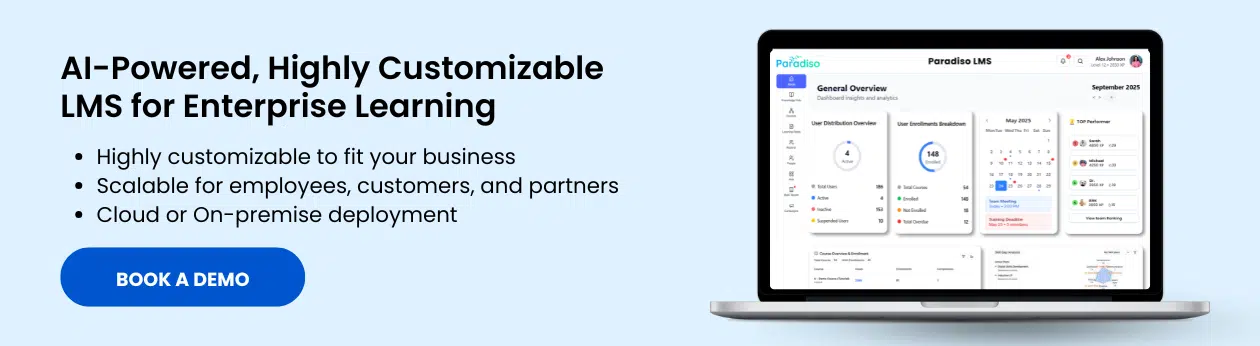
1. Paradiso LMS by Paradiso Solution

Paradiso LMS leads the list with its comprehensive, enterprise-grade design tailored for large organizations. Built by Paradiso Solution, it excels in seamless system integration, providing an intuitive and user-friendly interface that is accessible across devices. With robust reporting tools, customizable learning paths, and stringent security protocols, Paradiso LMS is crafted to meet the complex training needs of modern enterprises while driving data-driven decision making and digital transformation.

Key Features:

  • AI-driven personalized learning paths
  • Social learning and collaboration tools
  • Advanced reporting and analytics
  • Multi-language and multi-domain support

2. Docebo LMS

Docebo is a powerhouse in the LMS arena, offering an AI-driven platform that personalizes the learning experience. Its modern interface supports social and collaborative learning environments, making it easy for teams to share insights and progress together. With extensive integration capabilities and a strong emphasis on analytics, Docebo enables organizations to monitor performance and continuously refine their training strategies for optimal outcomes.

3. SAP Litmos

SAP Litmos is known for its rapid deployment and scalability, making it a preferred choice for businesses aiming to streamline compliance and operational training. This cloud-based platform comes with an extensive library of pre-built courses and training modules, reducing time-to-value. Its detailed analytics and tracking features ensure that organizations can measure learning effectiveness and maintain industry compliance with ease.

4. Cornerstone OnDemand

Cornerstone OnDemand offers an all-in-one solution that combines learning management with talent management. This platform is designed to deliver personalized learning experiences through its rich content library and adaptive learning paths. With its strong mobile support and social learning features, Cornerstone OnDemand helps companies nurture talent and foster a culture of continuous improvement, all while providing deep insights through advanced analytics.

5. Blackboard Learn

Blackboard Learn has long been a staple in both academic and corporate settings. It delivers robust course management tools that facilitate a customizable learning environment tailored to diverse needs. Known for enhancing collaboration and engagement, Blackboard Learn integrates seamlessly with third-party tools, making it an excellent option for organizations seeking to leverage comprehensive course management securely and flexibly.

6. TalentLMS

TalentLMS is celebrated for its ease of use and flexibility, making it a favorite among businesses of all sizes. Its intuitive interface allows for rapid course creation and deployment, while flexible pricing options ensure that it can scale with your organization. With built-in assessments, multilingual support, and a focus on cultural adaptability, TalentLMS makes learning accessible and engaging for diverse global teams.

7. Absorb LMS

Absorb LMS is designed with a modern, responsive approach that delivers a smooth and engaging learning experience across devices. The platform offers powerful administrative tools, extensive customization options, and detailed analytics to monitor learner progress. Its content management capabilities ensure that organizations can create, deliver, and track training programs with precision and efficiency, making it a robust solution for complex learning environments.

8. Moodle Workplace

Moodle Workplace extends the legacy of the open-source Moodle platform into the enterprise realm. Highly customizable and flexible, it empowers organizations to create tailored learning environments that foster collaboration and innovation. With a focus on robust reporting and compliance tracking, Moodle Workplace provides a cost-effective solution backed by a vibrant community of developers and educators, ensuring continuous improvement and support.

9. 360Learning

360Learning is a collaborative learning platform designed to enable peer-driven learning within organizations. It allows employees to create and share training content directly on the platform, encouraging knowledge sharing across teams. With strong analytics, integrations, and user-friendly course creation tools, 360Learning helps enterprises build a culture of continuous learning.

10. D2L Brightspace

Brightspace by D2L is a versatile platform designed to adapt to various learning environments and organizational needs. It leverages adaptive learning technologies to create personalized content and offers in-depth analytics to track learner performance. With its emphasis on engagement and retention, Brightspace seamlessly integrates with existing enterprise systems, making it an ideal solution for organizations aiming to deliver dynamic and impactful training experiences.

How to Choose the Right Enterprise LMS Platform for Your Business?

Selecting the top Enterprise LMS platform for your organization depends on several factors:

  • Business Size: Small businesses may prefer affordable options like TalentLMS, while large enterprises might opt for Docebo or Cornerstone OnDemand.
  • Training Needs: Identify whether you need compliance training, skill development, or both.
  • Budget: Consider both upfront costs and long-term ROI.
  • Integration Requirements: Ensure the LMS integrates with your existing tools.
  • User Experience: Test the platform’s ease of use for both admins and learners.

Conclusion

Choosing the right Enterprise LMS platform is essential for organizations that want to streamline training, improve employee skills, and ensure compliance. Modern LMS platforms like Paradiso LMS, Docebo, SAP Litmos, and Cornerstone OnDemand offer advanced features such as AI-driven learning, analytics, integrations, and mobile accessibility to support large and distributed workforces.

The best platform depends on your organization’s size, training goals, budget, and integration needs. By selecting a scalable and user-friendly Enterprise LMS, businesses can centralize learning, enhance workforce productivity, and build a culture of continuous development in today’s digital workplace.

Frequently Asked Questions (FAQs) About Enterprise LMS Platforms

1. What is an Enterprise LMS?

An Enterprise LMS is a learning management system designed for large organizations to manage employee training, compliance programs, and skill development at scale. It enables companies to deliver training programs, track learner progress, and generate performance insights across multiple departments and locations.

2. How is an Enterprise LMS different from a traditional LMS?

A traditional LMS is typically designed for smaller organizations with limited training needs, while an Enterprise LMS is built to handle large user bases, advanced integrations, multi-tenancy, and complex organizational structures.

3. What features should organizations look for in an Enterprise LMS?

Important features include scalability, advanced reporting and analytics, mobile accessibility, integrations with enterprise systems, customizable learning paths, compliance tracking, and strong user management capabilities.

4. Why do large organizations use Enterprise LMS platforms?

Large organizations use Enterprise LMS platforms to deliver consistent training across global teams, improve employee performance, track compliance requirements, and support continuous skill development.

5. What are some of the top Enterprise LMS platforms available today?

Some of the most widely used Enterprise LMS platforms include Paradiso LMS, Docebo LMS, SAP Litmos, Cornerstone OnDemand, Absorb LMS, TalentLMS, Moodle Workplace, D2L Brightspace, and 360Learning.

Follow us!

Do NOT follow this link or you will be banned from the site!