
What Is Partner Training
A Complete Enablement Guide
How a customizable, role-based partner training LMS drives revenue at scale
Introduction to Partner Training
Partner training is no longer a support function or an operational afterthought.
For organizations that sell through channel partners, it is a revenue enablement system.
When partners are poorly trained, the symptoms are immediate and costly: inconsistent messaging in the market, longer sales cycles, increased dependency on internal teams, and lost revenue opportunities. Growth becomes unpredictable because partner performance varies widely and cannot be scaled or controlled.
This guide follows a proven, high-impact framework for partner training that organizations can adapt to their own channel ecosystems—whether they work with resellers, distributors, system integrators, franchisees, affiliates, or technology partners.
Modern businesses depend on partners to expand across markets and geographies. These partners directly influence pipeline generation, deal conversion, customer onboarding, and long-term retention. Without a structured partner training strategy, even the strongest partner programs struggle to deliver consistent results.
A well-designed partner training program ensures that every partner—regardless of role, region, or maturity—has the knowledge, certifications, and sales readiness required to represent your product accurately and confidently. It aligns partner behavior with business objectives, reduces friction in channel sales, and enables revenue growth without increasing internal headcount.
SaaS, manufacturing, telecom, healthcare, finance, and enterprise organizations now view partner training as essential infrastructure—not an optional add-on, but a primary growth driver.
Why Partner Training Is a Revenue System (Not Just Training)
Modern partner ecosystems are complex. Partners are no longer just distribution channels—they influence the entire revenue lifecycle, including:
Pipeline generation
Deal conversion
Retention and expansion
Without structured partner training, organizations consistently face the same challenges:
Long ramp-up times for new partners
Inconsistent sales behavior across regions and teams
Poor product positioning in the market
Heavy dependency on internal sales, product, and support teams
Effective partner training changes this dynamic.
A high-impact partner training program operates as a revenue system, not a learning initiative. It ensures that partner behavior is aligned with business goals and that every partner—regardless of location or role—has the clarity, confidence, and readiness to sell, implement, and support your offering independently.
When partner training is designed as a revenue system, outcomes become measurable:
Faster partner time-to-productivity
Higher-quality partner-led opportunities
More consistent deal execution
Reduced internal operational load
Predictable, scalable revenue growth
This shift—from training for knowledge to training for revenue—is the foundation of every high-performing partner ecosystem.
Evolution of Partner Training in the Digital Era
Partner training has evolved significantly over the past decade. What began as manual, in-person enablement has transformed into scalable, data-driven ecosystems—driven by the need for future-proof channel enablement that helps partners adapt, perform, and grow in rapidly changing markets.
Phase 1: Traditional Partner Training (Pre-2010)
Early partner training relied heavily on in-person workshops, roadshows, and classroom sessions. While effective for small partner networks, this approach was expensive, difficult to scale globally, and nearly impossible to measure or optimize.
Phase 2: LMS-Based Digital Distribution (2010–2017)
The introduction of partner portals and LMS platforms made training more accessible. Standardized courses, certifications, and structured onboarding workflows became common, allowing organizations to train partners remotely and at scale.
Phase 3: Data-Driven Partner Enablement (2017–2022)
As partner ecosystems grew, analytics moved to the center of enablement strategies. Organizations began tracking partner readiness, completion rates, and certification status, while integrating LMS and CRM systems to connect training outcomes with pipeline and revenue performance.
Phase 4: AI-Powered Personalization (2022–Present)
Modern partner training platforms now recommend personalized learning paths based on partner roles, behavior, and performance. Predictive analytics forecast revenue impact, automated onboarding reduces manual effort, and real-time dashboards enable continuous optimization.
Phase 5: Autonomous Partner Ecosystems (Emerging)
The next evolution of partner training will focus on AI-generated content, dynamic skill mapping, and real-time capability benchmarking across partner tiers. Training will continuously adapt as partner needs and market conditions change.
What was once just a support activity has transformed into a strategic growth driver for companies dependent on channel sales.
What Is Partner Training?
Partner training, It is a structured enablement strategy designed to educate and empower external partners regarding your company’s products, services, processes, brand standards, and customer expectations. The purpose of partner training is to improve partner performance, accelerate onboarding, reduce support costs, and create higher partner-driven sales outcomes.
What Partner Training Typically Includes:
A high-impact partner training program is built around multiple enablement layers, each serving a specific business purpose.
Partner Onboarding Training
Introduces new partners to:
Your brand and value proposition
Target customers and ICP
Product ecosystem and partner roles
The goal is to reduce ramp-up time and get partners productive quickly.
Product & Technical Training
Enables partners to:
Understand product features and use cases
Handle integrations, implementations, and troubleshooting
Confidently support customers post-sale
This is critical for solution partners, system integrators, and technical resellers.
Sales & Marketing Enablement
Provides partners with:
Messaging frameworks and pitch narratives
Competitive positioning and objection handling
Demo flows, use cases, and sales assets
This ensures consistent, accurate product representation in the market.
Compliance & Policy Training
Ensures partners follow:
Legal and regulatory requirements
Brand and communication guidelines
Industry-specific standards
This is especially important in regulated industries such as healthcare, finance, and telecom.
Partner Certification Programs
Certifications:
Validate partner skill and readiness
Create clear capability benchmarks
Build credibility and trust with customers
Certification-based enablement also helps organizations tier and manage partners more effectively.
Continuous Learning & Updates
Keeps partners aligned with:
New product features and releases
Enhancements and roadmap changes
Market and industry trends
Continuous learning ensures partner knowledge stays current as your business evolves.
Key Outcomes of Partner Training:
When partner training is structured, scalable, and aligned with business goals, organizations consistently see:
- Faster time-to-productivity for partners
- More qualified partner-led opportunities
- Higher win rates in channel sales
- Reduced dependency on internal support teams
- More consistent brand and product representation
- Stronger loyalty and long-term partner relationships
Partner training ensures that every partner—regardless of role or geography—operates with the same clarity, confidence, and readiness as your internal teams.
In practice, this means partners become predictable, revenue-generating contributors, not bottlenecks that slow growth.
In the current partner ecosystem economy, structured partner training delivers clear competitive edge. Businesses neglecting partner enablement face extended sales cycles, erratic partner results, and forgone revenue potential.
Well-designed enablement programs create measurable business impact by increasing win rates, deal velocity, and customer retention. Research shows that organizations with structured partner training programs experience 20-35% faster sales cycles and 25-45% higher win rates compared to those without formal enablement.
Top Reasons Partner Training Has Become Critical
-
Increasing Complexity of Products & Services
Technology evolves quickly. Partners must be continuously trained to keep pace with new releases, features, and integrations. Organizations releasing new product versions every quarter see partner confusion without proper training infrastructure. -
Global Market Expansion
As businesses expand worldwide, partners ensure local coverage. Training enables consistent delivery of your message and value—regardless of geography. This is why 67% of enterprise organizations now use centralized LMS platforms for distributed partner ecosystems. -
Competitive Differentiation
Well-trained partners outsell poorly trained competitors. The quality of partner education directly influences customer decision-making. Partners who complete certification programs close deals 2.5x faster than untrained partners. -
Multi-Channel Customer Journeys
Modern customers engage with many touchpoints—partner sales, partner support, partner onboarding. Well-trained partners create seamless experiences.
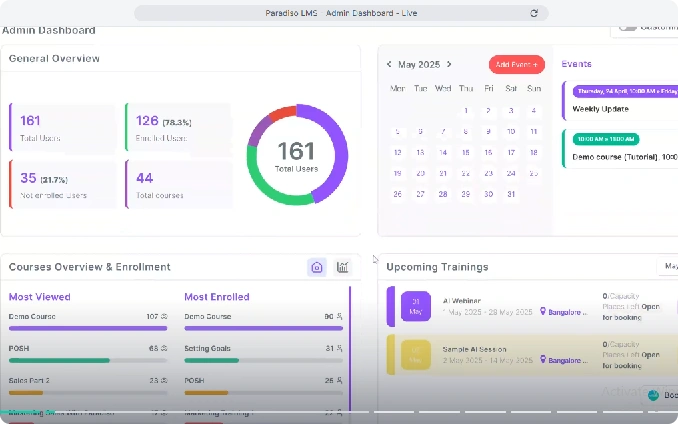
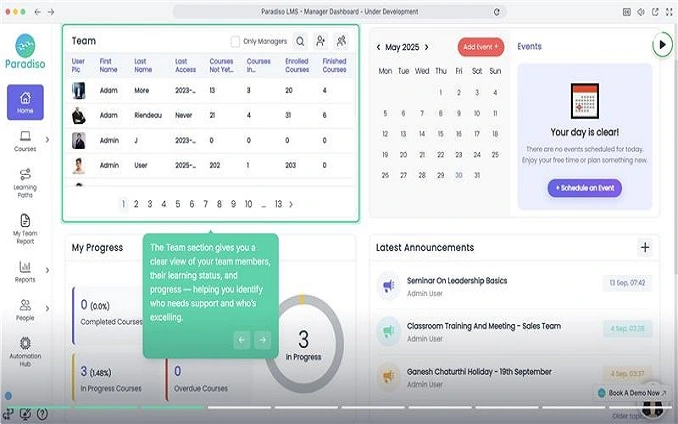
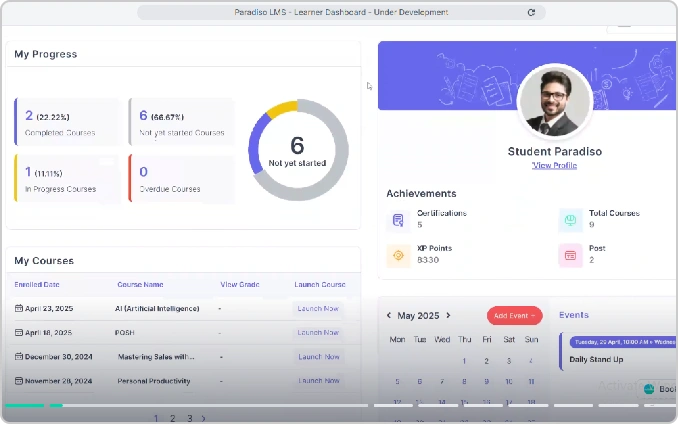
Explore Paradiso LMS at Your Own Pace
Why Partner Training Matters: Business Impact & ROI
-
Revenue Dependence on Channel Sales
More than 70% of global tech revenue now flows through partners. Training ensures partners can generate pipeline, close deals, and retain customers—making it directly tied to organizational revenue targets. -
Partner Expectations Have Changed
Partners expect self-service training, mobile accessibility, certifications, rewards, and transparent performance metrics. Organizations failing to deliver modern enablement lose partners to competitors with better programs. -
Rise of Partner Ecosystem Models
Beyond resellers, today's ecosystems include affiliates, influencers, implementers, MSPs, referral partners, and integration partners. Training is crucial across all partner types.
Direct Business Impact
-
Revenue Growth:
Partner training fuels revenue growth by creating knowledgeable partners who sell more, sell faster, and handle objections effectively. This increases win rates by 25-45%, shortens sales cycles by 20-35%, drives more upsell and cross-sell opportunities, and improves retention through better implementation and support. -
Faster Scaling:
Structured, repeatable partner training standardizes onboarding and learning across regions, enabling growth from a small partner base to thousands without proportional headcount increases. Organizations using modern partner LMS platforms scale 3x faster with the same team size. -
Consistent Brand Representation:
When partners are trained on messaging, product details, and guidelines, miscommunication, overpromising, and off-brand behavior decreases dramatically across markets and roles. This protects brand equity and customer trust -
Reduced Support Burden:
Well-trained partners resolve common issues independently, make fewer mistakes, and escalate only complex problems. This frees internal teams to focus on innovation and strategic work. Support cost reductions average 15-30% when partner training is implemented effectively. -
Stronger Partner Loyalty
When partners see training helps them win more business, improve skills, and differentiate in their market, they prioritize your products and deepen long-term collaboration. Retention rates for trained partner ecosystems exceed 90% vs. 60-70% for untrained channels.
Partner training drives revenue acceleration, risk reduction, and scalable expansion.
Organizations that treat partner training as a strategic system outperform those that treat it as an operational afterthought—every time.
Who Needs Partner Training & Industry-Specific Use Cases?
Partner training is essential for any organization where external stakeholders influence revenue, customer experience, or brand perception.
If partners represent, sell, distribute, implement, support, or promote your offerings, their readiness directly impacts business outcomes. Without structured training, performance becomes inconsistent, quality drops, and growth becomes difficult to scale.
In short:
If an external party affects your customer journey or revenue, you need a partner training system.
Organizations That Require Partner Training:
-
SaaS & Technology Companies
Partners drive subscriptions, implementations, renewals, and integrations. Rapid product releases require continuous enablement to prevent confusion and mis-selling. -
Manufacturing Companies
Distributors, installers, technicians, and service partners must understand product configuration, safety standards, and maintenance procedures to avoid costly errors. -
Retail & Consumer Brands
Channel partners need consistent product knowledge, service behaviors, and brand guidelines to deliver uniform customer experiences across locations. -
Financial Services & FinTech
Agents, brokers, and distributors must comply with strict regulatory requirements while clearly explaining complex, trust-sensitive products. -
Healthcare & Pharma
Partner training ensures safety, regulatory compliance, and accurate product representation in environments where errors can have serious consequences. -
Franchise Businesses
Franchise owners and staff must follow standardized operating procedures, brand rules, and customer experience guidelines across locations. -
Telecom & IT Services
MSPs, VARs, and service partners require technical enablement to meet SLAs, manage deployments, and handle escalations effectively. -
E-learning & EdTech Providers
Institutions, resellers, and trainers need product, platform, and instructional training to deliver effective learning experiences.
If partners are involved in selling, delivering, or supporting your offering, training is not optional — it is operational infrastructure.
Eight Core Partner Types and Their Training Needs
Different partner types require different enablement strategies. High-performing ecosystems design training by partner role, not one-size-fits-all content.
1. Resellers & Value-added Resellers (VARs)
Primary focus: Selling and positioning
Product mastery and competitive positioning
Sales methodology, demos, objection handling
Basic implementation and customer success
Outcome: Faster time-to-first-deal and higher win rates.
2. Distributors
Primary focus: Scale and logistics
Product catalog knowledge
Ordering, pricing, and discount workflows
Inventory, handling, and compliance
Outcome: Accurate fulfillment with minimal vendor intervention.
3. Technology Partners & Integrators
Primary focus: Implementation and integration
Architecture and solution design
APIs, SDKs, security, and performance
Advanced troubleshooting and optimization
Outcome: Reliable delivery in complex customer environments.
4. Consulting Partners
Primary focus: Business transformation
Value and ROI modeling
Industry-specific solution patterns
Change management and stakeholder alignment
Outcome: Credible advisory-led selling and expansion.
5. Affiliate & Referral Partners
Primary focus: Lead generation
Core messaging and ICP clarity
High-level positioning
Lead qualification and referral rules
Outcome: Higher-quality pipeline with minimal training overhead.
6. Service Partners & Managed Service Providers (MSPs)
Primary focus: Ongoing operations
Operational runbooks and workflows
Monitoring, incident response, escalation
Compliance and lifecycle management
Outcome: Reduced support load and better customer retention.
7. Training & Certification Partners
Primary focus: Enablement at scale
Train-the-trainer programs
Curriculum, labs, exams, grading standards
Version control and content maintenance
Outcome: Consistent knowledge delivery across ecosystems.
8. Channel & Indirect Sales Partners
Primary focus: Market expansion
Sales enablement and messaging
Partner program rules and incentives
Forecasting and opportunity management
Outcome: Predictable, scalable revenue growth.
Technology & SaaS
In Technology and SaaS, partner training is critical because products change quickly and frequent releases demand constant knowledge updates so partners can sell, implement, and support effectively. The focus is on deep product mastery, real-world use cases, API and integration skills, modern sales methodologies, and strong customer success capabilities, typically delivered to resellers, integrators, and consulting partners through a blended model of self-paced learning and live workshops with multiple certification tiers.
Manufacturing
In manufacturing, partner training is essential because physical products, strict safety requirements, and complex installations create high risk when partners are not properly trained, potentially leading to accidents, failures, or costly errors. Training focuses on correct installation and configuration, safety and regulatory compliance, maintenance and troubleshooting, and spare parts and lifecycle management, typically for distributors, value-added resellers, and service partners who handle these products in the field
Healthcare & Life Sciences
In healthcare and life sciences, partner training is critical because patient safety and strict regulatory requirements leave no room for error, so every partner must operate with precise, compliant practices. Training emphasizes regulatory and SOP adherence, correct use of medical devices or solutions, and robust data privacy and security, particularly for distributors, consulting partners, and service partners who handle sensitive products and information.
Industry Specific Use Cases for Partner Training
Finance & FinTech
Finance and FinTech rely on strong partner training because complex regulations and trust-sensitive products demand high rigor, so partners must master AML/KYC, data privacy and other regulatory rules, accurately explain product suitability and risk, and follow secure processes for handling data, especially in consulting and distribution roles.
Retail
In retail, training is crucial because frontline staff and retail partners directly shape customer experience, so programs emphasize deep product knowledge and use cases, consistent brand and service standards, and upsell/cross-sell skills for franchisees and in-store sales partners.
Franchises & SMEs
For franchises and SMEs, partner training matters because brand consistency across locations is essential for trust, focusing on standard operating procedures, brand and customer service guidelines, and local marketing execution for franchisees and small business partners.
Telecom
In telecom, training is vital because complex services, infrastructure, and strict SLAs require strong technical and process knowledge, so partners such as distributors, VARs, and MSPs are trained on network and service basics, provisioning and installation, support workflows, and regulatory and contractual obligations.
Education Technology
In education technology, effective partner training is important because it directly impacts learners and institutions, centering on platform and feature mastery, sound pedagogical practices, and data privacy and accessibility compliance for consulting and training partners.
Insurance
In insurance, training is critical because mis-sold or poorly explained products create legal and reputational risk, so agents, brokers, and consulting partners are trained on product and coverage details, compliance and documentation, and strong advisory and consultative skills to guide customers responsibly.
B2B Professional Services
In B2B professional services, partner training is essential because service firms need a deep understanding of your solution to credibly embed it into their advisory and implementation engagements. Training focuses on how to position the solution within consulting work, apply structured implementation frameworks, and manage change and stakeholder communication effectively, typically for consulting partner networks that lead large transformation projects.
Types of Partner Training
A high-performing partner enablement strategy includes multiple training categories tailored to partner roles, responsibilities, and business models. Below are the most essential types of partner training programs used across modern partner ecosystems.
1. Product Training
Product training gives partners the knowledge to explain your value proposition, showcase key features and use cases, and confidently demo your product against competitors, forming the foundation of effective partner enablement.
2. Sales Enablement Training
Sales enablement training teaches partners how to sell your solution by aligning them on ideal customer profiles, messaging, objection handling, pricing guidelines, and sales qualification methods, so they can close more deals efficiently.
3. Compliance Training
Compliance training ensures partners follow legal, regulatory, data protection, and brand standards, reducing risk and ensuring your solutions are sold, implemented, and marketed in a safe, compliant way across all regions.
4.Technical Training & Certifications
Technical training and certifications equip implementers and technical teams with skills in setup, integrations, troubleshooting, and advanced features, validating their capability to deploy and support your product successfully in complex environments.
5. Customer Support Training for Partners
Customer support training for partners enables them to handle common issues, follow escalation rules, use support tools correctly, and guide onboarding and adoption, resulting in better end-user experiences and fewer escalations.
6. Co-Marketing & Brand Training
Co-marketing and brand training align partners on your brand identity, messaging, and asset usage so they can run consistent, compliant campaigns and represent your value proposition accurately in their local markets.
7. New Partner Onboarding Training
New partner onboarding training provides a structured starting path with welcome content, company and ICP overviews, product introductions, portal walkthroughs, and initial certifications to get partners productive as quickly as possible.
8. Ongoing Partner Development Training
Ongoing partner development training keeps partners current through product updates, advanced certifications, industry briefings, and refresher modules, maintaining engagement and ensuring skills evolve with your roadmap and market.
Partner Training LMS: The Enablement Backbone
A Partner Training LMS is a specialized learning platform built specifically for external learners—your channel partners.
Unlike a generic corporate LMS, a partner focused system is designed for multiorganization, multiregion, and multirole ecosystems where each partner needs a tailored experience.
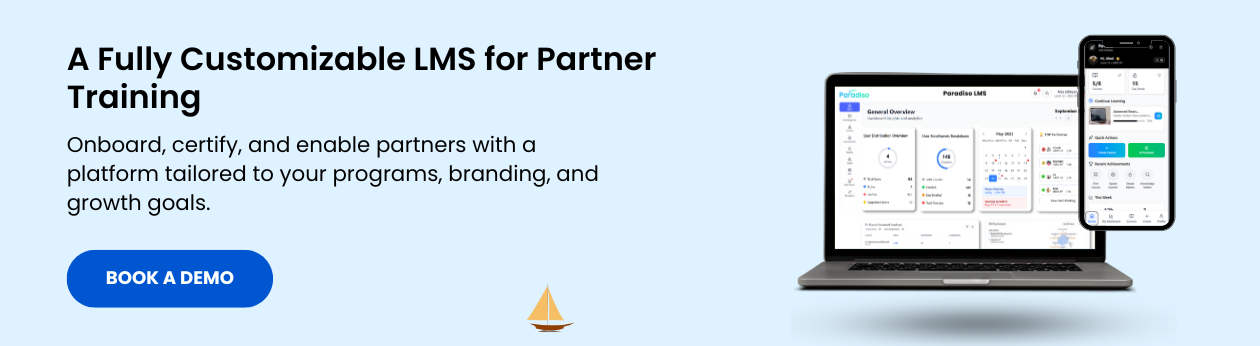
Paradiso LMS is designed as a Partner Training LMS, built to support complex, global partner ecosystems with multi‑tenant portals, automation, and deep analytics.
Core Capabilities of a Partner Training LMS:
-
Multi-tenant partner portals:
Each partner gets a multi-tenant, personalized, branded learning hub tailored to their roles and needs. -
Automated partner onboarding:
Pre-built learning paths triggered upon sign-up. -
Certifications & Partner Badges:
Tracks partner competencies and expertise levels. -
Integrations with CRM/PRM systems:
Syncs partner activity, revenue contribution, and engagement scores. - Localization & multi-language support: Essential for global partner ecosystems.
- AI-driven recommendations: Personalized course suggestions based on partner roles and performance.
- SCORM/xAPI course compatibility:Ensures easy migration and content standardization.
- Reporting & analytics: Reporting tracks partner progress, certification completion, and sales-readiness metrics.
- Mobile-first learning:Responsive design enabling partners to learn on smartphones and tablets.
Essential Integrations for a Partner Training LMS
CRM Integrations (e.g., Salesforce, HubSpot):
- Tie training completion to pipeline generation and revenue.
- View which trained partners drive more opportunities and higher win rates.
- Prioritize MDF, leads, and support for partners who invest in learning.
PRM / Partner Portal Integrations:
- Connect training with deal registration, incentives, and partner tiers.
- Automatically adjust benefits or status when partners complete certifications.
SSO (Single Sign On) & Identity Providers:
- Simplify access for partners with existing corporate credentials.
- Reduce friction and support overhead caused by multiple logins.
CMS and Content Repositories:
- Synchronize learning assets from your content management systems.
- Ensure partners always see the latest versions of documents, decks, and videos.
Product & Support Tool Integrations:
- Link training with support portals, knowledge bases, and ticketing tools.
- Provide hands-on learning in sandboxes or demo environments.
Why Organizations Use a Partner Training LMS:
- To reduce manual training overhead.
- To scale training across regions and partner tiers.
- To ensure consistent global training standards.
- To track training ROI and partner performance data.
- To build repeatable, automated channel enablement workflows.
A modern Partner Training LMS is the backbone of a high‑performing partner ecosystem, and Paradiso LMS is purpose‑built to support that model.
How to Build a Partner Training Strategy (Step-by-Step)
Building an effective partner training strategy requires a structured, repeatable approach that aligns with your business goals, partner capabilities, and customer expectations. A high-performing program doesn’t happen accidentally—it is intentionally designed, tested, optimized, and scaled.
Below is a step-by-step framework inspired by proven methodologies used by top-performing partner ecosystems, LMS platforms, and enablement teams.
Step 1: Define Partner Training Goals
The first step in building a partner training strategy is establishing clear, measurable goals that directly support your broader channel objectives.
Examples of Partner Training Goals:
- Reduce partner onboarding time from 60 days to 30 days
- Increase partner certification rates by 40%
- Improve partner-led win rates by 25%
- Reduce support escalations from partners by 30%
- Enable partners to independently handle product demos
- Improve partner product adoption in new markets
Questions to Ask:
- What business targets will partner training support?
- Which KPIs define partner success?
- What behaviors or competencies must partners demonstrate?
Defining goals ensures alignment across sales, marketing, customer success, and partner teams.
Step 2: Identify Partner Personas & Audience Segments
Not all partners are the same. Different partner types play different roles, possess different skills, and need different training formats.
Common Partner Personas:
- Resellers & VARs – focus on sales, demos, customer acquisition
- System Integrators – need deep technical training & implementation workflows
- Distributors – require product knowledge, pricing, logistics details
- Franchise Operators – need operational, compliance, and brand training
- Affiliates & Influencers – focus on messaging, positioning, and brand guidelines
- Service Providers – require installation, maintenance, and support training
Why Persona-Based Training Matters:
- Ensures content relevance
- Reduces information overload
- Improves engagement and completion rates
- Provides personalized learning paths
- Enables accurate certification models
Step 3: Map Partner Needs, Skill Gaps & Competencies
Once partner personas are defined, identify the skills and knowledge required for each partner type—and where gaps currently exist.
Types of Skill Gaps:
- Product knowledge gaps
- Technical implementation gaps
- Sales competency gaps (pitching, objection handling, demoing)
- Compliance & regulatory knowledge gaps
- Customer support process gaps
Competency Mapping Includes:
- Role-based skills (e.g., technical, sales, support)
- Behavioral expectations
- Proficiency benchmarks
- Tier-level competencies (Silver, Gold, Platinum partners)
Core Elements of Effective Training Design:
- Clear Value Proposition for Partners explaining why training matters and what they gain
- Defined Skills, Competencies & Learning Paths with structured progression from beginner to expert
- Modular Content Structure using microlearning, SCORM courses, videos, guides for flexibility
- Certification & Badging Systems to validate readiness through exams and compliance checks
- Assessments & Practical Evaluations using quizzes, scenarios, demos, labs to measure real competency
- Reporting, Analytics & Partner Scorecards tracking completion, certification, sales-readiness, and quality metrics
- Role-Based Learning Journeys tailoring training for sales, technical, success, marketing, and service roles
Step 4: Create Training Content (Formats, Tools, Templates)
After mapping competencies, it’s time to build training content that is engaging, effective, and scalable.
Content Formats to Include:
- Microlearning modules for quick knowledge retention
- SCORM/xAPI courses for trackable compliance and technical training
- Video tutorials & product demos
- Sales decks, playbooks, and scripts
- Interactive simulations and role-play scenarios
- Implementation & troubleshooting guides
- Knowledge base articles & FAQs
- Assessments & quizzes
Content Must Address:
- Partner motivations
- Ease of consumption (mobile-ready)
- Clear learning outcomes
- Structured learning paths
Step 5: Choose the Right Delivery Model (Portal, LMS, Hybrid)
Selecting the correct training delivery infrastructure is essential for scaling your partner ecosystem.
Delivery Options Include:
Partner Training LMS (Most Common)
Purpose-built for external audiences with:
- Multi-tenant portals
- Certification tracking
- White-label branding
- CRM/PRM integrations
- Mobile learning
Partner Portal
Useful when training must integrate with:
- Deal registration
- Program benefits
- Incentives and partner tiers
Hybrid Enablement Architecture
Combines LMS, portal, and content management tools for mature ecosystems.
What to Look For:
- Ease of access
- Analytics & partner scorecards
- SCORM/xAPI compatibility
- AI recommendations
- Global scalability
- Integration capabilities
Step 6: Implement Partner Onboarding Workflows
Partner onboarding must be standardized, automated, and repeatable. A structured onboarding process accelerates productivity and ensures partners start strong.
Onboarding Workflow Components:
- Automated welcome sequences
- Introductory product & company modules
- Mandatory certifications
- Partner portal orientation
- Sales enablement starter kits
- Access to marketing resources
- Implementation best practices
Why Onboarding Matters:
- Sets expectations early
- Reduces time-to-first-deal
- Improves partner confidence
- Strengthens early engagement
Step 7: Launch Training & Drive Engagement
A training program is only effective if partners participate. Launching successfully requires communication, incentives, and ongoing engagement strategies.
Engagement Tactics:
- Gamification and leaderboards
- Certifications, badges, and recognitions
- Partner newsletters & enablement updates
- Co-marketing incentives for certified partners
- Partner performance competitions
- Push notifications & automated reminders
Launch Best Practices:
- Deliver a clear roadmap of available courses
- Highlight partner benefits
- Offer incentives for early completion
- Provide onboarding support for new users
Step 8: Monitor, Measure & Optimize
A partner training strategy must evolve over time. Measuring performance allows you to continually refine learning paths, content effectiveness, and partner readiness.
Key Metrics to Monitor:
- Course completion rates
- Partner certification levels
- Sales-readiness scores
- Partner-generated revenue
- Win rates by trained vs. untrained partners
- Support ticket volume from each partner
- Onboarding time reduction
- Training satisfaction surveys
Optimization Activities:
- Updating outdated modules
- Refining learning paths
- Adding advanced certifications
- Addressing knowledge gaps with new content
- Personalizing training based on partner performance
When this feedback loop is managed in Paradiso LMS, you can continuously refine courses, learning paths, and certifications based on real partner performance and revenue impact.
Partner Training Formats & Delivery Modalities
Effective partner training is not delivered through a single format.
High-performing partner ecosystems use a multi-format delivery strategy that balances scale, engagement, and real-world application.
Different partner types, roles, geographies, and learning preferences require different training modalities. The goal is not to choose one format—but to combine formats intentionally based on complexity, importance, and business impact.
Self-Paced E-Learning
Best For:
Product knowledge, foundational certifications, onboarding, global rollouts
Advantages:
Partners learn on their own schedule
Highly scalable with no live instructor required
Cost-effective for large partner bases
Easy to update and version control
Disadvantages:
Lower engagement and completion rates
Limited opportunity for questions and discussion
Less suitable for complex, hands-on skills
Best Practices:
Keep modules to 3–5 minutes for mobile learning
Use microlearning to break content into digestible chunks
Include quizzes and knowledge checks
Provide certificates upon completion
Live Webinars
Best For:
Complex topics, Q&A, product launches, strategic training
Advantages:
- Real-time interaction with experts and instructors
- Opportunity for deep Q&A and discussion
- High engagement for strategic content
- Enables relationship building between vendor and partners
Disadvantages:
- Scheduling challenges across time zones
- Difficult to scale to very large partner bases
- Requires live facilitators and production resources
- Recording quality often diminishes engagement
Best Practices:
- Limit to 45–60 minutes maximum
- Use polls and interactive elements throughout
- Record for on-demand access
- Provide slide decks and reference materials
Blended Learning (Hybrid)
Best For:
Complex technical skills, sales certifications, implementation training
Advantages:
- Combines flexibility of self-paced with richness of live training
- Self-paced covers foundational knowledge; live sessions address complex topics
- Higher completion and engagement rates than self-paced alone
- Better real-world application than live-only approaches
Disadvantages:
- Requires coordination between multiple delivery channels
- More resource-intensive to develop and maintain
Recommended Model:
- Week 1–2: Self-paced foundational modules
- Week 3: Live workshop covering advanced topics
- Week 4: Hands-on lab or implementation project
- Week 5: Certification exam and assessment
In-Person Workshops
Best For:
High-priority partners, complex implementation training, relationship building
Advantages:
- Highest engagement and knowledge retention
- Hands-on practice in controlled environments
- Deep relationship building opportunities
- Effective for complex technical certifications
Disadvantages:
- Expensive (travel, venues, instructors)
- Difficult to scale globally
- Scheduling challenges
Best Practices:
- Focus on strategic, high-ROI partner segments
- Include hands-on labs and role-play exercises
- Combine with pre- and post-workshop online content
- Record and repurpose workshop content for others
Microlearning
Best For:
Just-in-time knowledge, product updates, quick reminders
Advantages:
- Fits partners’ busy schedules
- High completion rates (short format)
- Mobile-optimized and easy to consume
- Effective for knowledge retention and reinforcement
Disadvantages:
- Limited for deep, complex topics
- Requires more content pieces to cover comprehensive topics
Best Practices:
- Keep to 2–5 minutes per module
- Focus on single learning objective per piece
- Use mobile-friendly formats (videos, infographics, quizzes)
- Deploy via push notifications or learning feeds
Mobile Learning
Best For:
Field-based partners, just-in-time support, global accessibility
Advantages:
Partners access training on-the-go
Mobile-first design reaches broader audience
Enables push notifications and microlearning delivery
Essential for modern partner ecosystems
Disadvantages:
Requires mobile-optimized content
Smaller screen sizes limit interactive complexity
Technical considerations for offline access
Best Practices:
Ensure all content is mobile-responsive
Design for thumb-friendly interfaces
Enable offline access for key content
Use push notifications for engagement
Gamification
Best For:
Driving engagement, creating friendly competition, building loyalty
Advantages:
Increases engagement and completion rates by 30–50%.
Creates friendly competition among partners.
Builds community and belonging.
Provides motivation for learning.
Disadvantages:
Requires careful design to avoid over-gamification.
May not suit all organizational cultures.
Needs ongoing management and updates.
Best Practices:
Use points, badges, and leaderboards strategically.
Tie rewards to business outcomes (deals, certifications).
Create team-based and individual competitions.
Celebrate winners publicly (with partner permission).
Rotate challenges to maintain novelty.
Recommended Multi-Format Strategy
Optimal Mix for Partner Training:
- 40% Self-paced e-learning (foundation and onboarding)
- 30% Blended learning (critical certifications)
- 15% Live webinars (updates and strategic content)
- 10% Hands-on labs and workshops (technical/implementation partners)
- 5% Microlearning (reinforcement and updates)
- Gamification layered across all formats
This approach maximizes reach and engagement, supports different learning styles, and ensures long-term knowledge retention—without sacrificing scalability.
Selecting & Evaluating Partner Training Platforms
Choosing the right partner training platform is critical to your program’s success. The platform serves as the operating system for your enablement strategy, directly impacting scalability, partner experience, and training ROI.
1. Core Platform Capabilities
The right partner training platform must support external users at scale with multi-tenancy, flexible role-based permissions, bulk user management, SSO, adaptive learning paths, broad content format support (SCORM/xAPI, video, microlearning, interactive content, webinars), and robust certification and badging with exams, tiers, and automated recertification
2. Essential Features for Partner Program Success
To drive partner performance, the platform should offer scenario-based and practical assessments, real-time analytics and scorecards showing engagement, certifications, and business impact, plus flexible, scheduled reporting for roles, geos, and compliance proof.
3. Integration Capabilities
An effective partner LMS integrates tightly with CRM and sales systems, PRM/partner portals, SSO providers, webinar tools, and support systems, and exposes APIs so training data, certifications, and activities can flow into core revenue and support dashboards.
4. Technical Basics
The platform must provide enterprise-grade security and compliance, data isolation between partner orgs, strong scalability and performance (including mobile-responsive UX and offline access), and localization with multi-language support, regional hosting, and accessibility compliance.
5. How to Evaluate and Choose
Step 1: Define Must-Haves vs. Nice-to-Haves
Must-haves (non-negotiable):
- Multi-tenancy support
- SCORM/xAPI compatibility
- CRM integration
- Real-time analytics
- SSO integration
- Mobile learning support
Nice-to-haves:
- Advanced AI recommendations
- Integrated content authoring
- Specific integrations you might not need
Step 2: Evaluate Vendors
During demos and trials, test:
- How easy is it to create learning paths and segment by role?
- How intuitive is the user interface?
- How quickly can you set up SSO and CRM integration?
- Can you run the specific reports you need?
- How responsive is vendor support?
Red flags:
- Vendor can’t demo integrations you need
- UI is clunky or hard to navigate
- Implementation timeline is vague or very long (20+ weeks for medium programs)
- They can’t provide references from similar customers
Step 3: Check References
Ask previous customers:
- How long did implementation actually take?
- How satisfied are your most critical partners with the platform?
- Has the platform scaled as your partner base grew?
- What would you do differently if you could start over?
Step 4: Evaluate Total Cost of Ownership
Consider:
- Platform licensing (user-based, usage-based, or hybrid)
- Implementation and setup costs
- Content migration (if moving from another platform)
- Custom integrations (SSO, CRM)
- Content creation and ongoing updates
- When does the platform break even and generate positive ROI?
The right platform scales with your partner program, integrates with your existing tools, provides the data you need to prove ROI, and creates a great user experience that drives adoption.
Take time to define requirements, evaluate thoroughly, and plan implementation carefully. The platform will power your partner enablement for years and deliver measurable business impact.

Paradiso LMS: Purpose-Built for Partner Training
Paradiso LMS is specifically designed for partner training ecosystems, delivering capabilities that go far beyond standard LMS features. Purpose-built solutions deliver significantly better results for scaling diverse partner networks across multiple geographies and roles than generic platforms adapted for this purpose.
Paradiso LMS is specifically designed for partner training with:
- Multi-tenant white-label portals for each partner with independent branding
- Automated onboarding workflows that reduce setup time by 60%
- Advanced certifications with digital badges and renewal management
- Deep CRM integrations (Salesforce, HubSpot) tying training to revenue
- AI-powered recommendations suggesting personalized learning paths
- Real-time analytics showing training ROI and partner readiness
- Global scalability supporting thousands of partners across regions
- Mobile-first design with offline access for field-based partners
- SCORM/xAPI compatibility ensuring content portability
Paradiso serves as the complete enablement platform for channel partners, integrating training, certifications, resources, and analytics in one unified system.
Measuring Success: KPIs, ROI & Common Challenges
A partner training program only matters if it produces measurable business outcomes.
Completion rates alone are not success. Revenue impact, partner readiness, and operational efficiency are.
High-performing partner organizations treat training like a growth system—tracked, optimized, and iterated continuously.
KPIs That Actually Matter
1. Partner Engagement & Readiness Metrics
These indicate whether partners are prepared to sell, implement, and support independently.
Track:
Enrollment vs. activation rates
Course and certification completion rates
Time taken to complete onboarding and certifications
Partner satisfaction and feedback scores
These metrics tell you who is engaged and who is falling behind, but they are only the starting point.
2. Sales Performance Metrics (Most Important)
Training must translate into better sales outcomes.
Track trained vs. untrained partner cohorts on:
Time-to-first-deal
Deal velocity (sales cycle length)
Win rates
Average deal size
Upsell and cross-sell frequency
Well-trained partners consistently:
Close deals 25–45% faster
Achieve higher win rates
Require less pre-sales hand-holding
If these numbers don’t improve, training is not aligned with reality.
3. Operational Efficiency Metrics
Training should reduce internal load, not add to it.
Track:
Time-to-productivity for new partners
Support tickets raised by partners
Escalation frequency
Training cost per partner
Organizations with structured partner training typically reduce partner-related support costs by 15–30%.
4. Revenue Impact & ROI Metrics
This is the metric leadership ultimately cares about.
Track:
Total revenue influenced by trained partners
Revenue per certified partner
Cost of training vs. incremental partner revenue
Well-designed partner training programs routinely deliver 300–500% annual ROI when measured correctly.
Why ROI Measurement Is Non-Negotiable
Partner training is not a cost center—it is a revenue investment.
Organizations that systematically track ROI:
Secure continued executive buy-in
Allocate resources to the right partner segments
Improve partner adoption and engagement
Scale programs with confidence
If ROI cannot be demonstrated, training will always be questioned—even if partners “like” it.
Common Partner Training Challenges (And How to Solve Them)
Low Partner Adoption
Problem: Partners don’t complete training.
Solutions:
Make certification mandatory for deal registration or tier advancement
Tie training to incentives, MDF access, or lead distribution
Use gamification and recognition, not just reminders
Ensure executive and channel leadership sponsorship
Training must be seen as necessary to win business, not optional.
Outdated or Irrelevant Content
Problem: Partners disengage because content feels stale or theoretical.
Solutions:
Use role-based learning paths instead of generic libraries
Update content within 2 weeks of major product releases
Collect partner feedback quarterly and act on it
Remove content that no longer maps to real partner workflows
Relevance drives engagement more than volume.
Difficulty Measuring Business Impact
Problem: Training activity exists, but impact is unclear.
Solutions:
Integrate LMS with CRM and PRM systems
Compare trained vs. untrained partners across sales metrics
Track certifications alongside pipeline and revenue data
If training data is disconnected from revenue data, impact will always be invisible.
Global Scaling Challenges
Problem: Time zones, languages, and regional differences slow adoption.
Solutions:
Prioritize self-paced and on-demand learning
Provide multi-language support for key regions
Localize examples while standardizing core messaging
Consistency does not mean identical—it means aligned.
Partner Time Constraints
Problem: Partners claim they’re too busy to train.
Solutions:
Offer microlearning modules (2–5 minutes)
Enable mobile-first access
Provide just-in-time job aids instead of long courses
Training must fit into the partner’s working day—not interrupt it.
Optimization Rhythm (How Winning Teams Operate)
Effective partner training programs follow a clear cadence:
Monthly: Review engagement and completion metrics
Quarterly: Analyze revenue impact and sales performance
Annually: Refresh strategy, certifications, and partner tiers
This mirrors the core problem-solving loop:
Identify issues → analyze data → test improvements → iterate
Conclusion: Turning Partner Training Into a Competitive Advantage
For organizations that sell through partners, training determines how effectively revenue scales. When partners clearly understand your product, positioning, and delivery model, they sell with confidence, implement accurately, and support customers with minimal dependency on internal teams.
Companies that invest in structured, data-driven partner enablement consistently achieve measurable outcomes—25–45% higher win rates, 20–35% faster sales cycles, fewer support escalations, and stronger long-term partner loyalty. These gains show up directly in pipeline velocity, deal quality, and operational efficiency.
High-performing partner training programs follow a disciplined approach. They begin with clear business goals, define role-based partner personas, track impact from day one, and continuously optimize using real performance data. Just as critical as the strategy is the platform that enables it.
Paradiso Partner Training LMS is built specifically to scale external partner ecosystems. It provides multi-tenant partner portals, automated onboarding workflows that reduce setup time by up to 60%, advanced certifications with digital badges, deep CRM integrations with Salesforce and HubSpot to connect training with revenue, AI-driven personalized learning paths, real-time analytics to measure readiness and ROI, and the global scalability required to support thousands of partners.
In a partner-driven economy, success is not defined by the number of partners you have, but by how prepared they are to sell, implement, and represent your solution. Start with your highest-impact partner segments, measure what truly matters, and iterate continuously. That is how partner training becomes a sustainable competitive advantage.
Table Of Content
Q&A Session
Have questions? Click here.

Partner training is a structured program that equips external partners with product knowledge, sales readiness, and support skills to represent and deliver your product effectively.
It ensures consistent product messaging, faster sales enablement, reduced dependency on internal teams, and better customer experiences.
Partner onboarding typically spans a few weeks initially and continues as ongoing, self-paced training to support product updates and growth.
A partner certification program validates partner expertise through structured courses, assessments, and tracked learning outcomes.
An LMS that supports scalable, role-based, trackable product training—such as Paradiso LMS—is ideal for partner enablement.
Yes, partner training can be automated through smart course assignments, progress tracking, and personalized learning paths.
Global partners are trained using centralized, mobile-friendly, self-paced learning combined with virtual webinars and demos.
Partners should be re-certified regularly—typically annually or after major product updates—to ensure ongoing readiness.